
The ASX200 looks to be finishing fairly flat for the week, rising just 0.13% over the last five days.
The Nasdaq and FTSE100 were in similar positions, gaining just 0.47% and 0.24% in the same period.
The Nikkei225 and S&P500 made larger gains, climbing 1.08% and 1.33% respectively as the Hang Seng shed 0.54%.
On the ASX, Energy (3.65%) and Materials (1.88%) were the only sectors to rise significantly, with Information Technology (-2.51%) and Healthcare (-2.23%) taking the biggest falls.
Commodities were mostly in the green, rising an average of 5% as palladium gained a comfortable 10.66%, and gold shed -0.23%.
Bitcoin trails behind rallying Nasdaq
Cryptocurrency faithfuls have taken another blow this week, as Bitcoin failed to maintain its historical correlation with the Nasdaq, lagging behind as the index reached a three-month high.
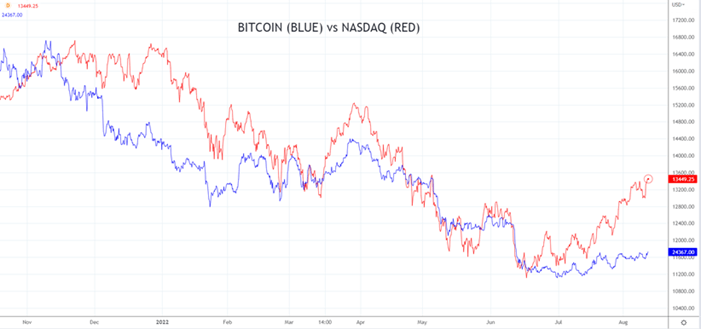
The last time the Nasdaq closed above 13,000 points – as it did overnight – Bitcoin was trading near US$35,000, a whopping 31.6% higher than its current price of US$23,916.
Commentary from Tony Sycamore, market analyst at City Index, underscored that Bitcoin has broken its lockstep with the Nasdaq.
“While it’s impossible to say how long the breakdown may last (it could be days, weeks or even months), we can speculate why the breakdown has occurred,” Sycamore explained.
“One immediate explanation that springs to mind is that following the softer CPI data overnight, usually reliable Fed doves Kashkari and Evans reiterated that higher interest rates are required, and that rate cuts in 2023 are 'unrealistic'".
“The prospect of higher interest rates in 2023, instead of the rate cuts the interest rate market is promising, is a headwind to crypto.
“Technically, we view the rally from the $17,952 low as corrective, which has the potential to test resistance at $25,400/700 (the May low and trend channel resistance).
“A break and close below $20,500 would indicate the correction is complete and that a retest of the June low is underway.”
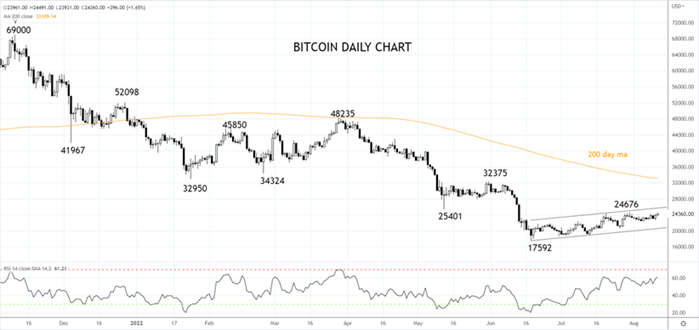
Source: Tradingview. The figures stated are as of August 11, 2022. Past performance is not a reliable indicator of future performance.
Galaxy Digital (TSX-V:GLXY) CEO Mike Novogratz recently told Bloomberg a large rally is unlikely.
“Will Bitcoin get through US$30,000 on this move up? We will see. I’m doubtful. I think we’re going to probably be in this range now. I quite frankly would be happy if we’re in a US$20,000, US$22,000, or US$30,000 range for a while,” Novogratz said.
“We’re not seeing huge institutional flows, to be fair, but we’re not seeing anyone back away.”
Kiribati money in Australian banks surges 4700x during pandemic
The nation of Kiribati is a collection of 33 islands in the central Pacific Ocean, some 5,000 kilometres northeast of Australia.
The island nation increased its investment in Australian banks by some 4,700x since 2019, raising questions about trust funds and tax havens as fewer than 120,000 people inhabit Kiribati, with a median household income of just $12,000 a year in 2020.
There are some 876 Australian bank accounts ostensibly held by Kiribati residents, with an average balance of more than $700,000.
Collectively that’s over $682 million, a dizzying height compared to just $14 million in 2019.
Kiribati is not alone, as Tuvalu, another Pacific Ocean nation with a population of 11,792 in 2020, held over 200 accounts with some $194 million in Australia, and Equatorial Guinea represented 52 accounts holding $4 million.
Not to be outdone, the notorious tax-dodging havens of Bermuda, Cayman Islands, British Virgin Islands and Jersey registered some $6.3 billion in Australian banks.
The RBA estimates that this offshore funding accounts for about a third of Australian banks’ assets.
"The latest data of accounts held in Australia from offshore continue to present red flags for money laundering and tax evasion," Tax Justice Network’s Mark Zirnsak said.
Zirnsak highlighted the damaging nature of tax evasion in an op-ed with The Guardian in July 2013, commenting:
“The OECD have publicly stated tax evasion is not only bad for markets, but also allows tax evaders to obtain a competitive advantage.
“This is not because they are more efficient and innovative, but because they are better at hiding profit from tax authorities.
“Tax dodging deprives governments of the revenues they need to provide basic services. Either everyone else needs to pay more tax, or we see further cuts to public services.”
The Federal Labor Government has vowed to introduce a “beneficial ownership register” that would create additional hurdles for those wishing to hide their identity and intentions.
Zirnsak welcomed the commitment, stating it may aid in uncovering just who is holding these Australian accounts.
"The government should also strengthen unexplained wealth laws, to be able to seize money shifted into Australia where there is a high likelihood the money has an illicit source," he said.
"The new government should also act on the recommendations made by the recent parliamentary inquiry into money laundering, to reduce the ability of criminals to shift profits from crime into Australia."
On the small cap front
Rivergold Ltd soared up 56.6% over the last week after acquiring the Tamourah Lithium Project in Western Australia and announcing a 10,000-metre drill program for the tenure.
Meeka Gold surged 45.6% over the same period, having completed the sale of the Gecko North Project and striking “exceptionally high-grade gold” up to 32 metres at 16.07 g/t gold at the Murchison Gold Project.
Magnis Energy Technologies Ltd (ASX:MNS, OTCQX:MNSEF) jumped 32.8% higher over the last five days, after successfully beginning commercial production of lithium-ion batteries at its New York battery plant.
Aldoro Resources Ltd (ASX:ARN) hiked 27.2% this week, having hit multiple very wide pegmatite intervals at both the Wyemandoo Rubidium-Lithium Project and Niobe Rubidium-Lithium Project
Alto Metals Ltd (ASX:AME) has climbed 21.7% after fielding further high-grade gold from the Sandstone Project’s indomitable camp and extending the resource boundary