
Critical Resources Ltd (ASX:CRR, FRA:9S70) strengthened its diversified critical minerals and technology portfolio during the June 2026 quarter, delivering high-grade tungsten and gold results in New Zealand, expanding lithium targets at Mavis Lake in Canada and progressing its solid-state battery program into full-format pouch-cell testing.
The company ended the quarter with A$1.2 million in cash and cash equivalents after completing field programs across several exploration assets and advancing permitting and technology evaluation workstreams.
Granite Creek emerges as priority tungsten target
At the Croesus Project in New Zealand, first-pass fieldwork confirmed a greisen-hosted tungsten system at the Granite Creek target.
Channel sampling returned up to 16.63% tungsten trioxide over 0.41 metres, while nine of 25 samples graded between 0.67% and 16.63% tungsten trioxide.

The results elevated Granite Creek to a priority exploration target and reinforced historical sampling that returned grades of up to 42.6% tungsten trioxide.
Critical Resources has lodged an Extension of Land application covering the full mapped extent of the Granite Creek–Barrytown Granite Pluton and is targeting an exploration permit application in the second half of 2026.
Sampling elsewhere at Croesus also confirmed a structurally controlled gold-antimony system, with assays of up to 13.3 g/t gold and 0.7% antimony.
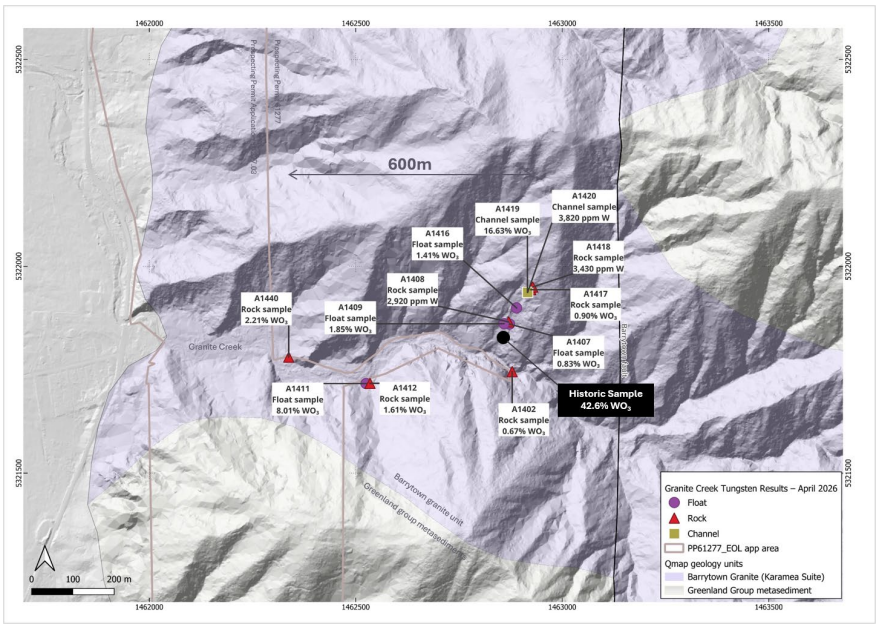
Granite Creek tungsten sample results.
Gold mineralisation confirmed at Lammerlaw
At the Lammerlaw Gold Project in Central Otago, first-pass rock-chip sampling returned 5.42 g/t gold from the Devils Creek target.
Additional float samples returned 1.63 g/t and 1.45 g/t gold along the interpreted strike of the mineralised veining.
Soil sampling also defined coherent arsenic anomalism around the historic workings, supporting the interpretation that the Devils Creek lode or shear system remains open along strike.
A separate arsenic anomaly extending for about 600 metres was identified at Stony Creek, providing another target for follow-up work.
Mavis Lake lithium targets expanded
At the Mavis Lake Lithium Project in Ontario, Critical Resources completed a first-pass mapping and sampling program across the Corona Pegmatite Field, about four kilometres north of the Main Zone.
The program mapped 14 pegmatite bodies, including six previously unrecognised occurrences, across an underexplored five-kilometre trend.
A total of 106 rock samples were collected, alongside 161 outcrop maps and 74 structural measurements.
Lithogeochemical analysis identified the most highly evolved lithium-caesium-tantalum pegmatites within the Northern Prospects area, where samples returned potassium-to-rubidium ratios as low as 17.4 and elevated lithium pathfinder elements including up to 5,510 parts per million rubidium, 221 parts per million caesium and 53 parts per million tantalum.
The company plans to integrate the results with geological, structural and geophysical datasets to refine follow-up targets across the broader Mavis Lake district.
Mavis Lake hosts an inferred mineral resource of 8 million tonnes at 1.07% lithium oxide and an exploration target of 18 million to 29 million tonnes at 0.8% to 1.2% lithium oxide.
Battery program reaches pouch-cell testing
Critical Resources also advanced its solid-state lithium-ion battery evaluation program at the South Dakota School of Mines & Technology.
A dry solvent-free cathode composite was assembled into full-format pouch cells for the first time, using a liquid electrolyte as a reference baseline.

The company also completed a single-step, room-temperature deposition of a composite layer combining lithium iron phosphate cathode material, a reference solid electrolyte and a carbon-nanotube conductive network.
Separately, its amorphous solid-state electrolyte was benchmarked at ionic conductivity of 3.2 millisiemens per centimetre and demonstrated lithium-metal interface stability over more than 1,200 hours.
The proprietary electrolyte has not yet been integrated into the pouch-cell architecture.
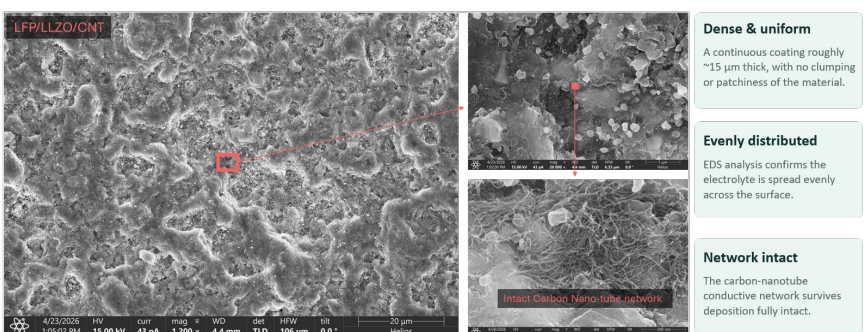
Surface view of the LFP/LLZO/CNT matrix. Scanning electron microscope (SEM) images of the singlestep, solvent-free co-deposited layer.
Thermal management portfolio broadened
During the quarter, Critical Resources secured an exclusive worldwide licence from NTUitive covering two-phase spray-cooling technology for lithium-ion batteries, CPUs, GPUs and high-density data-centre electronics.
The system is designed to operate using coolant at about 30 degrees Celsius without refrigeration or mechanical chillers.
Published academic testing reported a 25.8% reduction in total data-centre energy consumption, a power usage effectiveness ratio of 1.08 and a seven-degree reduction in chip temperature at full load.
Next steps
Critical Resources plans to progress permitting and target generation at Mavis Lake, lodge an exploration permit application for Granite Creek and advance follow-up exploration at Croesus, Lammerlaw and Cap Burn.
At Cap Burn, the company is finalising down-plunge drilling and expanded soil geochemistry across the approximately 10-kilometre Cap Burn Fault corridor.
The battery program will continue through structured pouch-cell testing and further evaluation of the amorphous electrolyte, while a proposed research collaboration agreement with Nanyang Technological University is expected to guide technical and commercial assessment of the thermal-management technology.