
Critical Resources Ltd (ASX:CRR) has confirmed a high-grade tungsten system at the Granite Creek target within its Croesus Project on New Zealand’s South Island, with first-pass sampling returning up to 16.63% tungsten trioxide (WO₃) from an in-situ quartz-scheelite vein.
The standout result came from channel sample A1419, which returned 0.41 metres at 16.63% WO₃ across the true width of an exposed quartz-scheelite vein. The sample was taken perpendicular to the vein and is considered to represent the true width at the sample location.
The result was supported by repeat high-grade assays across the target, with nine of 25 samples from Granite Creek returning between 0.67% and 16.63% WO₃. Of these, six samples were above 1% WO₃ and three were above 2% WO₃.
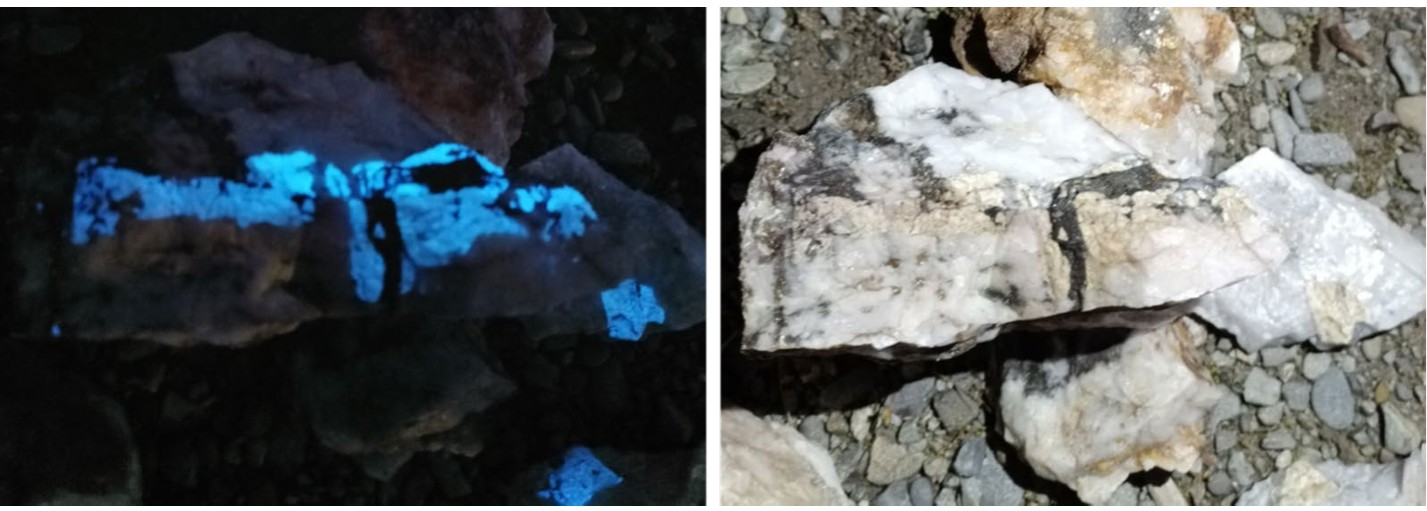
Scheelite-bearing quartz float sample A1411 at Granite Creek under plain light (right) and ultraviolet light (left). The intense blue-white fluorescence under UV illumination highlights the distribution of scheelite within the quartz sample. A1411 returned 8.01% WO₃.
Results point to broader system
Modern sampling identified multiple mineralised bedrock and float occurrences over at least 600 metres of the Granite Creek target area.
Additional in-situ results included 2.21% WO₃ from scheelite-bearing quartz in sample A1440, 1.61% WO₃ from granite vein selvage in A1412, 0.90% WO₃ from a 0.15-metre quartz vein in A1417 and 0.67% WO₃ from a 0.05-metre quartz vein containing visible scheelite in A1402.
A separate adjoining 0.20-metre footwall sample, A1420, returned 3,820 parts per million tungsten, indicating that elevated tungsten extends into altered wall rock immediately adjacent to the high-grade vein.
Significant float samples included 8.01% WO₃ from scheelite-bearing quartz in A1411, 1.85% WO₃ in A1409, 1.41% WO₃ in A1416 and 0.83% WO₃ in A1407.
The distribution of results supported the interpretation of a broader quartz-vein and greisen-hosted tungsten system rather than a single isolated occurrence.
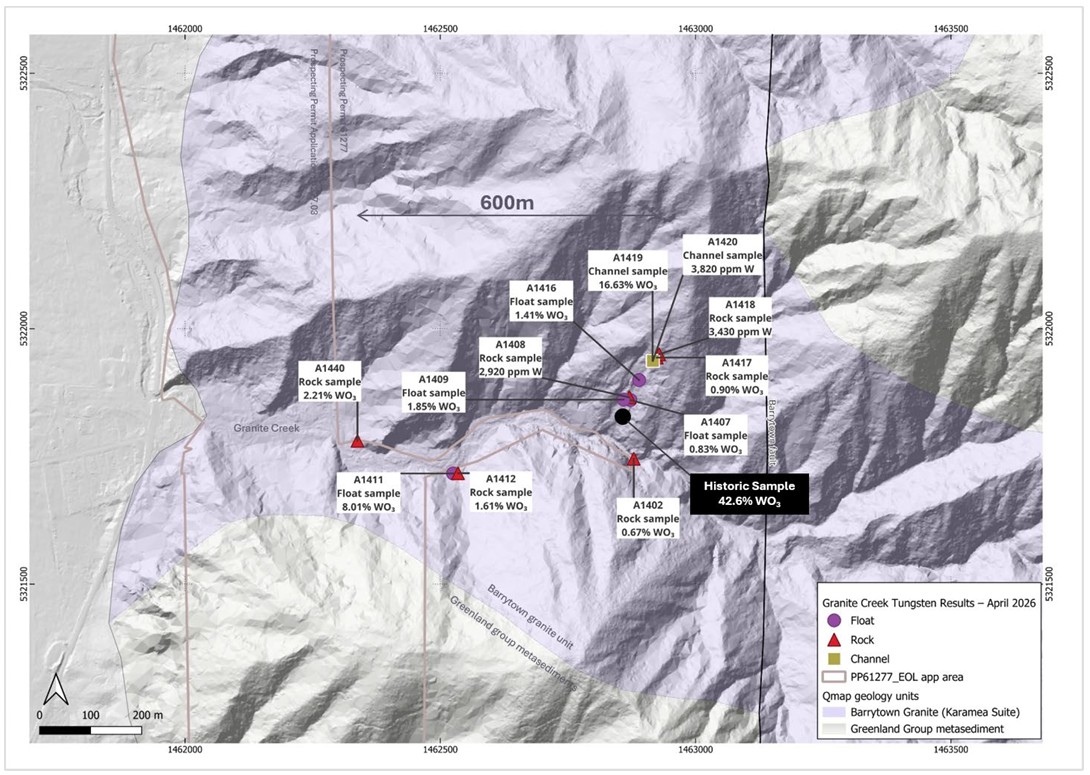
Granite Creek tungsten sample results showing selected in-situ channel and rock samples, together with float samples, across the mapped Barrytown Granite and adjacent Greenland Group metasedimentary rocks. The reported location of the 1988 historical sample returning 42.6% WO₃ is also shown.
Critical Resources managing director Tim Wither said the results showed “strong, repeatable tungsten grades”.
“The 0.41 metre channel assayed 16.63% WO₃ across the full width of an in-situ quartz-scheelite vein — a true-width result, not a selected high-grade chip,” Wither said.
“And it is not a one-off: 9 of our 25 samples returned high-grade tungsten, including 6 above 1% WO₃, and 3 above 2% WO₃, over more than 600 metres of the target.”
Wither said high-grade scheelite float on both flanks of the Barrytown Granite ridge pointed to a system extending beyond the immediate target.
Historical work strengthens drill targeting
Granite Creek has been subject to historical mapping and sampling that identified quartz veins, greisen alteration zones and scheelite-bearing occurrences associated with the Barrytown Granite.
Historical selective sampling by Mineral Resources NZ Ltd in 1988 reportedly returned grades of up to 42.6% WO₃ from scheelite-rich quartz and greisen material. Historical float samples from Granite Creek and Little Granite Creek also reportedly returned up to 26.6% WO₃ and 19.9% WO₃.
The company cautioned that historical and float samples are selective and are not representative of average grade, mineralised width or continuity. However, it said the historical dataset provides an advanced framework for modern exploration and focused drill-target definition.
The latest field program has partially validated this historical work by confirming high-grade tungsten in bedrock, mineralised altered granite next to the main vein and multiple tungsten occurrences over 600 metres
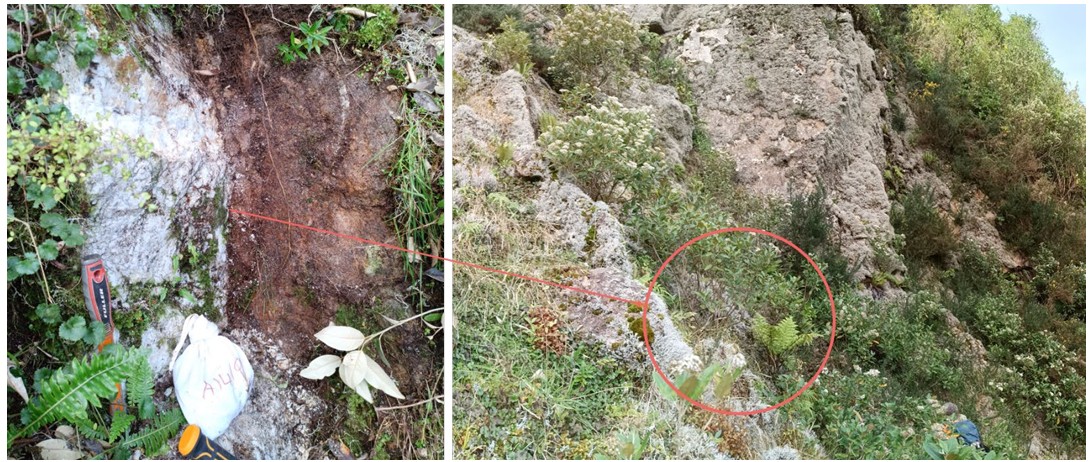
Left - Quartz-scheelite vein exposure at Granite Creek, New Zealand. Channel sample A1419 was collected perpendicular to the vein across its 0.41 m true width and returned 16.63% WO₃. The adjoining 0.20 m footwall sample A1420 returned 3,820 ppm W. Geological hammer shown for scale. Right. Location of channel sample.
Tungsten market context
Critical Resources said the Granite Creek results came at a time of increased focus on secure tungsten supply from stable jurisdictions.
Tungsten is used in cemented-carbide cutting and drilling tools, defence applications, aerospace alloys, electronics and semiconductor manufacturing. It is listed as a critical mineral by New Zealand, Australia, the United States and the European Union.
The company noted that global supply is highly concentrated, with China accounting for about 80% of world tungsten mine production and a similar share of downstream processing.
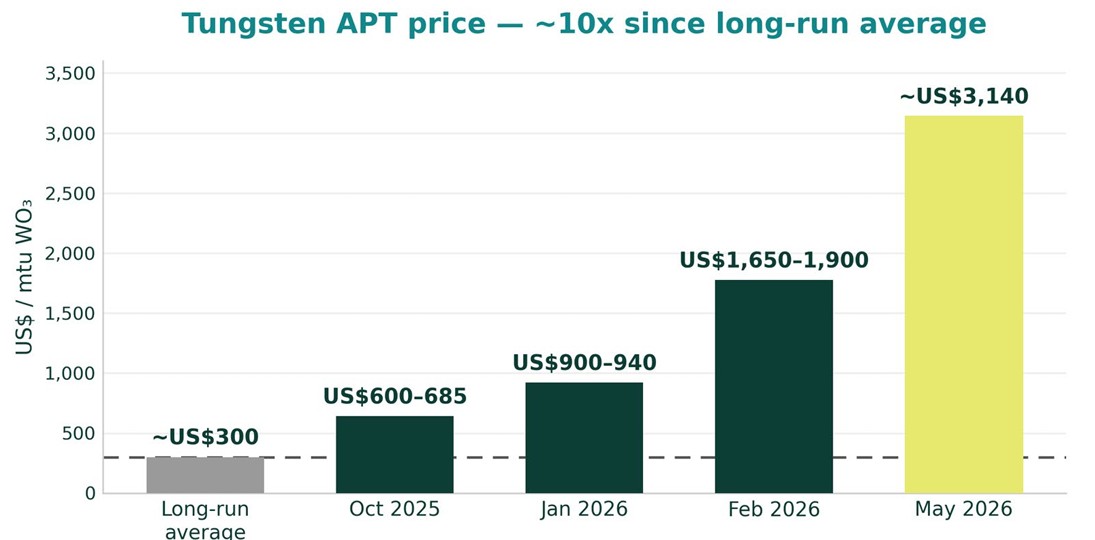
Critical Resources said ammonium paratungstate, the key tungsten benchmark, was assessed at about US$3,000 to US$3,200 per metric tonne unit CIF Rotterdam in early June 2026, near multi-year highs and around 10 times its long-run average.
Next steps
Critical Resources will now integrate historical and modern datasets, undertake targeted geological and structural mapping, carry out additional channel sampling where required and define priority drill targets at Granite Creek.
The company is targeting lodgement of an exploration permit application over the Granite Creek target area in the second half of 2026.
Maiden drill testing would follow, subject to permit grant, access arrangements and environmental approvals.