
Critical Resources Ltd (ASX:CRR, FRA:9S70) has sharpened its focus on tungsten exploration in New Zealand after completing first-pass field programs at its Lammerlaw and Croesus projects, with early work confirming the presence of a high-grade greisen-hosted system at Granite Creek.
The company said field mapping and sampling at the Croesus gold-tungsten project validated historical reports of tungsten mineralisation, prompting it to elevate Granite Creek as a near-term exploration priority within its broader New Zealand portfolio.
Managing director Tim Wither said the initial programs had delivered strong early indications despite challenging conditions.
“The standout was Granite Creek. The team confirmed greisen alteration and outcropping quartz vein structures across multiple locations, including at the historical rock sampling sites that returned up to 42.6% WO₃, elevating Granite Creek as a priority,” he said.
Tungsten target gains momentum
At Croesus, fieldwork focused on both a structurally controlled gold-antimony system and a separate greisen-hosted tungsten system across a 183-square-kilometre permit in the Reefton Goldfield.
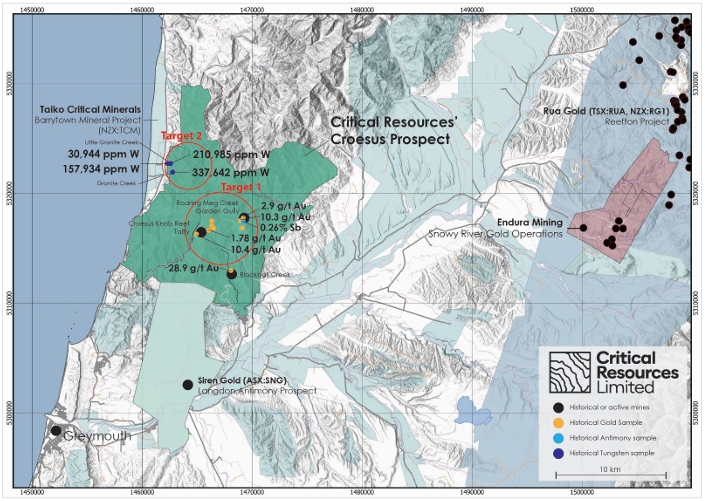
Location Map of Croesus prospecting permit in the Reefton Goldfields region.
Key activities included structural mapping, rock chip and stream sampling, and verification of historical workings across a more than 5-kilometre mineralised trend.
Historical data from the Granite Creek area highlights the potential scale and grade of the tungsten system, including:
- Up to 42.6% WO₃ from scheelite-rich quartz material
- Float samples grading 26.6% and 19.9% WO₃
- Greisenised granites returning up to 0.90% WO₃
While these results are from historical sampling and not yet verified by current assays, the company said recent field observations confirmed greisen alteration extending beyond previously mapped zones, suggesting a broader mineralised system.
Assay results from the Croesus program are expected in early June.
Strategic metal backdrop strengthens case
Critical Resources is advancing the project against a rapidly tightening tungsten market, with the metal increasingly classified as critical across Western economies.
According to the company, ammonium paratungstate (APT) prices have surged more than eightfold since early 2025, now trading between US$2,900 and US$3,200 per metric tonne unit, driven by Chinese export restrictions and rising demand from defence, semiconductor and energy sectors.
China currently accounts for around 80–85% of global tungsten supply, underscoring the strategic importance of potential Western-aligned sources such as Croesus.
“With tungsten formally designated a strategic critical mineral across the US, EU, UK, Japan, New Zealand and Australia, and APT prices having risen more than 8x since January 2025, confirming a Western-aligned greisen-hosted tungsten target in this market environment is strategically significant,” Wither said.
Lammerlaw fieldwork progresses
At the Lammerlaw gold project in Central Otago, the company completed structural mapping and geochemical sampling across two priority targets — the OPQ Trend (Devils Creek) and Stony Creek.
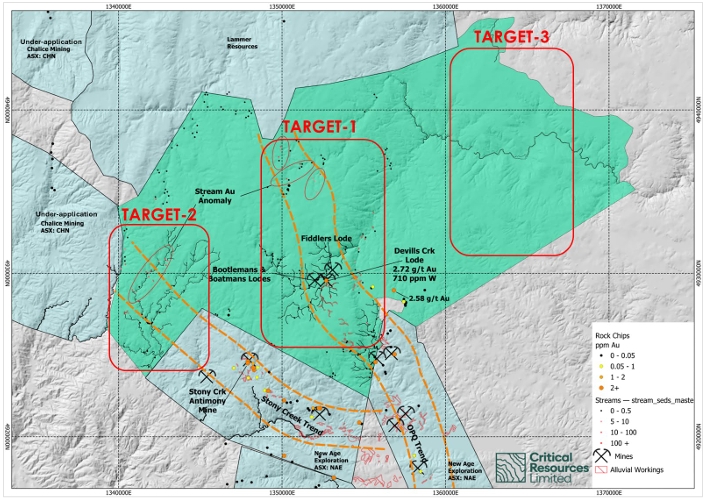
Lammerlaw permit showing locations of prospect targets and historic mine workings and surrounding permits.
Historical data at Lammerlaw includes gold rock chip grades of up to 2.72 g/t and tungsten anomalies of up to 340 ppm, alongside evidence of antimony mineralisation.
Initial assay results from Lammerlaw are expected in mid-May, with data to be integrated into the company’s geological models to refine follow-up targets.
Broader NZ strategy builds
The New Zealand portfolio now spans roughly 1,694 square kilometres across prospective gold and critical minerals regions, supported by recent permitting progress and favourable investment reforms.
Near-term work will include further mapping at Granite Creek, ongoing analysis of historical data, and continued drilling planning at the Cap Burn gold project.
The latest update builds on Critical Resources’ expanding multi-commodity strategy, which spans lithium, battery technology and critical minerals, and reflects a growing emphasis on assets aligned with tightening global supply chains for strategic materials.