
Critical Resources Ltd (ASX:CRR, FRA:9S70) has extended its push into next-generation battery technology, securing an evaluation licence over advanced thermal management systems developed by Singapore’s Nanyang Technological University (NTU), as it builds out its solid-state lithium-ion program.
The agreement, executed with NTU’s commercial arm NTUitive Pte Ltd, gives the company access to intellectual property covering cooling technologies for lithium-ion batteries and high-density electronics — an area increasingly seen as critical to performance, safety and scalability in next-gen battery systems.
The licence broadens Critical Resources’ downstream ambitions beyond raw materials supply, linking its Mavis Lake lithium project in Canada with in-house battery development and now thermal management — a key bottleneck in high-temperature battery applications.
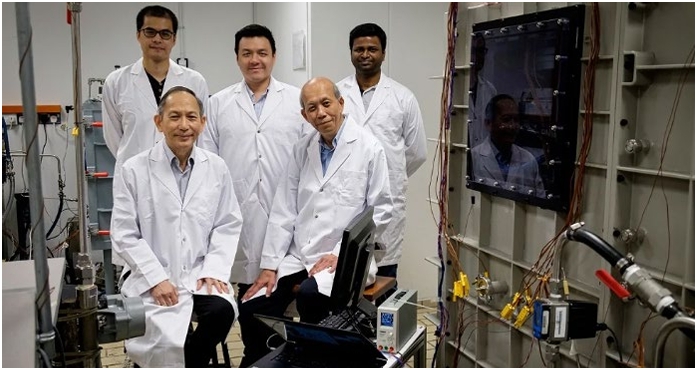
(anti-clockwise from bottom left) Leader of the project, NTU Associate Professor Wong Teck Neng, former Associate Professor Toh Kok Chuan, research fellow Ranjith Kandasamy, Asst Prof Ho Jin Yao, and research fellow Liu Pengfei, with prototype cooling system for data centres on the right. Photo Credit: NTU Singapore.
Cooling technology targets efficiency gains
At the core of the licence is a two-phase spray cooling system designed to remove heat directly at the source. The approach uses a dielectric fluid sprayed onto components, where it evaporates on contact to dissipate heat, before being condensed and recirculated in a closed loop.
The technology is designed to operate at ambient temperatures, eliminating the need for energy-intensive refrigeration chillers — a feature that could prove particularly valuable in warm climates and high-density computing environments such as data centres.
Performance data cited by the company points to:
- 25.8% reduction in total facility energy consumption
- Power Usage Effectiveness (PUE) of 1.08 versus ~1.69 for conventional systems
- 7°C reduction in chip surface temperatures under full load
The system also incorporates a Model Predictive Control (MPC) framework that dynamically adjusts energy use in real time, optimising both performance and efficiency — a capability that could be adapted for battery temperature management.
Relevance for solid-state battery development
Thermal control is a central challenge in solid-state battery design, where operating temperature influences ionic conductivity, interface stability and degradation rates. As Critical Resources advances towards prototype configurations, integrating effective thermal management becomes increasingly important.
Managing director Tim Wither said the addition strengthens the company’s position across the lithium value chain.
“Our solid-state lithium-ion battery program gives Critical Resources insight across the lithium value chain — from supply at the Mavis Lake Lithium Project through to downstream next-generation lithium-ion battery development,” Wither said.
“Thermal management sits at the centre of that downstream work: heat directly affects battery performance, cycle life and safety,” he added. “The NTU portfolio represents a potential future tool for this challenge.”
Structured, capital-light evaluation pathway
The licence is structured as a low-cost evaluation, with Critical Resources paying an initial SGD$10,000 and holding an option to secure a full commercial licence by September 2026.
If exercised, the commercial terms include staged payments over a 10-year period alongside patent cost recovery obligations.
The company plans to assess the technology through a milestone-based evaluation program, with further expansion contingent on technical validation and integration with its existing battery workstreams.
The move builds on a series of recent battery-related developments, including electrolyte and cathode manufacturing advances, as Critical Resources continues to diversify beyond exploration and position itself within the broader battery technology ecosystem.