
Critical Resources Ltd (ASX:CRR, FRA:9S70) has reported a key technical milestone in its solid-state battery strategy, with laboratory validation of its amorphous solid-state electrolyte (ASE) demonstrating sustained stability and performance under testing.
The results mark an early but meaningful step in addressing one of the most persistent challenges in solid-state battery development — electrolyte instability — while strengthening the company’s broader integrated battery program.
Electrolyte stability confirmed over extended testing
The company said its ASE achieved stable operation for more than 1,200 hours at room temperature, confirming durable lithium-metal interface performance under controlled laboratory conditions.
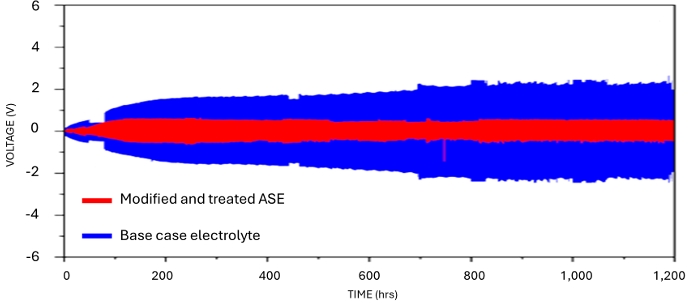
Galvanostatic charge/discharge cycling performance of the modified ASE (red) and untreated electrolyte (blue), demonstrating stable interfacial behaviour of the ASE over 1,200 hours at a current density of 0.1 mA cm⁻² under controlled laboratory conditions.
This interface stability is widely considered a critical hurdle for solid-state batteries, as degradation at this junction can lead to short circuits, performance loss and reduced lifespan.
Testing also confirmed:
- Ionic conductivity of 3.2 mS/cm at room temperature
- Low activation energy of 0.27 eV, supporting efficient lithium-ion transport
- Stable voltage behaviour during extended cycling
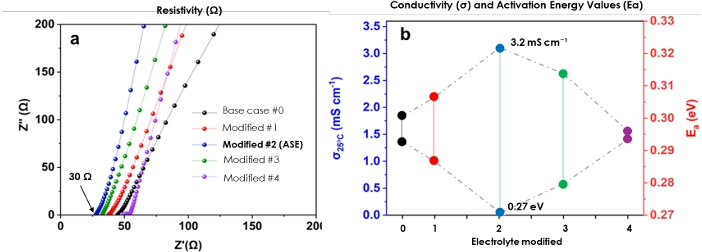
(a) Nyquist impedance plots for modified amorphous electrolytes measured at 25 °C (b) Calculated values of lithium-ion conductivity and the corresponding values of activation energy at room temperature for amorphous electrolytes in a temperature range of 20−70 °C.
Importantly, the electrolyte was evaluated within a full solid-state cell configuration rather than as a standalone material, demonstrating functional electrochemical performance in a working system.
Reducing a key failure mode
Managing director Tim Wither said the results represent an important early-stage validation of the company’s approach.
“This first step in our lithium-ion solid-state electrolyte (ASE) validation program advances our integrated battery strategy by addressing several of the key technical failure modes from chemical design that have constrained solid-state battery development,” he said.
“Demonstrating room-temperature electrolyte performance alongside sustained lithium-metal interface stability for more than 1,200 hours under controlled laboratory conditions materially reduces early-stage interface-related risk — one of the most challenging aspects of solid-state battery development.”
The company noted that electrolyte instability — particularly at the lithium-metal interface — has long been a major barrier to commercialisation, with failure modes including increased resistance, safety risks and premature cell degradation.
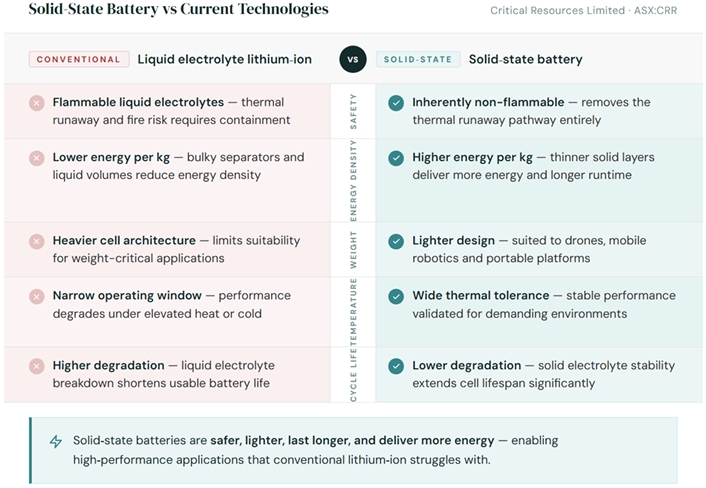
Solid-state battery design delivers measurable safety, energy density, and longevity advantages over conventional liquid electrolyte lithium-ion technology.
Integrated battery strategy taking shape
The ASE program forms part of Critical Resources’ broader battery technology push, complementing its Dry Supersonic Deposition (DSD) workstream, which focuses on solvent-free cathode manufacturing.
Together, the two programs are designed to tackle both materials and manufacturing challenges in parallel, with the aim of reducing technical risk across the full battery development chain.
This integrated approach is being advanced under the US-based Centre for Solid-State Electric Power Storage (CEPS) framework in collaboration with the South Dakota School of Mines & Technology.
The company said the latest results move the ASE program from theoretical feasibility into laboratory-validated performance, providing a stronger technical foundation for future development.
The work also builds on Critical Resources’ broader push into next-generation battery technologies, following earlier progress in solvent-free cathode manufacturing and its solid-state battery program.
Next steps focused on optimisation and scale
While the program remains at an early laboratory stage, Critical Resources is now progressing towards more advanced evaluation phases.
Planned next steps include:
- Further optimisation of electrolyte composition to improve conductivity and stability
- Expanded testing across a wider range of operating conditions
- Integration into more advanced full-cell architectures
- Combined trials with DSD-fabricated cathodes
The company will also assess manufacturing pathways, including compression techniques aimed at improving interface contact and scalability.
With solid-state batteries widely viewed as a next-generation solution offering improved safety, energy density and lifespan, the company’s strategy is focused on systematically reducing key technical risks before moving toward later-stage development.
Critical Resources said the latest results indicate the program is progressing in the right direction, while maintaining a disciplined, capital-light approach to technology validation.
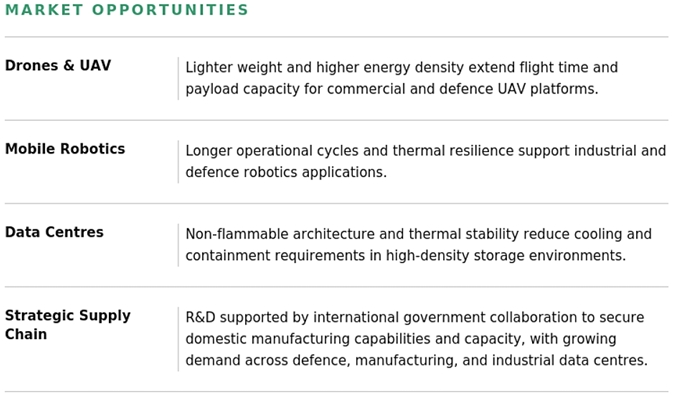
Solid-state battery market opportunities, delivering performance and safety advantages over conventional lithium-ion technology.