
Critical Resources Ltd (ASX:CRR, FRA:9S70) has reported a "game-changing" technical milestone in its solid-state battery evaluation program, successfully validating a solvent-free cathode manufacturing process that could simplify battery production and improve safety and energy efficiency.
The company confirmed that Dry Supersonic Deposition (DSD) can produce mechanically robust and electrochemically active lithium iron phosphate (LFP) cathodes without the use of solvents or polymer binders, a development that may support scalable next-generation battery manufacturing.
The validation was achieved through laboratory-scale testing conducted within the US National Science Foundation-supported Centre for Solid-State Electric Power Storage (CEPS) framework at the South Dakota School of Mines & Technology.
Key manufacturing breakthrough
DSD is a manufacturing technique that accelerates dry powder particles at supersonic velocity in an inert gas stream, allowing them to mechanically bond to a conductive substrate such as aluminium foil. Unlike conventional slurry-casting methods, the process eliminates the need for solvents, binders and large industrial drying ovens.
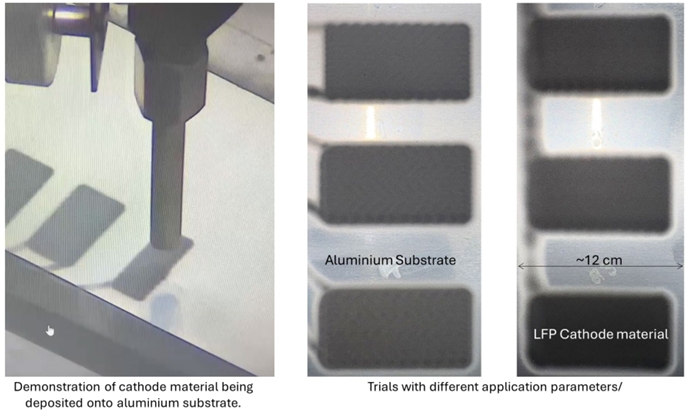
Dry-Supersonic-Deposition (DSD) of Lithium-Iron-Phosphate (LFP) cathode material onto aluminium foil substrate.
According to Critical Resources, this solvent-free pathway could reduce manufacturing energy use, simplify factory infrastructure and improve safety outcomes in battery production.
Laboratory tests confirmed that the LFP cathode material maintained its crystal structure during the high-velocity deposition process, addressing a key technical risk associated with solvent-free electrode manufacturing.
Scanning electron microscopy also showed strong binder-free adhesion between the cathode layer and aluminium current collectors, with dense mechanical bonding and no evidence of delamination.
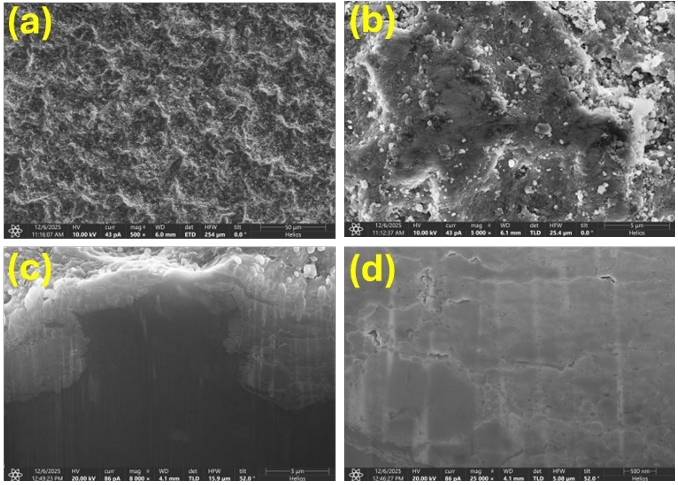
SEM micrographs of DSD-fabricated LFP cathode on aluminium current collector. Surface views (images a & b) show a continuous heterogeneous surface with plastically deformed and partially intact particles. Cross-sections (images c & d) show a thin, dense deposited layer with strong mechanical interlocking into the aluminium substrate, with no large interfacial voids or evidence of delamination observed.
Tunable electrochemical performance
Electrochemical testing demonstrated that the performance of the dry-deposited cathodes can be adjusted depending on their intended application.
Two configurations were evaluated: as-deposited cathodes and cathodes subjected to a controlled heat-treatment process known as annealing.
Annealed cathodes showed improved discharge capacity during slower charge-discharge cycles, making them suitable for energy-focused applications such as stationary grid storage. In contrast, as-deposited cathodes retained stronger performance during faster cycling conditions, supporting higher-power applications.
This ability to tune cathode behaviour through controlled manufacturing parameters represents a key step towards establishing DSD as a viable electrode production pathway.
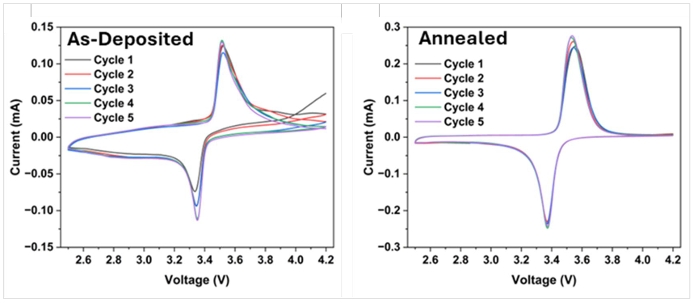
Cyclic voltammetry of DSD‑fabricated LFP electrodes. (a) As‑deposited cathode (no heat treatment) shows broader redox features and higher polarization, while (b) annealed cathode exhibit sharper, more stable peaks and near double peak current (mA) indicating partial restoration of LFP crystalline structure.
De-risking solid-state battery development
Managing director Tim Wither said the results represent a major step forward in the company’s battery technology program.
“We have demonstrated that dry supersonic deposition can produce functional, solvent-free cathodes without damaging the active material, while delivering predictable and tunable electrochemical performance,” he said.
“This work materially de-risks a potential cathode manufacturing pathway that is simpler, safer and more energy-efficient than conventional processes.”
While testing remains at laboratory scale, the results establish a repeatable baseline that could support the next phase of development, including integration with solid-state electrolytes and early prototype battery architectures, Wither added.
Strategic relevance
Critical Resources said solvent-free cathode manufacturing could become increasingly important as demand for large-scale battery storage rises alongside electrification and data centre growth.
Conventional cathode production relies on solvent handling, drying infrastructure and recovery systems that add complexity, energy consumption and permitting requirements to battery manufacturing facilities.
By demonstrating functional solvent-free cathodes with preserved material integrity and controllable electrochemical behaviour, the company believes it is advancing a potentially scalable production pathway that may support future licensing, partnerships or downstream collaboration.
Next steps
The next phase of work will focus on refining the DSD process and expanding testing.
Planned activities include optimising deposition parameters to improve coating uniformity, conducting broader electrochemical testing across different charge-discharge rates, and evaluating additional cathode chemistries.
The company also intends to progress from standalone cathode validation to integrated solid-state battery structures by sequentially depositing cathode and solid-state electrolyte layers.
These technical milestones will inform future decisions around prototype development and potential commercial partnerships as Critical Resources continues to advance its battery technology strategy alongside its broader critical minerals portfolio.