
Critical Resources Ltd (ASX:CRR, FRA:9S70) has advanced its solid-state lithium-ion battery evaluation program into full-format pouch cell testing, a key scale-up step for its dry spray deposition (DSD) cathode manufacturing process.
The company has built full-format pouch cells incorporating its DSD-deposited cathode composite and is now carrying out electrochemical testing to assess how the material performs in a complete working cell.
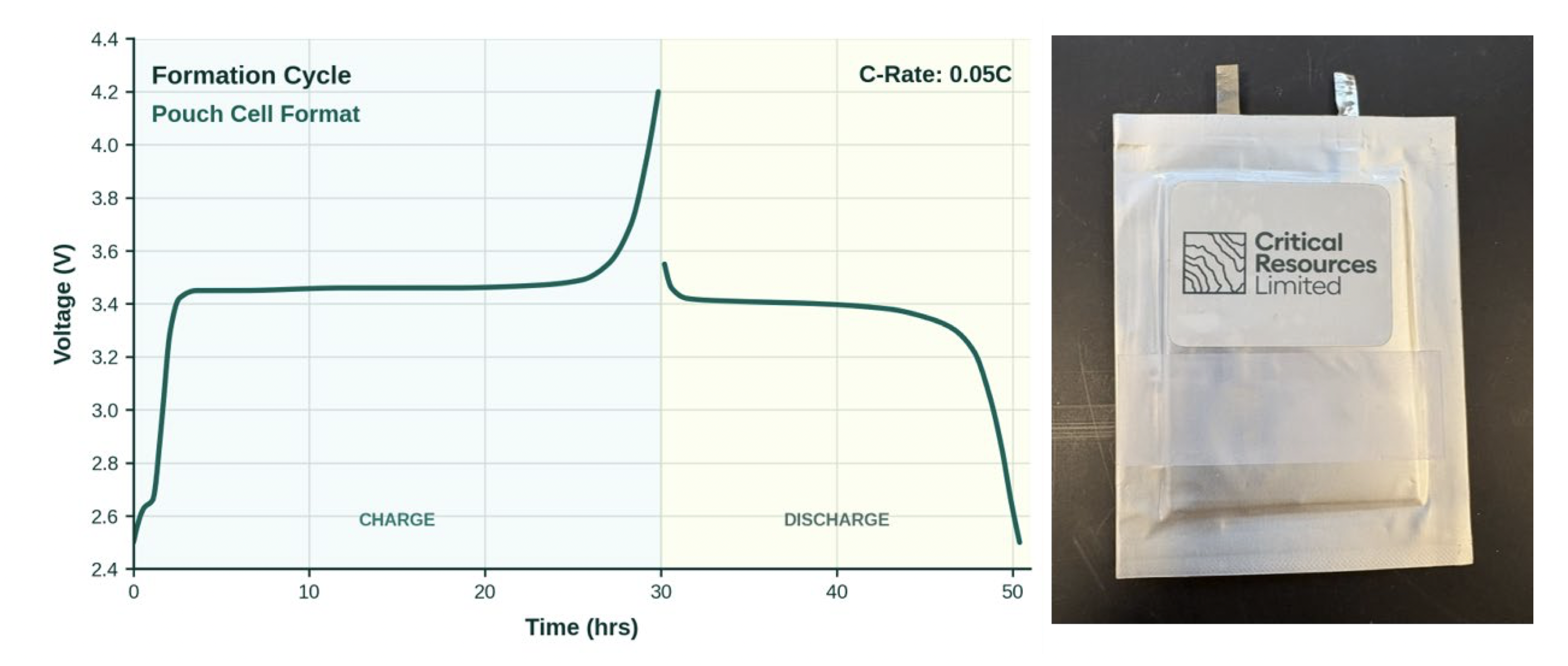
Left: initial conditioning (formation) cycle for DSD pouch cell, C-rate 0.05C. Right: full-format pouch cell built with the DSD-deposited cathode composite on a liquid-electrolyte baseline.
The move follows Critical Resources’ recent single-step composite-layer deposition milestone and shifts the program beyond coin-cell testing, where battery chemistry is first assessed, into a larger format that more closely demonstrates cell assembly and function.

Program moves into larger cell format
The full-format pouch cells had been built after deposition of a complete composite battery layer.
The cells use a liquid electrolyte as a reference baseline, allowing the company to isolate and validate the DSD-deposited cathode before integrating its proprietary sulphur-free solid-state electrolyte.
The program is being conducted at the South Dakota School of Mines & Technology within the US National Science Foundation-supported Centre for Solid-State Electric Power Storage.
It is led by Dr Alevtina Smirnova, director of the centre and technical adviser to Critical Resources, whose research developed the solid-state battery intellectual property over which the company holds an exclusive option.
Testing now underway
The test cells comprise a roughly 15-micron DSD-deposited cathode composite made up of lithium iron phosphate cathode material, lithium lanthanum zirconium oxide reference electrolyte and a carbon-nanotube network.
This has been paired with a standard liquid electrolyte and a 20-micron lithium-metal anode.
Critical Resources said the cells were undergoing conditioning, or formation cycles, at 0.05C — a low-rate first-cycle process designed to allow stable interphase layers to form before performance testing.
During this early conditioning phase, the cells behaved as expected. Full performance results, including capacity, efficiency and cycle life, remain under evaluation.
Coin-cell electrochemical testing of the DSD composite is also continuing in parallel with the pouch-cell work.
What the company is doing
The current work is designed to validate the DSD-deposited cathode in a working full-format cell before the company adds its solid-state electrolyte.
Critical Resources said this sequencing allowed the manufacturing step to be isolated and assessed on a liquid baseline before moving to a more complex full solid-state configuration.
The DSD-deposited composite is produced using a dry, room-temperature process with no solvents, binders, furnace or compression steps.
The company is also progressing thin-film deposition of its amorphous solid-state electrolyte (ASE), which it intends to integrate into the pouch-cell platform in the next stage of development.
Where the program is at
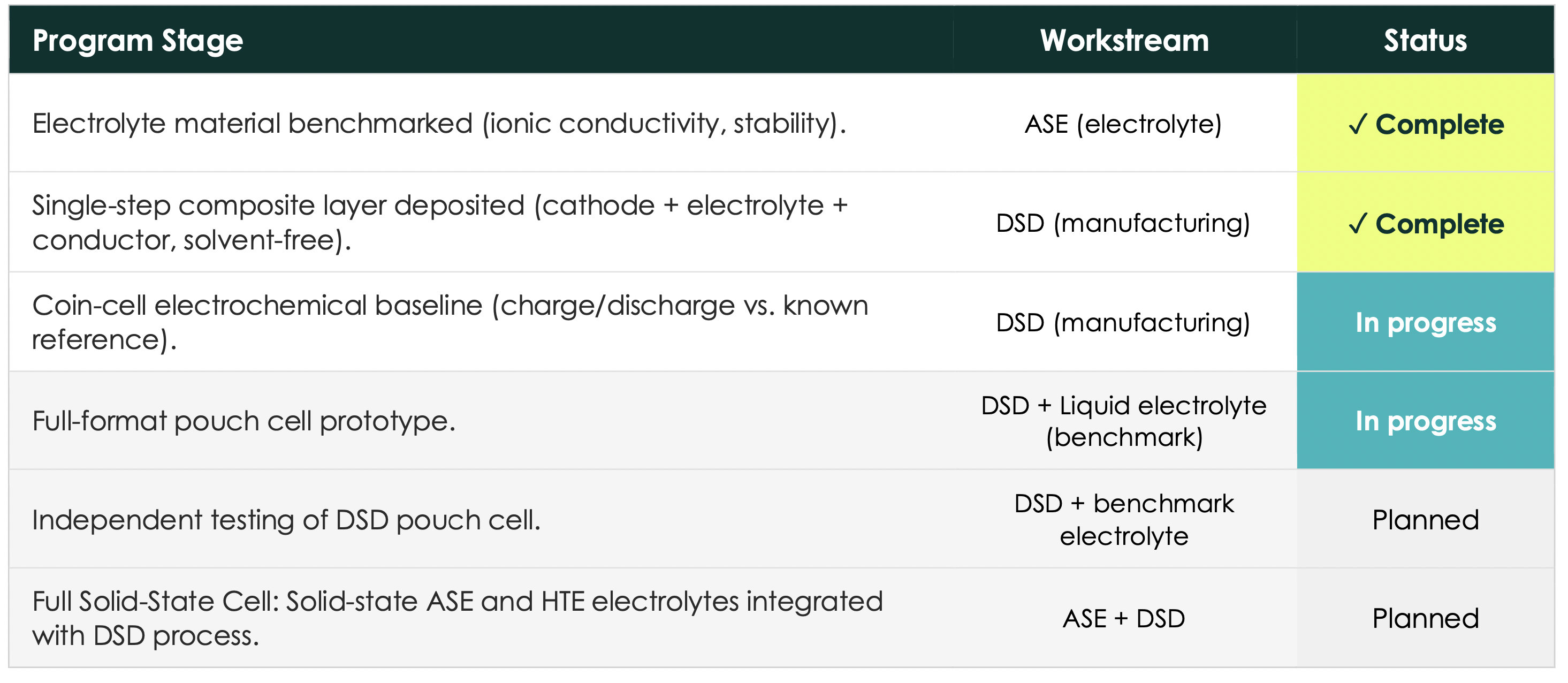
Critical Resources has completed the benchmarking of its ASE electrolyte material and the deposition of a single-step composite layer containing cathode, electrolyte and conductor materials.
Coin-cell electrochemical baseline testing is in progress, alongside the full-format pouch cell prototype work.
Independent testing of the DSD pouch cell remains planned, while the future integration of solid-state ASE and high-temperature electrolyte materials with the DSD process is also on the program schedule.
Managing director Tim Wither said moving from coin cells to a full-format pouch cell showed the DSD process could build a working cell, rather than only proving chemistry in a button cell.
"Moving from coin cells to a full-format pouch cell is the step that shows our DSD process can build a real, working cell, not just prove the chemistry in a button cell. It is the first time we have built our DSD-deposited cathode into a complete cell, and the early conditioning is behaving as we'd expect. We are now depositing our sulphur-free ASE solid-state electrolyte as a thin film — integrating it into the cell is the next technical challenge, and one we expect to work through step by step, as is normal for development at this stage.’
"We are doing this in the right order — prove the manufacturing in a working cell on a liquid baseline first, isolating the deposition step, then integrate our solid electrolyte. That sequencing keeps each result clean and interpretable. This is early-stage laboratory work, not commercial manufacturing, and we expect to solve problems as we go. But the direction is encouraging, and we will keep advancing it through a disciplined, capital-light evaluation approach, with outstanding work from the South Dakota School of Mines research team."
Next steps
Critical Resources’ next steps include completing internal electrochemical testing of the pouch and coin-cell formats, including C-rate and cycling characterisation.
The company then plans to optimise the cell and deposition process before submitting an optimised baseline cell for independent third-party electrochemical testing.
Following that work, Critical Resources intends to replace the liquid electrolyte baseline with its ASE thin-film electrolyte to progress toward a full solid-state cell.
Further trials are also planned to deposit ASE and high-temperature electrolyte materials using the dry DSD process, which the company describes as the manufacturing endpoint that would bring together its sulphur-free electrolyte and DSD manufacturing workstreams.
About Critical Resources
Critical Resources is an Australian mining and technology company focused on critical metals and next-generation technologies.
Its portfolio includes the Mavis Lake Lithium Project in Ontario, Canada, the Halls Peak Base Metals Project in New South Wales and a growing gold portfolio in New Zealand.
The company’s strategy for the battery program is to license its battery materials and manufacturing intellectual property rather than manufacture cells itself, with each technical milestone intended to support future licensing and partnership opportunities.