Critical Resources Ltd (ASX:CRR, FRA:9S70) has attained a manufacturing milestone in its solid-state battery evaluation program, depositing a complete cathode, solid electrolyte and conductive network in a single dry step.
The work demonstrated a streamlined pathway for solid-state lithium-ion battery production without solvents, binders, drying ovens or furnaces - processes that are typically among the most energy and capital-intensive parts of battery manufacturing.
The milestone was achieved using dynamic spray deposition (DSD) at the South Dakota School of Mines & Technology within the US National Science Foundation-supported Centre for Solid-State Electric Power Storage (CEPS) research program.

Complete composite layer deposited
Critical Resources said the process co-deposited lithium iron phosphate (LFP) cathode material, lithium lanthanum zirconium oxide (LLZO) reference electrolyte and a carbon-nanotube conductive network onto battery-grade aluminium foil.
The result was a dense coating of about 15 microns, with analysis confirming the electrolyte was evenly distributed across the surface rather than clumped or patchy.
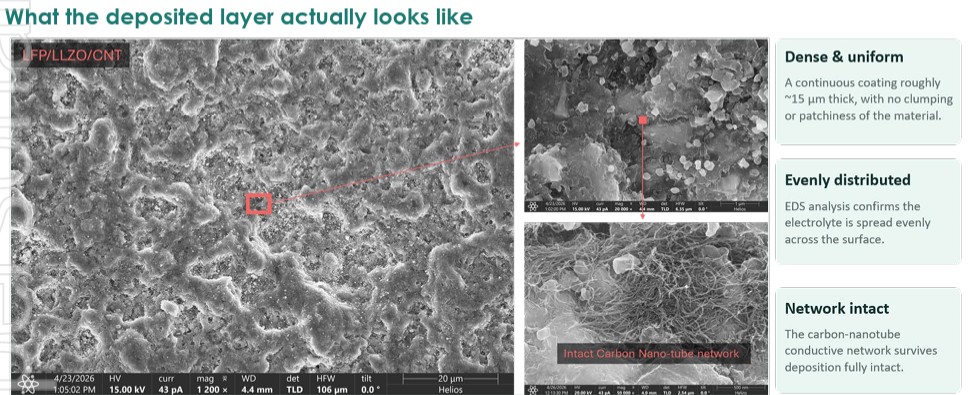
The LLZO electrolyte used in the trial was a reference material selected to validate the deposition process. It is separate from Critical Resources’ proprietary amorphous solid-state electrolyte (ASE), which is expected to be assessed in later development work.
The achievement marked the next step from CRR's earlier validated solvent-free LFP cathode work to a complete composite layer.
Targeting manufacturing challenge
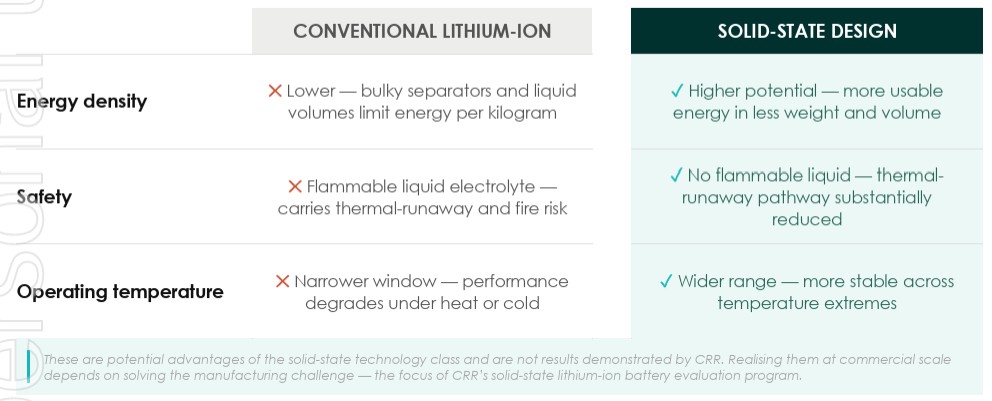
Solid-state battery development is widely focused on improving safety, energy density and thermal stability compared with conventional lithium-ion batteries, which rely on flammable liquid electrolytes.
Critical Resources said battery chemistry performance was only valuable if it could be manufactured reliably, safely and cost-effectively.
The company is positioning the DSD workstream as a licensable, solvent-free process rather than a production line it would build or own.
The process is being assessed for potential use in high-reliability applications including defence, aerospace, industrial systems and high-density computing, where weight, heat and safety constraints are significant.
Critical Resources said a deposition-based process may also allow batteries to be “printed” to fit the geometry of a host platform rather than being limited to standard cell formats.
Two parallel workstreams
The company is advancing two complementary solid-state battery workstreams.
Its ASE program is focused on the materials challenge, including ionic conductivity and stability, while the DSD program is focused on the manufacturing challenge, including solvent-free and low-temperature cathode and electrolyte fabrication.
Critical Resources recently reported that its non-sulphur ASE material conducted lithium ions at 3.2 millisiemens per centimetre, which it said was among the highest reported for non-sulphide, non-halide amorphous electrolyte chemistries.
The latest DSD milestone is intended to show that electrolyte material can also be incorporated into a manufactured composite layer using a scalable dry process.
“Genuine milestone”
Critical Resources managing director Tim Wither said depositing the solid electrolyte, cathode and carbon-nanotube conductive network in a single step was “a genuine milestone” for the program.
“The hardest part of a solid-state battery is the join between the cathode and the electrolyte, and forming that join during manufacture — rather than pressing finished parts together afterwards — is exactly the kind of problem this technology is designed to solve,” Wither said.
He said the work remained early-stage laboratory development rather than commercial manufacturing, but pointed to a cleaner and simpler way of making solid-state cells.
Licensable IP strategy
Critical Resources’ battery strategy is based on developing and licensing battery and manufacturing-process intellectual property, rather than becoming a cell manufacturer.
The company holds an exclusive option over a portfolio of solid-state battery patents developed at South Dakota School of Mines & Technology, including five granted US patents and one pending application.
New materials, processes and structures developed through the CEPS framework, including the dry-deposition work, are being protected through provisional patent applications.
What's ahead
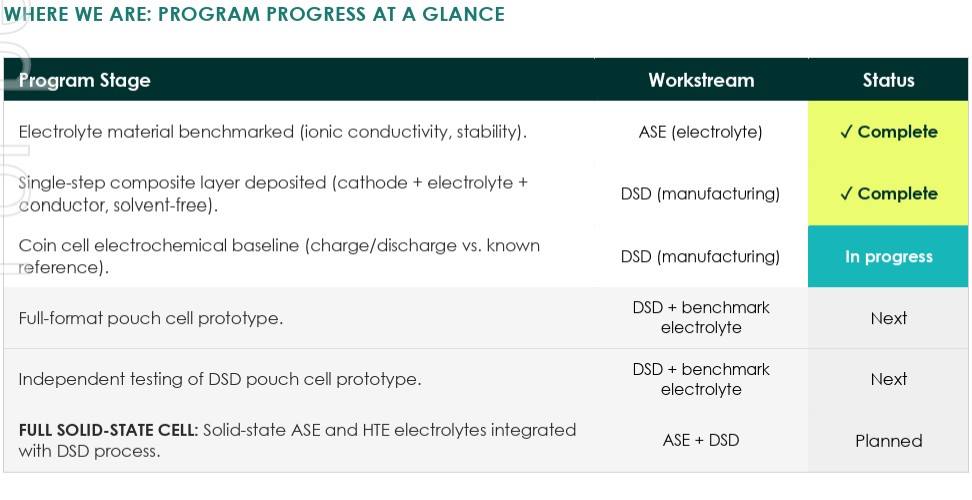
Critical Resources said coin-cell electrochemical testing of the DSD composite had started, using a liquid electrolyte as a known performance reference before solid-state integration.
The company is also working on standalone electrolyte deposition, further composite characterisation using SEM, XRD and XPS analysis, and optimisation of deposition parameters.
A full-format pouch cell prototype is being developed for independent evaluation, with outcomes expected to guide future prototype development and potential downstream partnership, validation or licensing opportunities.