
Critical Resources Ltd (ASX:CRR, FRA:9S70) says peer-reviewed benchmarking has shown its sulphur-free amorphous solid-state electrolyte (ASE) technology can deliver ionic conductivity and activation energy competitive with sulphide-class solid-state battery materials — without the toxic gas risks and manufacturing constraints associated with sulphur-based chemistries.
The company said its first-pass ASE composition achieved room-temperature ionic conductivity of 3.2 mS cm⁻¹ and activation energy of 0.27 eV during testing at the South Dakota School of Mines & Technology (SDM), within the US National Science Foundation-supported Centre for Solid State Electric Power Storage framework.
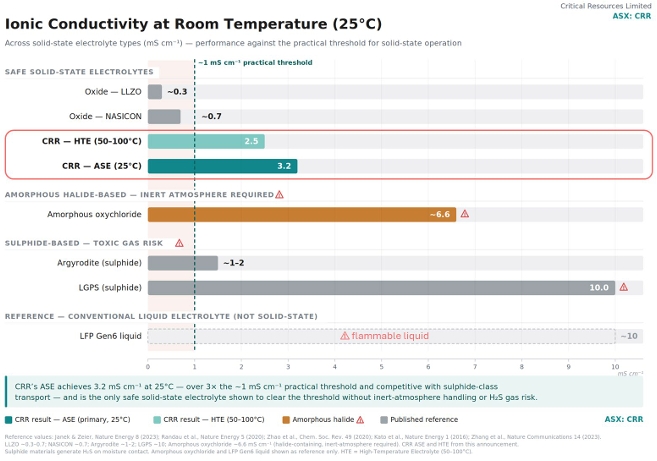
Ionic conductivity comparison. Initial ASE results exceed the ~1 mS cm⁻¹ practical operation threshold without sulphide chemistry — with further improvement expected through ongoing formulation work. HTE = High Temperature Electrolyte.
Critical Resources said those results benchmarked competitively against leading sulphide electrolytes widely viewed as the highest-performing solid-state battery materials currently under development, while avoiding the hydrogen sulphide gas generation risk that has complicated efforts to commercialise sulphide-based batteries at scale.
Solid-state batteries are seen as a major next-generation energy storage technology because they can potentially offer higher energy density, improved safety and broader temperature stability than conventional lithium-ion batteries. Critical Resources said those characteristics are particularly relevant for defence, aerospace, industrial systems and AI-linked data centre infrastructure, where heat management and thermal runaway risks remain major constraints.
Benchmarking against industry standards
Critical Resources said its electrolyte exceeded the widely cited ~1 mS cm⁻¹ threshold considered necessary for practical solid-state battery operation by more than three times, despite being an unoptimised first-pass composition.
The company said the electrolyte also outperformed common oxide electrolyte benchmarks including LLZO and NASICON, while matching or approaching sulphide-class activation energy levels traditionally associated with lithium-ion transport efficiency.
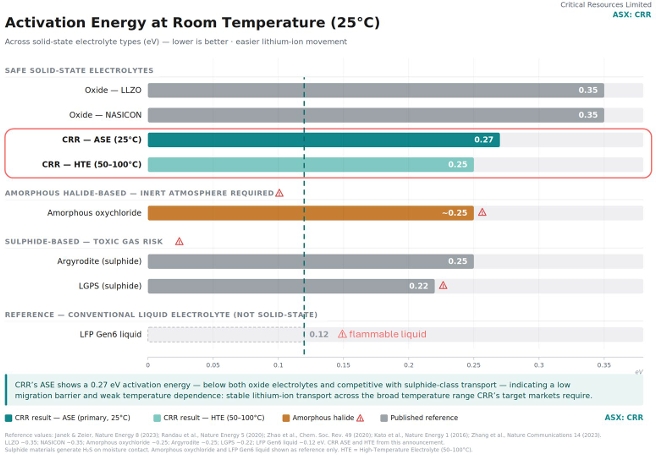
Activation Energy comparison. CRR's amorphous ASE achieves activation energy the field has historically associated only with sulphide-class electrolytes - directly relevant to broad-temperature-range applications.
Managing director Tim Wither said the results challenged a long-standing assumption in the sector that sulphide-class transport performance required sulphide chemistry.
“Benchmarking our first-pass ASE results against published peer-reviewed literature reveals a performance position that is a result of years of combined research by Dr Smirnova and the SDM team,” he said.
“Being competitive on ionic conductivity — and matching sulphide-class activation energy — from an initial composition is a strong starting point.”
Wither cautioned the program remained at an early laboratory validation stage and did not yet imply commercial readiness, but said the technical results were encouraging and optimisation work was only beginning.
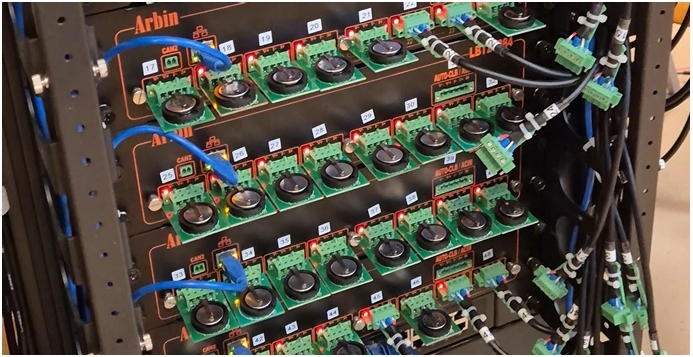
Critical Resources test cells under evaluation on a 48-channel Arbin coin-cell cycler at the South Dakota School of Mines & Technology (SDM), which runs cells through repeated charge cycles to validate real-world performance and durability.
Integrated battery strategy advances
Critical Resources said the ASE program forms part of a broader battery technology strategy alongside its Dry Supersonic Deposition (DSD) manufacturing workstream, which is focused on solvent-free, low-temperature battery fabrication pathways.
The company said the two programs were designed to work together as an integrated development pathway aimed at reducing both materials and manufacturing risk for future solid-state battery designs.
Coin-cell testing is already under way at SDM, with future work planned around electrolyte optimisation, interface stability testing, compression pathway assessment and progressive full-cell evaluation.
Critical Resources said solid-state batteries are increasingly attracting interest as demand rises for higher-density and safer battery systems tied to AI infrastructure growth, defence technologies and industrial electrification.
The company cited third-party forecasts estimating the global solid-state battery market could grow from roughly US$1.1 billion–1.4 billion in 2024–25 to as much as US$22 billion–27 billion by 2034.
Broader battery and lithium exposure
Critical Resources said the technology program complements its broader exposure to battery materials through the Mavis Lake Lithium Project in Ontario, alongside its gold and base metals exploration portfolio.
The company has recently expanded its battery technology focus through thermal management and electrolyte-related intellectual property initiatives, while also continuing exploration activities across its New Zealand gold portfolio and Canadian lithium assets.