Critical Resources Ltd (ASX:CRR) has received independent peer-reviewed validation for its optioned dry supersonic deposition (DSD) cathode manufacturing technology, strengthening the company’s push to commercialise battery materials and manufacturing intellectual property through a licensing model.
The research, published in international journal Electrochimica Acta, confirms the DSD process as a solvent-free, binder-free and single-step cathode manufacturing method, with early testing showing coulombic efficiency above 99.5% over 500 cycles.
Dry process removes key manufacturing steps
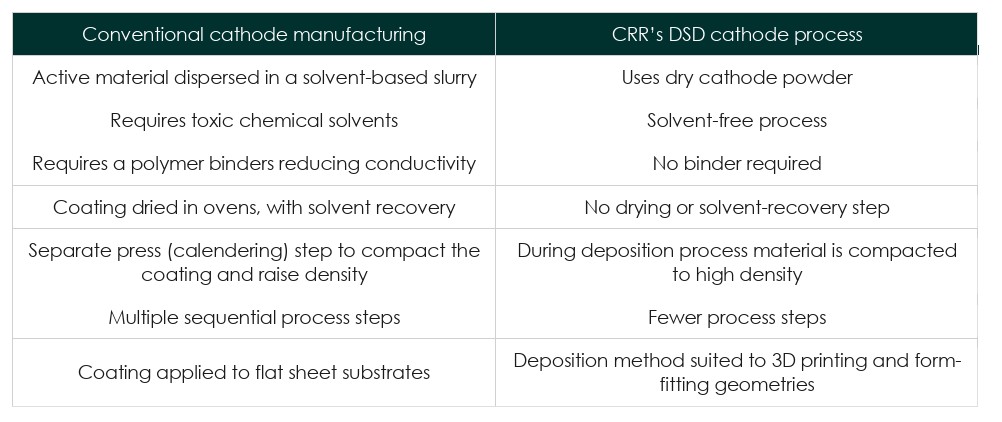
The DSD technology differs from conventional slurry-based cathode manufacturing, which typically uses solvents, polymer binders and high-temperature drying ovens.
Critical Resources reported that the dry process deposits ceramic cathode material directly onto the current collector in a single step, removing solvents, binders and drying or solvent-recovery stages that add cost, energy use and capital intensity to traditional battery manufacturing.
The company holds an exclusive option over the provisional patent application covering the DSD process and has said its strategy is to license the technology rather than manufacture battery cells itself.
Early trials show durability
Published results from the first unoptimised DSD trials were conducted in coin-cell format using a liquid-electrolyte reference.
At low rate, the heat-treated cathode delivered about 154 milliamp-hours per gram, close to the theoretical capacity of lithium iron phosphate, and retained around 85% capacity over 500 cycles, equivalent to about 1,250 hours, at 1C.
Critical Resources noted that higher-current performance remains lower, as expected for an early unoptimised cathode, and improving rate capability forms part of ongoing optimisation work.
Partnering opportunity strengthened
Managing director Tim Wither said the international peer review provided “real validation” of the work being carried out at the South Dakota School of Mines and Technology and helped de-risk the process at the core of the company’s evaluation program.
He said the results were not from a finished commercial cell, but the durability shown in early testing was encouraging and demonstrated that the dry process did not degrade the active material.
Critical Resources said the validation strengthens its position in discussions with potential cell and component-maker licensees.
Next Steps
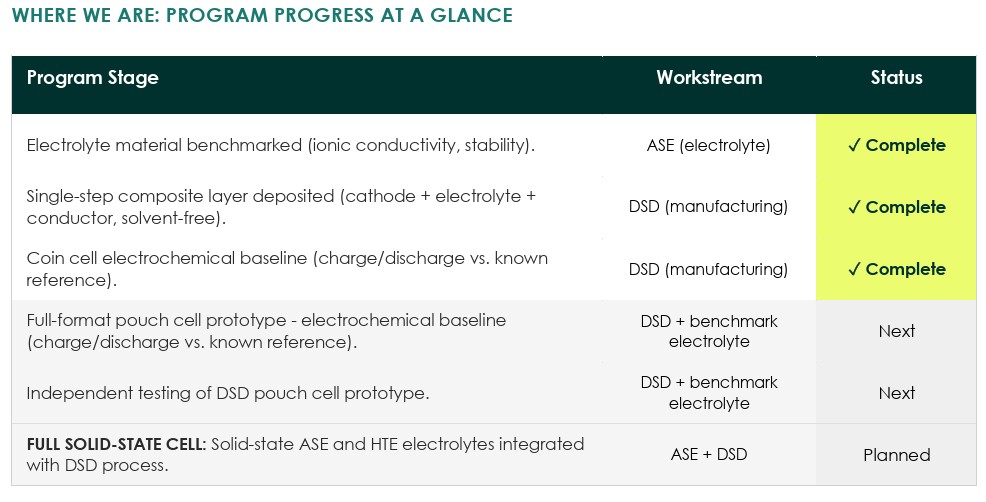
Critical Resources will now continue full-format pouch-cell performance testing, optimise the cell and deposition process, and submit an optimised baseline cell for independent third-party electrochemical testing.
The company is also working to replace the liquid baseline with its proprietary sulphur-free amorphous solid electrolyte, with deposition now underway as it builds toward a full solid-state cell.