
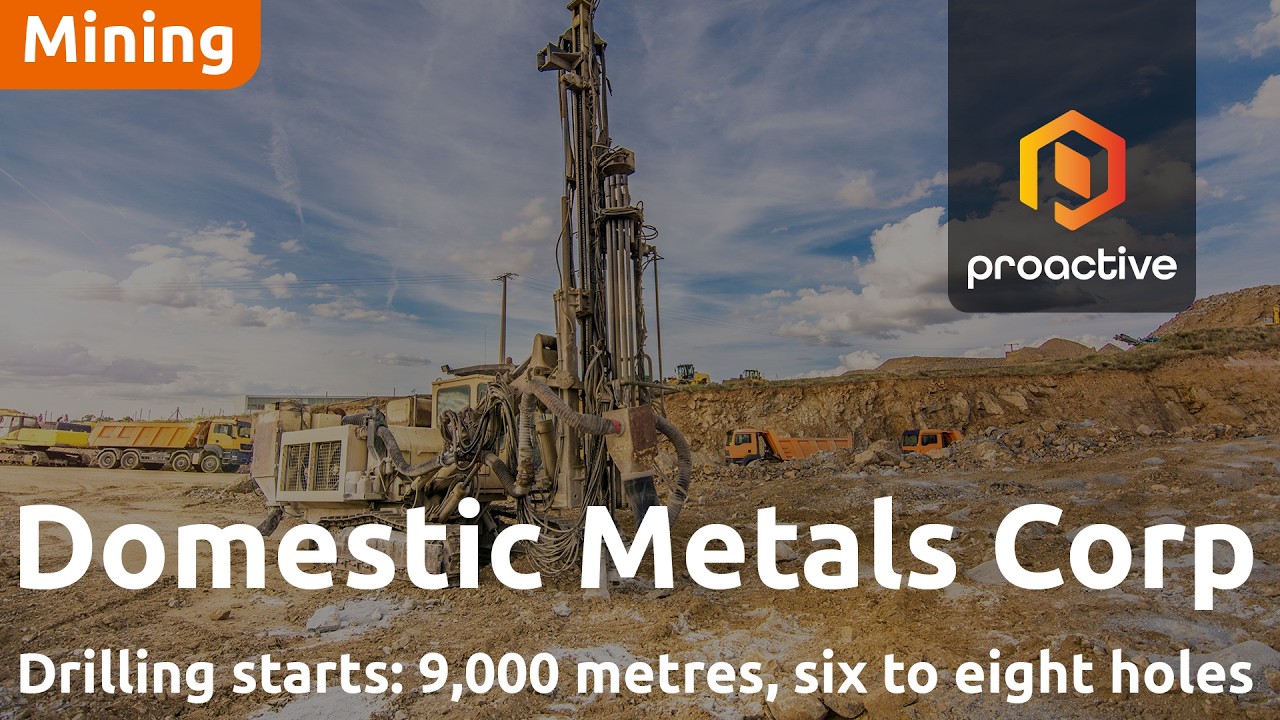
Domestic Metals Corp (TSX-V:DMCU, OTCQB:DMCUF, FRA:03E0) earlier this week provided an update on drilling at its Smart Creek project in Montana, with CEO Gordon Neal outlining a fully funded 9,000-metre program targeting copper and precious metals across two areas of focus.
Neal told Proactive that drilling had started at Smart Creek, where Rio Tinto previously completed 26 holes between 2017 and 2022.
Proactive: The company is really interesting, mostly because of the project you have. Why don’t you give everyone a refresher and tell me a bit about the project, where it is and what you’re looking at? Then we’ll talk about the work that’s going on.
Gordon Neal: It’s Domestic Metals Corp (TSX-V:DMCU, OTCQB:DMCUF). It trades on the TSX Venture under the symbol DMCU and, in the United States, on the OTC under DMCUF. We are in Montana. I’m actually leaving for Montana in a couple of days.
The drills have just started. It is a Rio Tinto project, and the name of the project is Smart Creek.
Rio Tinto drilled 26 holes on the project between 2017 and 2022. Its best hole was 109 metres of 0.75% copper, which included 84 metres of 0.97% copper, so almost 1%.
There’s a lot of copper oxide on site in the Smart Creek area. There are two areas of focus on the project. Smart Creek is on the eastern side, and the Sunrise Mine is on the west. We’re looking at both sides of the project because they have significant copper endowments showing. So that’s where we are in Montana.
You’ve got a fully funded 9,000-metre drill program starting up. It’s going to be about six to eight drill holes. Tell me about the design of this program and what you’re trying to fill in here.
The hole I just mentioned was Rio’s best hole, hole 22, on the Smart Creek side, which is on the eastern side of the project.
This isn’t a negative statement about Rio’s drilling abilities because it’s a big company. But Peter McGall was on the project with us and has joined the group, and Dan McNeil and I were on the project. Peter said, “I don’t know why you drill a vertical hole here with a dipping structure.”
It looks like we should probably go back in and test that again at the right angle. It looks like it dips 45 to 50 degrees to the west, we think.
We’re going to come at it at the right angle, and hopefully that will give us a true-width measure of the mineralised zone. Hopefully, we get either the same or higher grades.
That’s the plan for the first hole. We’re going to hit that hole and then move over to the Sunrise Mine area, which is in the west.
In the west, we have 102 grams per tonne gold on surface sampling. That mine used to produce 1.5% copper. It produced 12,500 ounces of gold at six grams per tonne gold and 31 grams per tonne silver.
It’s a past-producing area, but what really stuck out to us was that it was pulling 1.5% copper from the ground, so we’re going to test that area as well.
You’re expecting to have some results back in hopefully about a month to a month and a half. Is that right?
That’s about right. We’re hoping, to be honest, Steve, that if we have a large intercept of hole 22 that’s highly mineralised, we’ll take a page out of the book of BCM Resources and actually show the market what that mineralised core looks like while we have the assays in the lab, and then we’ll add the assays later.
We’re anticipating that, but if not, we’ll have assays out by the middle of October to the end of October.
I know you’re headed to site soon, so if we get a chance, maybe we’ll catch up with you there. If not, we’ll get those results for sure. Congratulations, Gordon. It sounds like it’s a pretty exciting venture that you’re in right now.
This is the most exciting time. I’m looking at core in the box, and we’re seeing exactly what we want to see. I’m just so excited about this time. This is when everybody gets excited, and you can bring some good returns for shareholders.
Quotes have been lightly edited for style and clarity


