
Krakatoa Resources Ltd (ASX:KTA, LSE:, AIM:) accelerated exploration and technical work at its flagship Zopkhito Antimony-Gold Project in Georgia during the June 2026 quarter, beginning a major resource definition drilling campaign, intersecting multiple zones of visible stibnite mineralisation and strengthening its pathway to acquire up to an 80% interest in the project.
The quarter marked a transition from preparatory work into active resource definition, with surface diamond drilling and underground drilling commencing in June. By early July, Krakatoa had completed four surface diamond holes and 13 underground holes, while initial core had been logged, sampled and dispatched for laboratory analysis.
The 2026 program is designed to convert and potentially expand Zopkhito’s existing foreign resource estimate into a maiden JORC-compliant Mineral Resource Estimate. Metallurgical optimisation, ore-sorting work, environmental studies, geological modelling and preliminary mining assessments are supporting drilling.
Krakatoa ended the quarter with $739,000 in cash and subsequently raised $1.6 million through a placement to sophisticated investors, providing additional funding for the expanded drilling campaign and associated project studies.
Drilling campaign moves into full operation
Krakatoa commenced Phase 2 drilling at Zopkhito during June, targeting five of the 17 known mineralised veins within the project area.
The program combines surface diamond drilling with underground core drilling from existing historical adits. Its principal objectives are to confirm the location, grade and continuity of known high-grade mineralisation, test the broader quartz-stibnite and gold alteration system and generate the data required for geological modelling and resource estimation.
Surface drilling has since expanded to a two-shift, 24-hour operation. Underground drilling is also expected to move to continuous operations, increasing the rate at which Krakatoa can test multiple vein positions and collect resource-quality data.
The company is integrating the new results with a substantial historical database accumulated through several phases of exploration dating back almost a century.
Zopkhito was discovered in 1929 and explored by the Soviet Government until 1979, with further work conducted between 2006 and 2019. Historical exploration includes about 27 kilometres of underground adits, more than 15,000 channel and geochemical samples, drill data, LiDAR surveys and induced polarisation geophysics.
This extensive dataset provides Krakatoa with a detailed starting point, although the company must validate and supplement the historical information before it can be incorporated into a JORC-compliant resource model.
Visible antimony mineralisation encountered
The early drilling delivered several visually encouraging intersections of stibnite, the principal ore mineral of antimony.
Surface diamond hole DD26ZOP-002 intersected a 2.86-metre mineralised interval from 44.02 metres, comprising quartz-stibnite breccia with stibnite filling veins and vugs.
Photograph of 44cm long drill core from hole DD26ZOP-002 (interval 44.66 – 45.00m) showing stibnite (antimony mineral) (estimated ~25%), slate and quartz breccia with disseminated sulphides
Within the interval, drilling encountered a 60-centimetre section of massive quartz and stibnite that was visually estimated to contain around 50% stibnite.
The upper part of the intersection included a 44-centimetre quartz breccia zone containing coarse visible stibnite mineralisation, visually estimated at about 25%.
Surface hole DD26ZOP-001 intersected a 1.8-metre interval from 52.6 metres consisting of silicified slate containing quartz-stibnite veins and veinlets. This included a 0.5-metre massive quartz-stibnite vein visually estimated to contain around 40% stibnite.
The interval also contained disseminated arsenopyrite, an alteration feature that may be associated with gold mineralisation.
Underground drilling encountered further examples of antimony-bearing mineralisation. Hole UG26ZOP-001 intersected a 0.75-metre interval from 3.84 metres containing quartz-stibnite breccia with stibnite in veins, veinlets and vugs.
UG26ZOP-003 intersected 0.47 metres of breccia containing disseminated stibnite from 6.36 metres, while other underground holes intersected quartz veining, pyrite, arsenopyrite and silicified host rocks.
Krakatoa has emphasised that the reported percentages are visual estimates only and should not be regarded as a substitute for laboratory assays. Visual estimates provide an indication of mineral abundance but do not establish antimony grade, gold content, recoverability or the presence of deleterious elements.
Assays from the initial drilling remain pending.
Gold potential remains an important part of the system
While the visible stibnite intersections have provided the clearest early indication of mineralisation, Krakatoa’s exploration model also incorporates a broader gold-bearing alteration system.
Arsenopyrite-rich sulphide alteration was observed adjacent to several of the antimony zones in both surface and underground drill core.
The company believes this alteration may contain gold and could form part of a larger mineralised envelope surrounding the narrower high-grade quartz-stibnite veins.
Previous drilling completed during 2025 confirmed mineralisation beyond the historical adits and supported the presence of an extended gold alteration system.
This is important because it suggests Zopkhito may contain more than isolated antimony veins. Krakatoa is assessing whether the project hosts a combined antimony-gold system with both high-grade vein mineralisation and broader zones of gold-bearing alteration.
Laboratory assays will be required to determine the actual gold and antimony grades within the new intersections and to assess how the different styles of mineralisation may contribute to a future resource.
Foreign resource provides scale target
Zopkhito contains a foreign resource estimate of 225,000 tonnes grading 11.6% antimony for approximately 26,000 tonnes of contained antimony.
The project also has a foreign gold estimate of 7.1 million tonnes grading 3.7 g/t gold for 815,119 ounces.
These estimates were not prepared in accordance with the 2012 JORC Code and have not been classified as Mineral Resources under Australian reporting standards.
A competent person has not yet completed sufficient work to classify the estimates under the JORC Code, and Krakatoa has cautioned that there is no certainty the historical estimates will ultimately be converted on the same basis.
The 2026 drilling program is therefore intended to validate the historical model, provide modern drilling and assay data and establish sufficient confidence in mineralisation continuity to support a maiden JORC Mineral Resource Estimate.
Krakatoa is also reviewing historical exploration information outside the current foreign resource area to identify additional targets and potential extensions.
Independent consultants review project
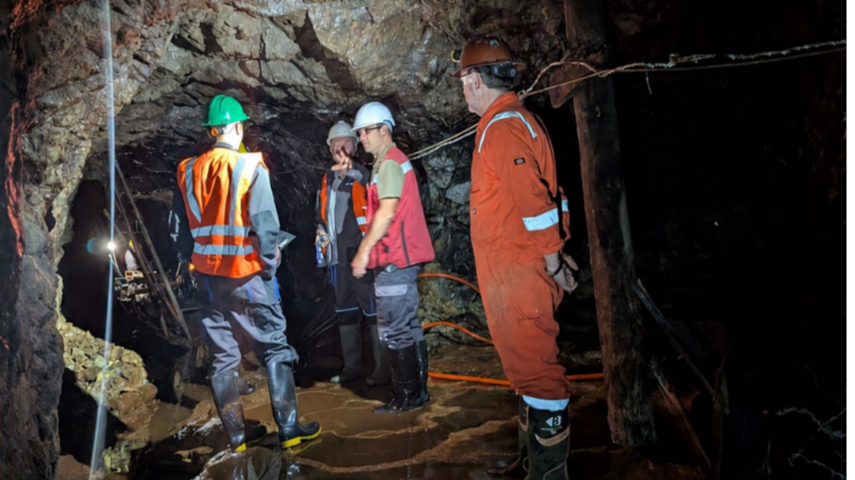
Independent mining and resource consultants visited Zopkhito after the quarter to inspect the project’s geological database, underground workings, historical core and newly drilled core.
The review included direct inspection of mineralised vein exposures in underground adits and examination of core from the 2025 and 2026 drilling campaigns.
The consultants’ findings will assist with geological interpretation, three-dimensional modelling, drill planning and the design of future mining studies.
Their involvement also provides additional technical oversight as Krakatoa works toward a JORC-compliant resource.
The project’s existing underground workings are expected to play an important role in this process, giving the company direct access to vein exposures and allowing underground drill holes to be positioned close to known mineralised structures.
Metallurgical program planned
Alongside drilling, Krakatoa is preparing to collect metallurgical samples from selected underground adits.
The samples are expected to include material from the principal antimony veins as well as the gold-rich alteration zones in the surrounding footwall and hanging wall.
The material will be sent to Europe for ore-sorting trials and metallurgical test work.
Ore sorting could potentially be used to separate higher-grade antimony-bearing material from waste before conventional processing, although the test work is still at an early stage.
The metallurgical program will also seek to establish how effectively antimony and gold can be recovered and whether separate or combined processing pathways may be appropriate.
These studies will be important in determining the technical and economic potential of the project and in guiding any future mine design.
Broader licence offers additional targets
Zopkhito covers 1,779 hectares in the Racha region of Georgia and is held under an exploration-mining licence valid until March 2042.
The project is located around 170 kilometres from Kutaisi, Georgia’s second-largest city, and approximately 20 kilometres from the village of Ghebi.
Rail infrastructure links the broader region with the Black Sea ports of Poti and Batumi, providing potential access to export routes.
Beyond the core Zopkhito mineralised system, Krakatoa has identified several satellite prospects containing indications of antimony, tungsten, copper and other base metals.
These prospects include Devrushi I and II, Sagebi, Kodiani and Edena.
Follow-up work is planned during 2026 as the company seeks to determine whether the licence hosts additional mineralised systems that could supplement the main project.
The review of historical datasets is also expected to help prioritise new targets for mapping, sampling and eventual drill testing.
Earn-in structure reshaped
A major corporate development during the quarter was the restructuring of Krakatoa’s option agreement with JSC Caucasus Minerals.
The amended agreement provides Krakatoa with a staged and more capital-efficient pathway to acquire up to 80% of the Zopkhito Project.
Under the revised structure, Krakatoa can first earn an initial 30% interest and then acquire a further 50% to reach a total 80% ownership position.
The company said the revised arrangement shifts a greater proportion of expenditure toward exploration, resource definition and project development rather than upfront acquisition payments.
This is intended to reduce immediate capital demands, limit dilution and allow spending to be tied more closely to technical milestones.
The staged structure also gives Krakatoa the opportunity to increase its ownership as confidence in the project grows through drilling and technical studies.
Exploration period extended
Krakatoa also secured a two-year extension to the exploration period applying to the Zopkhito mining licence.
The extension was approved through a decree signed by Georgian Prime Minister Irakli Kobakhidze in early June.
The underlying mineral extraction licence remains valid until March 2042.
The additional exploration time provides Krakatoa with greater flexibility to complete drilling, resource estimation, metallurgical work, environmental studies and other development activities before moving toward more advanced project decisions.
Environmental baseline studies and permitting work continued during the quarter and will remain an ongoing part of the project’s development pathway.
Placement strengthens funding position
Krakatoa held $739,000 in cash at June 30, 2026, compared with $1.034 million at the beginning of the quarter.
Operating cash outflows totalled $608,000, including $397,000 spent on exploration and evaluation and $211,000 on administration and corporate costs.
The company received $250,000 from the disposal of tenements, while financing activities contributed a net $63,000 during the quarter.
Subsequent to quarter-end, Krakatoa completed a placement of 400 million shares at $0.004 per share to raise approximately $1.6 million.
The funds are being directed toward drilling, metallurgical test work, resource modelling and preliminary mining studies at Zopkhito.
The company also proposes to issue 200 million options to placement participants and the lead manager. The options are exercisable at $0.01 and expire on September 29, 2028, subject to shareholder approval.
The capital raising addresses the company’s short-term funding requirements after its June quarterly cash flow report showed approximately 1.21 quarters of available funding based on the quarter’s expenditure rate.
Krakatoa said it expects to continue operating and meeting its business objectives with support from the completed placement and further capital raisings as required.
Australian portfolio rationalised
No material exploration activity was completed at the Mt Clere Project in Western Australia during the quarter.
Krakatoa reduced several licence areas to concentrate on priority targets and remove areas considered non-core.
The company also completed the transfer of the Belgravia Project and received the remaining $250,000 payable under the sale agreement.
An associated environmental bond refund was also returned during the quarter.
Krakatoa continues to hold a portfolio of Australian exploration assets, including tenements at Mt Clere, King Tamba, Turon and Rand, although Zopkhito has emerged as the company’s main operational focus.
Next steps
Krakatoa’s immediate priorities are to continue the expanded surface and underground drilling programs, receive the first laboratory assays and integrate results into the developing geological model.
The company will also collect underground metallurgical samples, begin ore-sorting and recovery test work in Europe and progress environmental and permitting activities.
Independent consultants will continue supporting resource modelling, drill targeting and preliminary mining studies.
With drilling operating across multiple shifts, assays pending and several technical programs underway, Krakatoa expects a steady series of exploration results and project development updates from Zopkhito during the second half of 2026.
About Krakatoa Resources
Krakatoa Resources is an ASX-listed exploration company focused primarily on critical minerals and precious metals.
Its flagship asset is the Zopkhito Antimony-Gold Project in Georgia, where it holds an exclusive option to acquire up to an 80% legal and beneficial interest.
The company is advancing Zopkhito through drilling, resource definition, metallurgical testing and preliminary development studies.
Krakatoa also retains exploration interests in Australia and continues to assess complementary critical minerals opportunities.


