
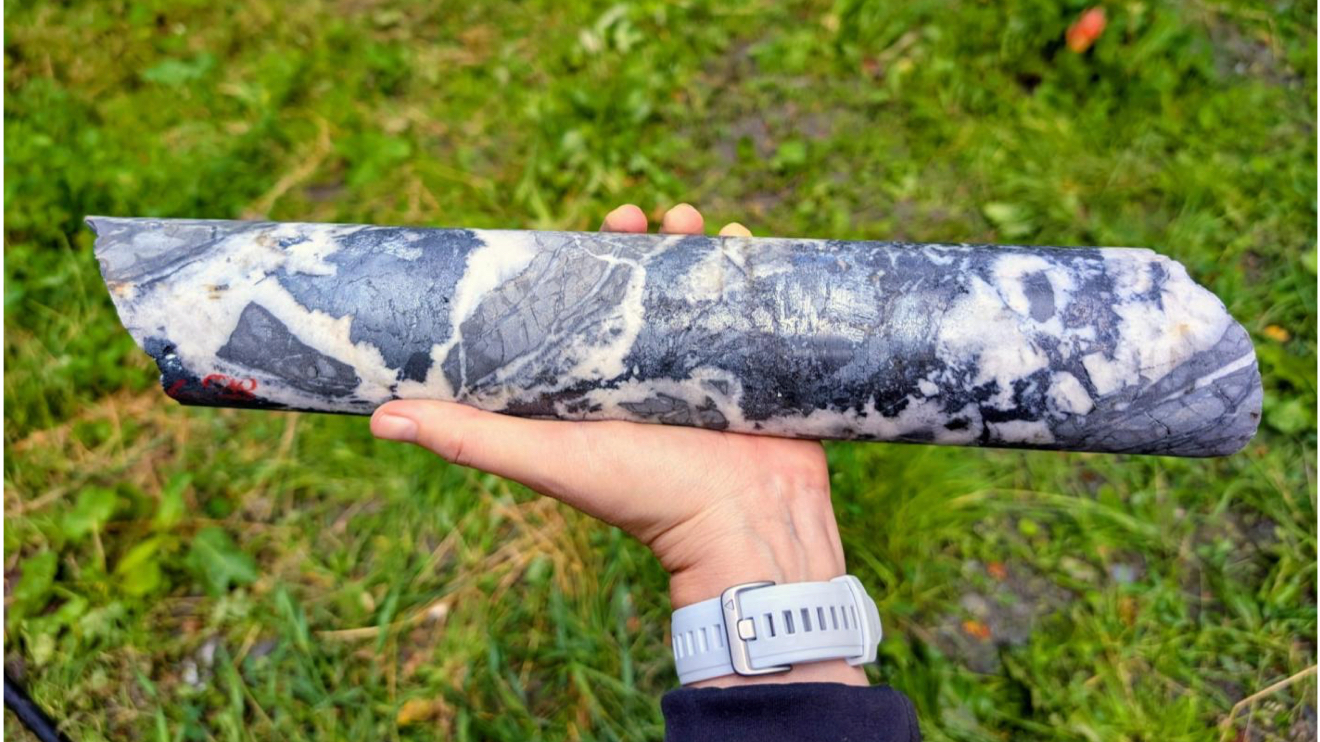
Krakatoa Resources Ltd (ASX:KTA) has reported multiple zones of significant visual antimony from initial surface diamond drilling at the Zopkhito Antimony-Gold Project in Georgia, marking an encouraging early step in its 2026 exploration program.
The company has completed two surface diamond drill holes and four underground in-adit core sampling holes, with drilling targeting known antimony and gold mineralised veins within historical underground workings. Underground panel and bulk sampling is expected to begin in the coming weeks.
Initial drilling identified a 2.86-metre interval of antimony mineralisation, including a 60-centimetre zone of massive quartz and stibnite with visual estimates of about 50% stibnite.
Photo of the mineralised antimony zones (yellow box) within drillhole DD2 6 ZOP-002 showing breccia of quartz with stibnite filling veins and vugs ( ~25% Stb) at start, transitioning to a massive stibnite ( 0.6m of ~50% Stb). Drilling prior to the antimony zone is enriched in arsenopyrite sulphide alteration which may contain gold. Assays are pending for this hole.
A separate 44-centimetre interval of quartz breccia containing coarse visible stibnite mineralisation was intersected in hole DD26ZOP-002, with visual estimates suggesting around 25% stibnite. Assays remain pending for these intervals.
Surface drill hole DD26ZOP-002 and underground hole UG26ZOP-001 both intersected visible stibnite mineralisation hosted in quartz and quartz breccia, occurring as vein and vug fill and locally transitioning into massive stibnite.
Summary of drillhole data as of 7 July 2026 with notable mineralised intervals.
Krakatoa CEO Mark Major said the early drilling was confirming historical vein models and supporting the company’s push toward a maiden JORC-compliant Mineral Resource Estimate.
“It fantastic to see the initial 2026 drilling confirming the historical vein models and demonstrating the continuity of the enriched antimony mineralisation at Zopkhito,” Major said.
“We are systematically working the veins, with each hole providing valuable information to improve our understanding of the mineralised system and supporting the delivery of a maiden JORC-compliant Mineral Resource Estimate.
“Further work is being planned as we step up activities at site and we are looking forward to a very busy year and maintaining strong news flow.”
Zopkhito resource conversion in focus
Zopkhito covers 1,779 hectares and is held under an existing mining licence valid until March 2042. Krakatoa has an exclusive option to acquire up to an 80% interest in the project.
The project currently hosts a foreign resource estimate of 225,000 tonnes at 11.6% antimony for 26,000 tonnes of contained antimony, along with 7.1 million tonnes at 3.7 g/t gold for 815,119 ounces of gold. The estimate is not reported under the JORC Code 2012.
The 2026 program is designed to validate historical high-grade results, define the geometry and extent of quartz-stibnite vein systems and associated gold zones, and generate enough data to support conversion of the foreign resource estimate into a maiden JORC-compliant resource.
More work ahead
Krakatoa expects a steady sequence of operational updates and assay results through 2026 as it advances Zopkhito.
The company also plans additional metallurgical optimisation test work, preliminary mining studies and an adit bulk sampling program. Environmental baseline studies and permitting activities are continuing in parallel to support future project development.


