
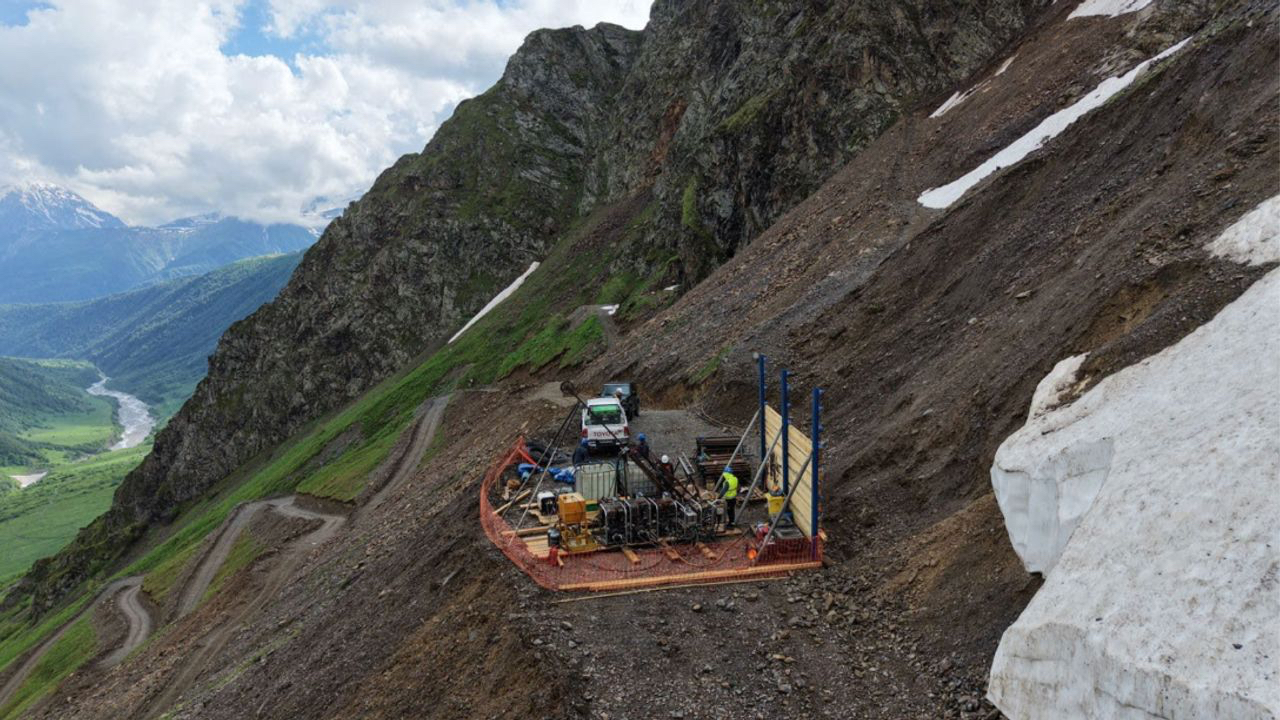
Krakatoa Resources Ltd (ASX:KTA) earlier this week kicked off its second field season at the Zopkhito Antimony-Gold Project in Georgia, with underground core sampling drilling now underway as the company targets a maiden JORC-compliant mineral resource estimate.
CEO Mark Major told Proactive that the project offered exposure to a historically worked but underexplored mineral system, with Georgia still relatively undeveloped in terms of modern resources exploration. Major said the country had seen extensive Soviet-era work, but had not been fully tested using newer exploration methods.
He said the Zopkhito Antimony-Gold Project was advanced rather than early-stage, pointing to more than 27 kilometres of existing adits. Major described an adit as “a tunnel right into the side of the hill which follows the vein” and said the underground access gave Krakatoa Resources Ltd (ASX:KTA, LSE:, AIM:) a useful starting point for its current field program.
“We’ve got access into the orebody straight away,” Major said, adding that the company could sample the orebody and drill from inside the adits.
A key catalyst for Krakatoa is the planned maiden JORC-compliant mineral resource estimate. Major said the company was working to convert a foreign resource into a JORC resource, which was required under the Georgian mining licence. He said Krakatoa hoped to be in a position to put the resource in place by the end of the year.
Major said mining studies, metallurgical studies and baseline environmental and social studies were also being progressed. These workstreams are expected to support a preliminary first-level study in the first half of next year, before the company considers further development steps and a potential move toward production.
He said Krakatoa planned to proceed in stages rather than immediately pursuing a large mechanised operation. The company is considering smaller-scale mining, gold concentration and later downstream processing.
Major also said investors might be missing the grade profile of the Zopkhito deposit. He said the historical foreign resource included antimony grades of around 11% to 12%, while the gold potential had not been the focus of Soviet-era work.
He said gold in the vein was around 3 to 3.5 grams per tonne, while material outside the vein halo had returned grades above 50 grams per tonne. Major said the gold aspect was “starting to reveal itself” and could point to a larger system, with the current foreign gold resource standing at 800,000 ounces.
Interview highlights
- Krakatoa Resources has kicked off its second field season at the Zopkhito Antimony-Gold Project in Georgia.
- Underground core sampling drilling is now underway as the company targets a maiden JORC-compliant mineral resource estimate.
- CEO Mark Major said Georgia remains underexplored from a modern resources perspective, despite significant Soviet-era work.
- Major said the project is advanced rather than early-stage, with more than 27 kilometres of adits already in place.
- He explained that the adits provide direct access to the orebody, allowing the company to sample and drill from underground.
- Krakatoa is working to convert a foreign resource into a JORC-compliant resource, which Major said is required under the Georgian mining licence.
- Major said the company hopes to be in a position to put the resource in place by the end of the year.
- Mining studies, metallurgical studies and baseline environmental and social studies are part of the work program.
- Major said these workstreams are expected to support a preliminary first-level study in the first half of next year.
- Krakatoa plans to take a staged approach to development, beginning with smaller-scale mining and gold concentration before considering downstream processing.
- Major said investors may be overestimating jurisdiction risk in Georgia and underestimating the grade profile of the deposit.
- The historical foreign resource included antimony grades of around 11% to 12%.
- Major said Soviet-era work focused mainly on antimony, leaving the gold potential less fully understood.
- He said gold in the vein is about 3 to 3.5 grams per tonne, while material outside the vein halo has returned grades above 50 grams per tonne.
- Major said the current foreign gold resource is 800,000 ounces, but he believes the broader system could be more robust.
Proactive: Back to Proactive Investors. Ladies and gentlemen, I’m your host once again, Kerry Stevenson. Today I’ve asked Mark Major, CEO of Krakatoa Resources Ltd (ASX:KTA, LSE:, AIM:), ASX code KTA. The company has gold and antimony over in Georgia. Some of you will be saying, “Where’s Georgia?” Mark, welcome to Proactive. First thing I’m going to ask you is: why Georgia, and why should people be getting a little bit excited about what you’re doing?
Mark Major: Thanks for having me, Kerry. Initially, Georgia is very undeveloped when it comes to exploration and resources. It was old Soviet era. There was a lot of work being done, but with new technologies, new exploration techniques and even the size of resources over there, it has not been explored, let’s be honest. So the opportunity is there for us.
Proactive: A lot of people in Australia, as I said at the start, would say, “Where is Georgia?” I just want people to understand Georgia is like a trade gateway between Asia and Europe. If you go to Europe, most people turn around and say, “Oh, Georgia, fabulous.” Is that correct?
Mark Major: In Europe, everybody knows Georgia. Everybody goes on holidays there. They love the wines and they enjoy the people there. So it is not a scary proposition for people in Europe. That is what we have found. The European market has been very receptive to us and to our project because it is such an advanced project.
We have already kicked the can down the road. We are well and truly into this. I think the Australian market has to open up and consider this. The risk profile in Georgia is a lot less than most African or other places. Do your research. That is all I say. It is there and it is easy to find out.
Proactive: You just said you are an advanced project, so you are not an exploration company. You are more into development. Explain to us why what you have got your hands on is important and how far you have got down the road.
Mark Major: It is an old historical Soviet deposit. The Soviets explored it for many years and were looking to actually develop it before the demise of the Soviet Union and Georgia became independent. It has sat there for a long time while Georgia decided what it wanted to do.
There are over 27 kilometres of adits already in place there, so we have direct access into the ore. There has not been any drilling there, but these adits are about 100 metres apart along the veins.
Proactive: You say adits. Explain adits for those who might not know.
Mark Major: An adit is basically a tunnel right into the side of the hill which follows the vein. That is a pretty good start to mining. They are exploration and development tunnels, let’s say. We have access into those, so we have access into the orebody straight away. We can sample that orebody and we can drill from inside those adits. That is the opportunity we are looking at.
We are really taking a foreign resource and converting it into a JORC resource, which is a requirement under the laws of this mining licence through Georgia. We have to put it into JORC. Once it is in JORC, we are obviously going to be looking at mining it quite quickly because we have already half-started, I guess.
Proactive: Talk to us about the timeline.
Mark Major: By the end of this year, we hope to be in a position where we can actually put the resource in place. We will then be doing mining studies and metallurgical studies this year as well. They are all culminating in a PEA, or first-level study, in the first half of next year. That will take us into the next season, where we will advance that again and then look at going into production.
We are also doing the bugs and bunnies studies, all the baseline studies for the environmental and social side. All those things are going to culminate in getting it all in line so that we can get the permitting done for the mining licence, because it is in the mining licence. It just needs to be permitted.
We are going to take small steps. We are not going to go full-blown, fully mechanised with a big plant and processing facility. We will take small steps and do more manual-style mining. Then we will go into a small-scale location for the gold concentration, and then we will look at the downstream processing of that as well.
Proactive: Have you got challenges when it gets very cold in Georgia, in other words, snow season?
Mark Major: There definitely are. For us right now, there has been very heavy snow over the winter, so it took us a little bit longer to get on. The locals have said they have never seen snow that much since they have been around, and a lot of them are very old.
They are the things you have to work with. Climate is something we have to consider. We can work all year round if we want to, but obviously you have to capitalise to do that. That is another aspect we have to consider when we are looking at the operations in future. Underground is fine. How we process it and all that sort of stuff, they are the next steps for us.
Proactive: What do you think investors might be missing about the Krakatoa story right now?
Mark Major: The two key things are that a lot of people see it as a jurisdiction risk or sovereign risk, just with the wars in those areas and the instability of Russia. We do not see it that way. There is still a lot of investment going in there from the US, especially into the real estate industry and agricultural industry.
The other part is that I do not think people understand the nature and the high-grade nature of this deposit as well. We are talking antimony around 11% to 12%. That is what the foreign resource was in.
Proactive: And the gold?
Mark Major: The gold, there is a gold halo in that vein itself. It is about 3 to 3.5 grams. Outside of that, there is a gold halo around that, and that is actually running a lot higher grade. We have got stuff up there over 50 grams per tonne.
Again, the gold part of it, the gold aspect, is a bit unknown because the Soviets never concentrated on gold. Their sole focus was the antimony. The gold is starting to reveal itself, I guess, and it is going to be a much bigger system.
At the moment, the foreign resource in the gold is only 800,000 ounces, but my back-of-the-envelope numbers look a lot more robust than that, I guess.
Proactive: You cannot say too much yet. Ladies and gentlemen, he is busting at the gut to tell you more. I have got to say this as well: maybe have a crack at Krakatoa. Not financial advice, ladies and gentlemen. Pick up the phone and talk to Mark.
Mark, thanks for coming on today and having a chat with us, bringing us up to speed with Krakatoa Resources Ltd, ASX code KTA. The company is in Georgia. It is open for business and it has a mining licence. Take a look. Thanks for joining me today on Proactive Investors. Mark, good to see you.
Mark Major: Good to see you, Kerry. Thank you very much.


