
Askari Metals Ltd (ASX:AS2, FRA:7ZG) has reported strong trenching results from the K9 pegmatite target at its 100%-owned Uis Project in Namibia, confirming extensive polymetallic mineralisation and strengthening plans for drilling later this year.
The Phase 1 trenching program returned encouraging grades of tin, lithium, tantalum, rubidium and caesium across a mineralised system extending about 950 metres along strike, with the company describing K9 as an emerging polymetallic target within the broader Uis critical minerals project.
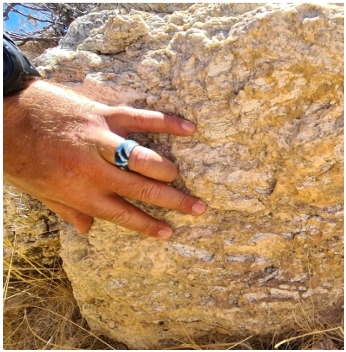
Pegmatite cutcrop at the K9 Target exhibiting weathered spodumene mineralisation.
Key assays included up to 4,050 parts per million (ppm) tin, 0.29% lithium oxide, 215ppm tantalum, 2,380ppm rubidium and 479ppm caesium. The results were generated from systematic trenching completed on 40-metre spacing across the target area.
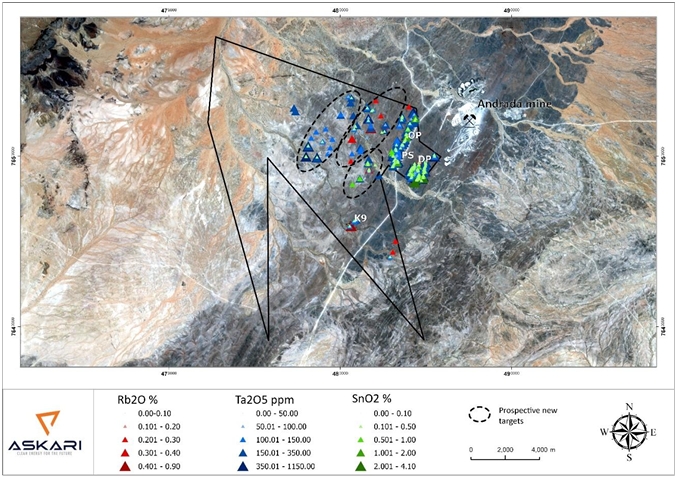
Map showing the interpreted corridor of interest on EPL 7345 along with pegmatite targets (DP, OP, PS and K9) trenched in the Phase 1 Trenching program.
‘Standout polymetallic discovery’
The Uis Project sits immediately southwest of Andrada Mining's operating Uis Tin Mine within Namibia's Cape Cross-Uis Pegmatite Belt, one of the world's best-known hard-rock tin, lithium and tantalum districts. Askari believes the latest results reinforce the project's potential to host a substantial polymetallic system.
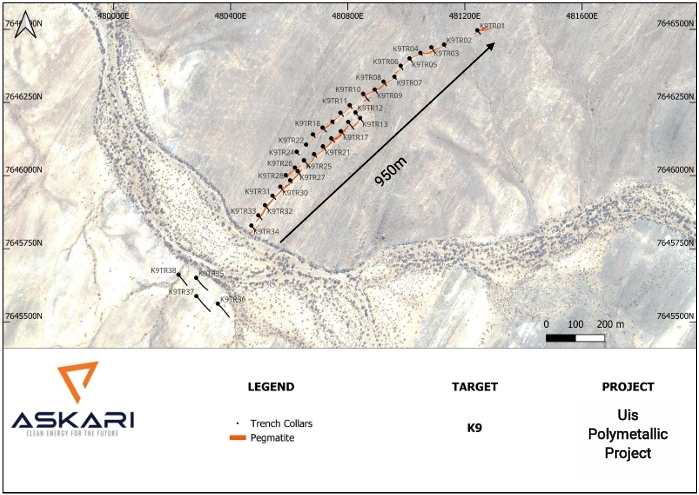
Map shows K9 trenches, pegmatites and their spatial nature of outcrop.
Executive director Gino D'Anna said the results had significantly increased confidence in the scale and continuity of mineralisation at K9.
“K9 is shaping up as a standout polymetallic discovery at Uis. Phase I trenching has confirmed broad, continuous mineralisation over a 950m strike, with standout results including up to 4,050ppm tin, 0.29% Li2O, 215ppm tantalum, 2,380ppm rubidium and 479ppm caesium,” he said.
“These results materially derisk drilling and strengthen our conviction that K9 sits within a fertile, high-quality mineralised corridor with the scale and commodity mix to capture strong investor attention.”
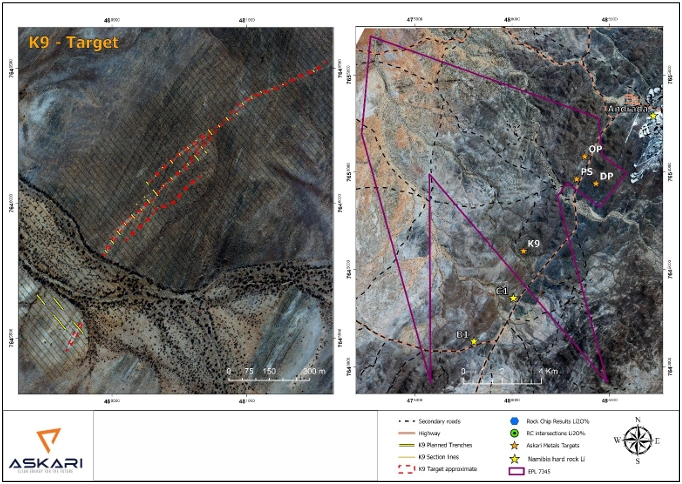
Map of the K9 pegmatite target including the location of the trench lines completed.
Extensive strike length confirmed
The trenching campaign forms part of a broader exploration effort across four priority pegmatite targets known as OP, PS, DP and K9. In total, Askari completed 135 trenches covering 7,269 metres and collected 2,098 channel samples across the project area.
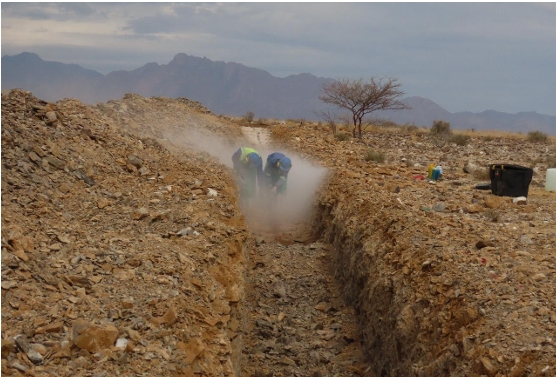
Example of the trenching completed at the K9 Target. Trenches are dug using a mechanised excavator to the point of refusal. The trenches are then cleaned manually and mapped by a geologist to document the exposed geology across the width of the pegmatite target and document the host lithology. Visual indicator marks are made across the pegmatite for channel sampling to be completed using a rock saw and hand chisel to remove the sample for bagging and sample preparation. Channel sampling is completed using a rock saw and hand chisel to remove the sample for bagging and sample preparation.
At K9 alone, the company excavated 38 trenches for 781.7 metres and generated 199 channel samples. The work represents the first systematic test of the target and has helped define the geometry, strike extent and metal distribution within the pegmatite system.
Multiple trenches returned elevated tin grades along much of the 950-metre trend, including:
- 2.8 metres at 1,810ppm tin from 9 metres, including 0.8 metres at 4,050ppm tin;
- 2 metres at 1,954ppm tin from 3 metres, including 1 metre at 3,030ppm tin; and
- 1 metre at 2,280ppm tin from 22 metres.
The company noted that several of the tin results compare favourably with grades reported from the neighbouring Uis Tin Mine, which has an average tin grade of about 0.15%.
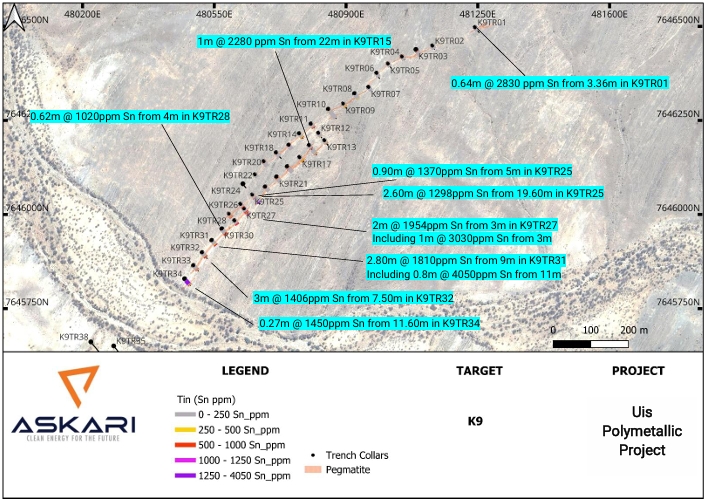
Tin (Sn) mineralisation intercepts from Phase1 K9 trenches with some highlights of high-grade tin exceeding 0.1% Sn.
Lithium and tantalum add to critical minerals mix
While lithium grades were more modest at surface, Askari believes weathering may have depleted lithium concentrations within exposed pegmatites and that fresh-rock drilling could return stronger results at depth.
Best lithium intercepts included:
- 1.10 metres at 0.29% Li₂O;
- 0.82 metres at 0.29% Li₂O; and
- 0.50 metres at 0.26% Li₂O.
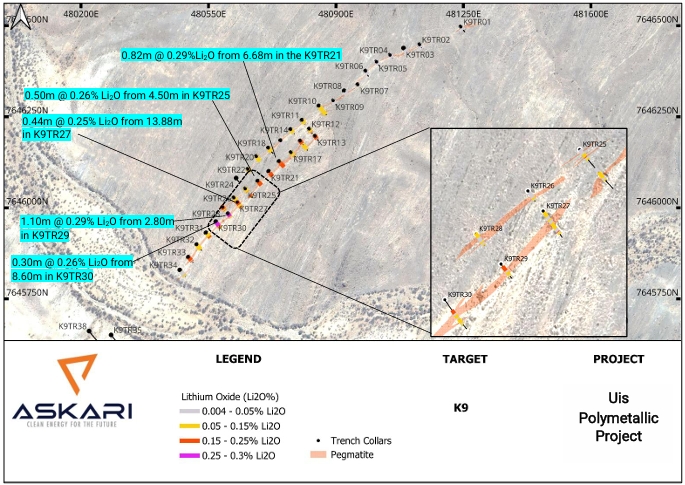
Lithium (Li2O%) results, with intercepts of 0.3% Li2O labelled on the map.
Tantalum mineralisation proved particularly consistent, with many trenches returning grades above 80ppm across the full strike length of the pegmatite.
Peak values reached 215ppm tantalum, while notable intersections included 3.26 metres at 131ppm tantalum, 3.3 metres at 115ppm tantalum and 4.8 metres at 118ppm tantalum.
Rubidium and caesium mineralisation was also identified throughout the system, highlighting the project's broader exposure to critical and specialty metals. The best rubidium result returned 3.26 metres at 0.18% Rb₂O, including 2 metres at 0.23% Rb₂O, while caesium values reached more than 500ppm in individual samples.
Drilling planned for H2
The latest results build on recent exploration success at Uis, where Askari has been systematically advancing multiple pegmatite targets through mapping, sampling, trenching and reverse circulation drilling programs.
Last month, the company launched a broad geochemical sampling campaign aimed at refining targets across a 15-kilometre-long corridor of interest and identifying additional lithium, tin and tantalum prospects.
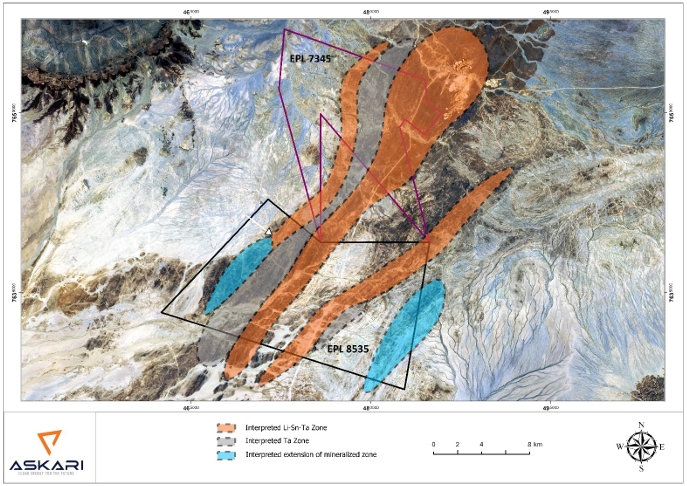
High-priority prospective “corridor of interest” with re-defined Li-Sn-Ta prospective zones, Ta prospective zones and areas of potential mineralization extensions.
RC drilling is now being planned for the K9, DP, OP and PS targets, with the program expected to test the continuity, geometry and depth extent of mineralisation beneath the surface exposures in the second half of the year.
“With drilling planned for H2 2026 and more results still to come, we see strong potential for continued newsflow as we unlock the broader upside at Uis,” D’Anna said. “In a strong tin and critical minerals market, we believe Uis is increasingly well positioned to deliver meaningful value as exploration momentum builds.”
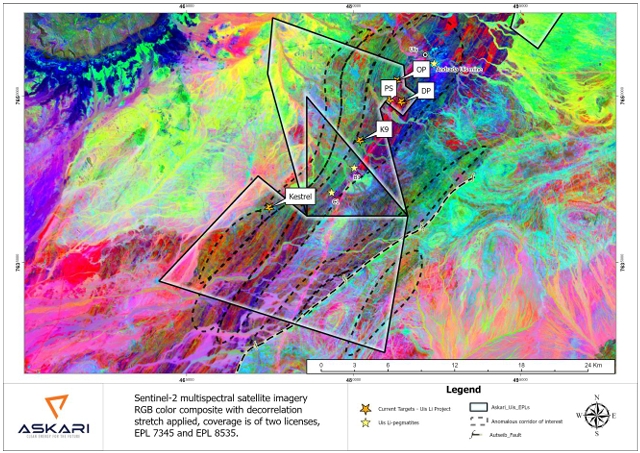
Hyperspectral imagery showing Askari Metals newly identified pegmatite targets on EPL 7345.