
Askari Metals Ltd (ASX:AS2, FRA:7ZG) has confirmed continuous polymetallic mineralisation from Phase 1 trenching at the PS Pegmatite Target within its 100%-owned Uis Project in Namibia.
Assays from the program returned peak results of 6,670 ppm tin, 0.49% lithium oxide, 465 ppm tantalum, 2,020 ppm rubidium and 134 ppm caesium, confirming tin-lithium-tantalum-rubidium-caesium mineralisation across the PS pegmatite system.
Peak results
- 6670ppmTin(Sn)
- 0.49%LithiumOxide(Li2O)
- 465ppmTantalum(Ta)
- 2020ppmRubidium(Rb)
- 134ppmCaesium(Cs)
"Phase I trenching at the PS Pegmatite Target continues to build on the momentum achieved from the OP and DP trenching results, again confirming high-grade continuous polymetallic mineralisation across these targets at the Uis Project in Namibia," executive director, Gino D’Anna, said.
"Mineralisation occurs along the entire pegmatite length and across its width with varying concentrations returning results of up to 6,670 ppm Sn, 0.49% Li2O, 465 ppm Ta, 2,020 ppm Rb and 134 ppm Cs. These results not only validate the previously limited exploration, they also generate robust, high-confidence drill targets. We plan to move the Uis Project into the next phase of development, through rigorous systematic drilling designed to confirm the scale of the pegmatites and deliver a maiden JORC (2012) Mineral Resource estimate. We are encouraged by the findings and will continue to build on this success through multiple streams of exploration. These results strongly indicate a significantly mineralised system that warrants further exploration as we target a maiden resource at our Uis Project later this year.
“We look forward to keeping our shareholders and investors well-informed as we progress with our planned activities.”
Drilling confidence builds
The results follow trenching at the OP and DP targets and provide further support for Askari’s plan to move to reverse circulation drilling in the second half of 2026.
The PS target sits on EPL 7345, adjacent to the operating Uis Tin Mine owned by Andrada Mining Ltd, and forms part of Askari’s broader 380-square-kilometre landholding in the Cape Cross-Uis Pegmatite Belt.
Phase 1 trenching was completed on about 40-metre spacing across the main PS pegmatite, which has been exposed over about 260 metres at surface, and a western parallel pegmatite extending about 140 metres.
At PS, Askari completed 14 trenches for 272 metres, collecting 159 channel samples. The program intersected a combined 76 metres of pegmatite, with sample lengths ranging from 0.4 metres to 2.2 metres.
Tin and lithium highlights
Notable tin results included 3.14 metres at 3,577 ppm tin from 11.06 metres in PSTR05, including 2.2 metres at 5,238 ppm, and 5.32 metres at 1,249 ppm tin from 3.8 metres in PSTR06, including 1 metre at 3,700 ppm.
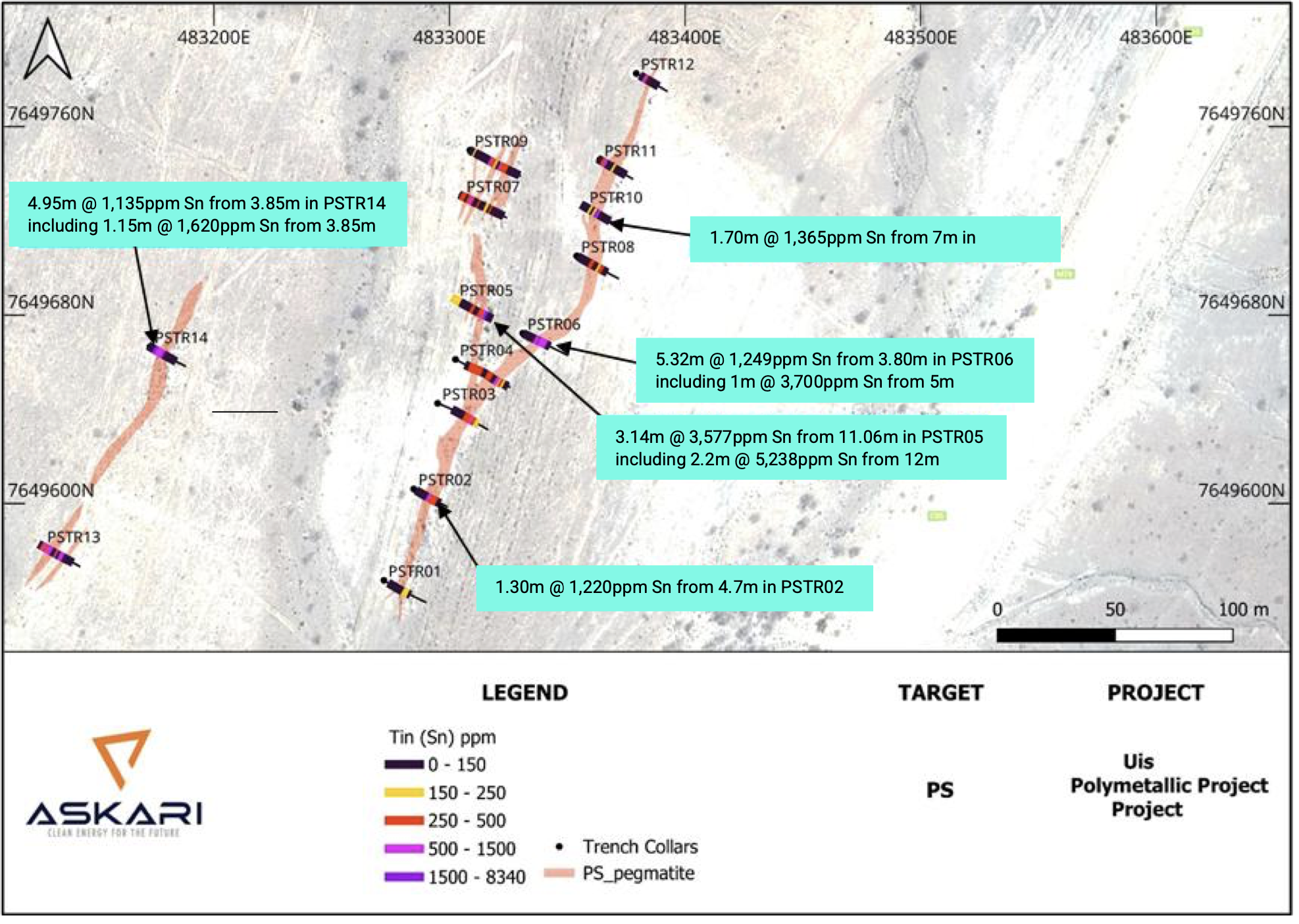
Tin (Sn) mineralisation intercepts from Phase1 PS trenches with some highlights of high-grade tin exceeding 0.1% Sn labelled on the map.
Lithium results included 4.55 metres at 0.4% lithium oxide from 4.7 metres in PSTR02, including 1 metre at 0.48%, and 4.11 metres at 0.31% lithium oxide from 17.24 metres in PSTR04, including 0.9 metres at 0.49%.
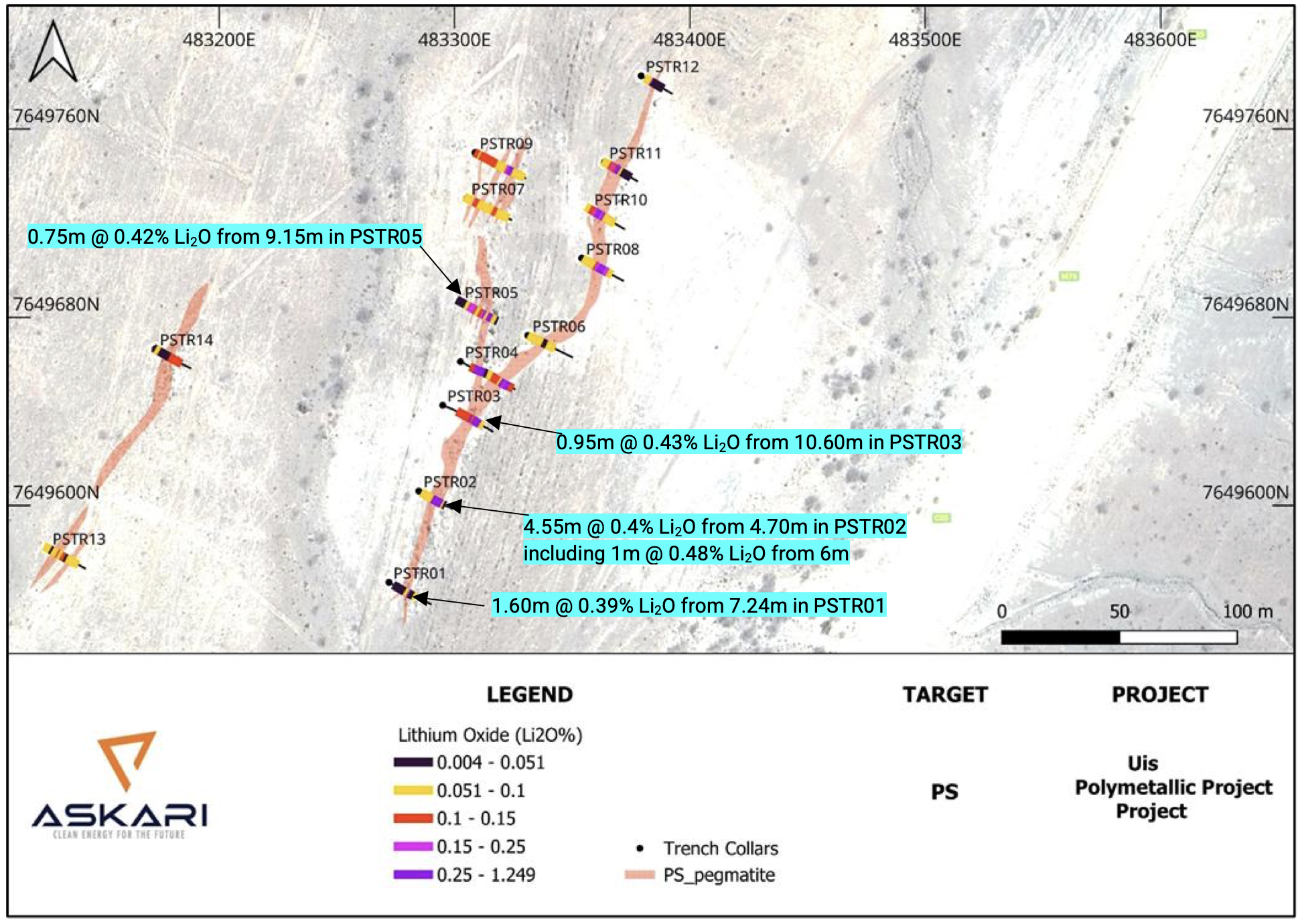
Lithium (Li2O%) results, with intercepts above 0.4% Li2O labelled on the map.
Broader critical minerals suite
Tantalum mineralisation was reported across the main pegmatite and associated splays, with a best intercept of 4.2 metres at 246 ppm tantalum from 14.5 metres in PSTR04, including 1 metre at 465 ppm.
Rubidium results included 1.64 metres at 0.16% rubidium oxide from 4.36 metres in PSTR08, while caesium assays included 0.6 metres at 134 ppm caesium from 18.7 metres in PSTR04.
Askari said the trenching validates earlier exploration, improves understanding of pegmatite geometry and provides high-confidence targets for drilling. Previous drilling at PS was limited and not optimally positioned because parts of the pegmatite were obscured by gravel scree and calcrete.
What’s next
Next steps include remaining assays from the K9 target, expected in mid-May 2026, soil and geochemical work on EPL 7626, mapping and rock chip sampling of new targets on EPL 7345, possible Phase 2 trenching and RC drilling across DP, OP, PS and K9. The K9 pegmatite is also planned for maiden diamond drilling.