
Askari Metals Ltd (ASX:AS2, FRA:7ZG) has launched a new field exploration campaign at its EPL 7626 licence within the broader Uis Project in Namibia, targeting buried tin and tantalum-bearing pegmatites along strike from the operating Uis Tin Mine.
The Phase I program includes geological mapping, rock chip sampling and a licence-wide soil geochemical survey across the highly prospective tenure, which is considered prospective for tin, tantalum, rubidium, caesium and lithium mineralisation.
EPL 7626 sits contiguous to Andrada Mining’s producing Uis Tin Mine, which hosts a JORC-compliant mineral resource of 77.51 million tonnes grading 0.79% lithium oxide, 0.15% tin and 82 parts per million tantalum.
The new exploration push follows recent trenching and mapping success across Askari’s neighbouring EPL 7345 and EPL 8535 licences, where the company previously confirmed continuous polymetallic mineralisation and identified multiple high-grade tin, lithium and tantalum pegmatite targets.
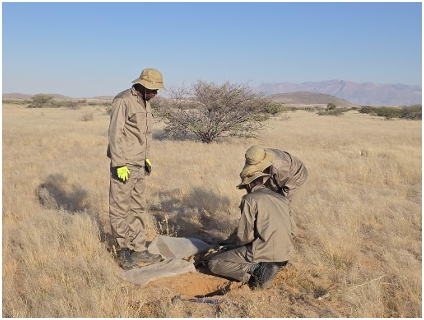
Sampling team in the field at EPL 7626 collecting sieved soil samples.
Remote sensing sharpens targeting
Askari said an in-house remote sensing study over EPL 7626 identified lithological zones with spectral signatures matching tin-tantalum pegmatite-hosting mica schists already mapped on adjacent ground.
The company believes those same mineralised units continue northeast from EPL 7345, through the Uis Tin Mine and into EPL 7626 beneath surface cover, opening the potential for concealed pegmatite systems.
Executive director Gino D’Anna said Askari’s hyperspectral targeting work had significantly improved its ability to identify both outcropping and buried pegmatites across the broader Uis tenure.
“The in-house re-processing of high-resolution satellite imagery and the development of our remote sensing hyperspectral methodology has allowed us to optimise our desktop targeting technique for the Uis project,” he said.
D’Anna said the same exploration model used successfully on Askari’s existing pegmatite prospects had now generated a pipeline of new targets across EPL 7626 and surrounding licences.
The remote sensing work used Sentinel-2 multispectral satellite imagery combined with Principal Component Analysis and decorrelation stretch techniques to enhance subtle geological signatures linked to pegmatite-hosted mineralisation.
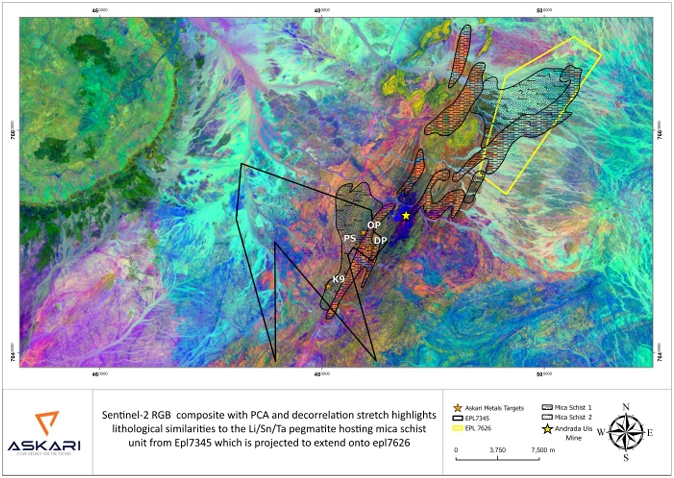
Sentinel-2 RGB composite with PCA and decorrelation stretch highlights lithological similarities and potential extension into EPL 7626.
Large-scale soil campaign under way
A major soil geochemical sampling campaign has now commenced over EPL 7626 using a 400-by-40-metre grid designed to detect geochemical halos associated with buried lithium-caesium-tantalum pegmatites.
The program will cover about 68 square kilometres and comprise 4,258 soil samples, giving Askari broad regional coverage while maintaining sufficient resolution to identify tin and tantalum anomalies.
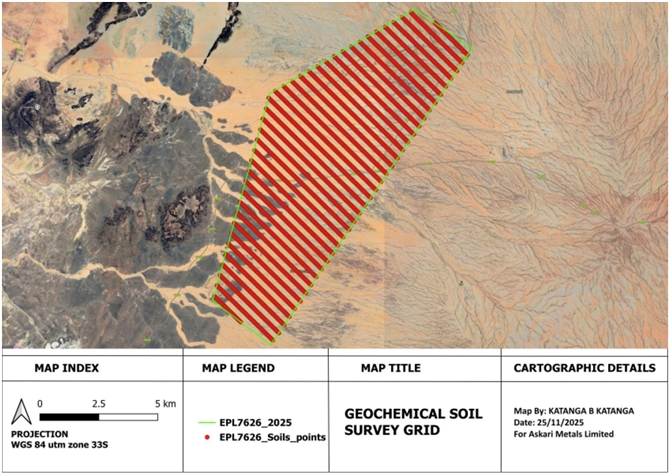
Map illustrating the soil sampling campaign on a 400m x 40m grid interval.
Askari said the survey design was informed directly by the remote sensing results, particularly structural and lithological trends analogous to mineralised zones already identified elsewhere within the project area.
Unlike many junior explorers relying on external laboratories, Askari plans to process samples on site using its own pellet press and LIBS (Laser-Induced Breakdown Spectroscopy) equipment, which the company says should accelerate turnaround times and lower costs.
The field program is expected to run for about three months, with results to guide follow-up infill sampling and trenching campaigns.
Broader Namibia strategy builds momentum
The latest campaign forms part of a broader exploration pipeline emerging across Askari’s Namibian ground, where the company has steadily expanded its pegmatite targeting work near the Uis mining district.
The Uis Project spans EPL 7345, EPL 8535 and EPL 7626 and hosts more than 80 mapped pegmatites, many historically worked for tin and semi-precious stones.
Future work planned across the broader project includes RC drilling at EPL 7345, first-phase trenching at EPL 7626 and EPL 8535, plus second-phase trenching and infill geochemical surveys.
D’Anna said investors could expect “a steady flow of news from Uis” in coming months as exploration ramps up, while the company also advances its Ethiopian copper-gold strategy centred on the advanced-stage Nejo Project.