
Askari Metals Ltd (ASX:AS2, FRA:7ZG) has delivered strong new evidence of high-grade polymetallic mineralisation at its Uis Project in Namibia, with Phase 1 trenching at the OP pegmatite target confirming continuous tin, lithium and tantalum mineralisation across a large-scale system.
The results mark a step forward in the company’s push to define a maiden resource at Uis, with systematic trenching providing a dense dataset to guide drilling planned for the second half of 2026.
The Uis Project sits directly along strike from the operating Uis Tin Mine, positioning Askari within a proven mineral district and reinforcing the strategic potential of its 100%-owned ground.
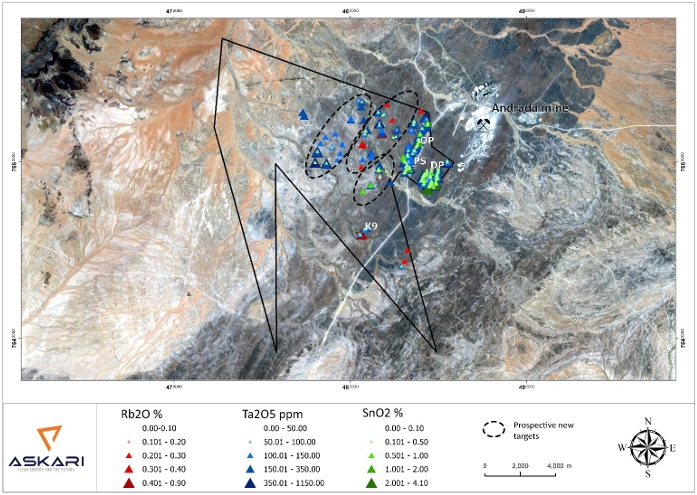
Map showing the interpreted corridor of interest on EPL 7345 along with pegmatite targets (DP, OP, PS and K9) trenched in the Phase 1 Trenching programme
Trenching confirms scale and continuity
Phase 1 trenching at the OP target was completed on roughly 40-metre spacing across a pegmatite system extending about 2.2 kilometres, with widths typically ranging from 15 to 30 metres.
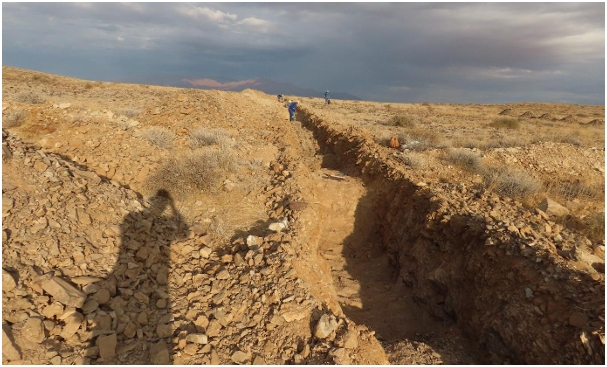
Example of the trenching completed at the OP Target. Trenches are dug using a mechanised excavator to the point of refusal. The trenches are then cleaned manually and mapped by a geologist to document the exposed geology across the width of the pegmatite target and document the host lithology. Visual indicator marks are made across the pegmatite for channel sampling to be completed using a rock saw and hand chisel to remove the sample for bagging and sample preparation.
The program returned peak assay results including:
- 8,340 parts per million (ppm) tin (Sn)
- 0.57% lithium oxide (Li₂O)
- 299 ppm tantalum (Ta)
- 2,380 ppm rubidium (Rb)
- 354 ppm caesium (Cs)
Multiple trenches intersected mineralisation along the entire strike length and across the pegmatite width, confirming a continuous and laterally extensive system.
A total of 135 trenches were completed across four priority targets (OP, PS, DP and K9), generating more than 2,000 samples and significantly improving geological understanding of the project.
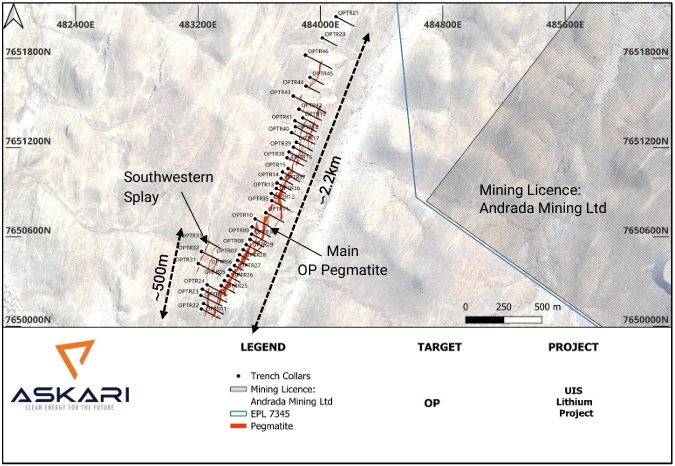
Map shows OP trenches, pegmatites and their spatial nature of outcrop.
Strong tin and lithium results support resource potential
Tin mineralisation emerged as a standout feature of the program, with numerous high-grade intercepts exceeding 0.1% Sn across much of the pegmatite.
Notable results included:
- 2 metres at 4,985 ppm Sn, including 1 metre at 8,340 ppm
- 3 metres at 1,747 ppm Sn, including 2 metres at 2,330 ppm
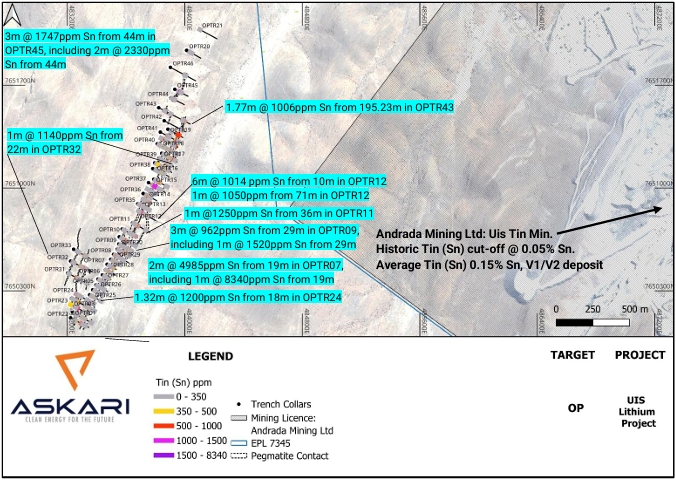
Tin (Sn) mineralisation intercepts from Phase1 OP trenches with some highlights of high-grade tin exceeding 0.1% Sn.
These grades compare favourably with Andrada Mining Ltd’s nearby Uis Tin Mine, which averages around 0.15% tin, underscoring the potential scale and economic relevance of the mineralisation.
Lithium results were also encouraging, with several intercepts exceeding 0.3% Li₂O — a commonly used cut-off for spodumene pegmatites — and peak values reaching 0.57% Li₂O.
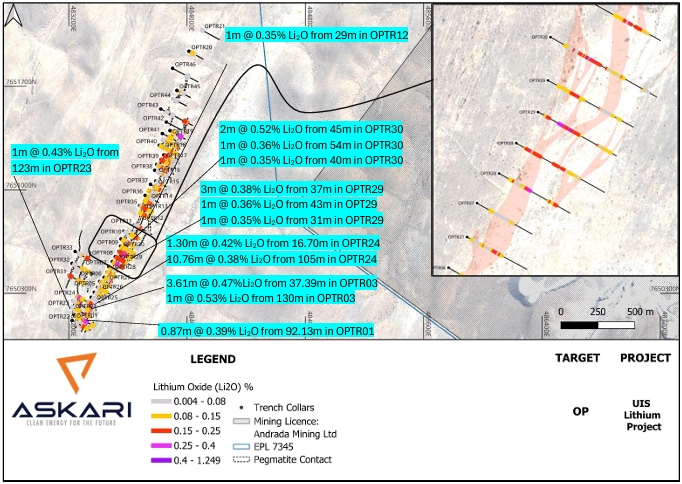
Lithium (Li2O%) results, with intercepts above 0.4% Li2O labelled on the map.
Importantly, these results were derived from near-surface material, suggesting potential for stronger grades at depth once drilling targets fresh rock below weathered zones.
Broad polymetallic system emerging
Beyond tin and lithium, trenching confirmed consistent tantalum mineralisation across the entire system, with grades up to 299 ppm and widespread results above 80 ppm.
These levels are broadly comparable to the adjacent Uis deposit, reinforcing the project’s credentials as a multi-commodity system.
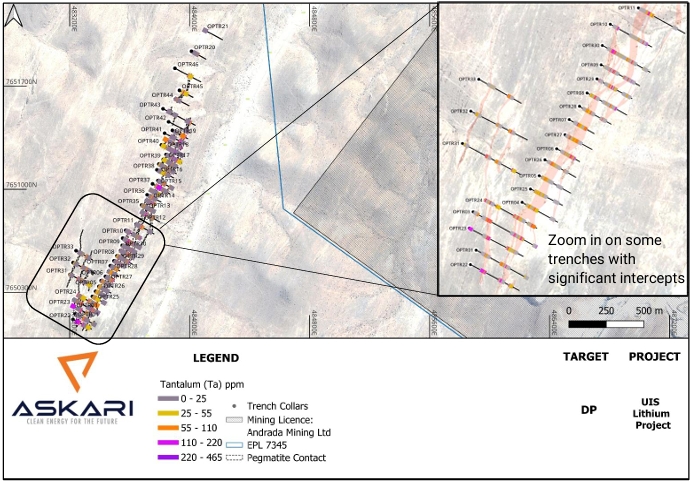
Tantalum (ppm Ta) results. Though 3% tantalum commodity proportion shown on the pie-chart, it is the most consistent with at least an intercept of above 80ppm Ta in almost all trenches along the entire length of the pegmatite.
Rubidium and caesium — both classified as critical minerals in several jurisdictions — were also identified across the pegmatite, further enhancing the project’s potential value proposition.
The presence of multiple payable elements positions Uis as a polymetallic asset with exposure to several high-demand commodity markets, including battery and technology metals.
Drilling plans and next steps
The trenching program has materially improved targeting confidence ahead of planned reverse circulation drilling, which is scheduled to begin in the second half of 2026.
Executive director Gino D’Anna said the results confirm continuous mineralisation across the pegmatite and point to “a significantly mineralised system warranting further exploration as we target a maiden resource”.
Additional assay results from the PS and K9 targets are expected in April, which could further expand the project’s footprint.
Building momentum across the portfolio
The latest results build on a growing body of exploration success across Askari’s African assets.
Recent work at Uis has already identified high-grade tin, lithium and tantalum mineralisation at the DP pegmatite target, while the company has also been advancing exploration at its Nejo gold project in Ethiopia as it sharpens its focus on the region.
Askari has also moved to strengthen its balance sheet, clearing debt to accelerate exploration across its portfolio.
With drilling now in sight and multiple targets delivering encouraging results, the Uis Project is emerging as a key focus — and a potential cornerstone asset — as the company works toward defining a maiden resource in a proven tin and lithium district.