
Askari Metals Ltd (ASX:AS2, FRA:7ZG) says early trenching at its 100%-owned Uis Project in Namibia has confirmed “strong, continuous polymetallic mineralisation” across the DP Pegmatite Target, setting up a planned reverse circulation (RC) drilling program in the June quarter.
The company’s Uis ground sits directly adjacent to Andrada Mining’s operating Uis Tin Mine, which hosts a JORC (2012) mineral resource estimate of 77.51 million tonnes (Mt) at 0.79% lithium oxide (Li₂O), 0.15% tin (Sn) and 82 parts per million (ppm) tantalum (Ta). Askari has positioned the project as an emerging critical minerals play with exposure to tin, lithium, tantalum, rubidium and caesium.
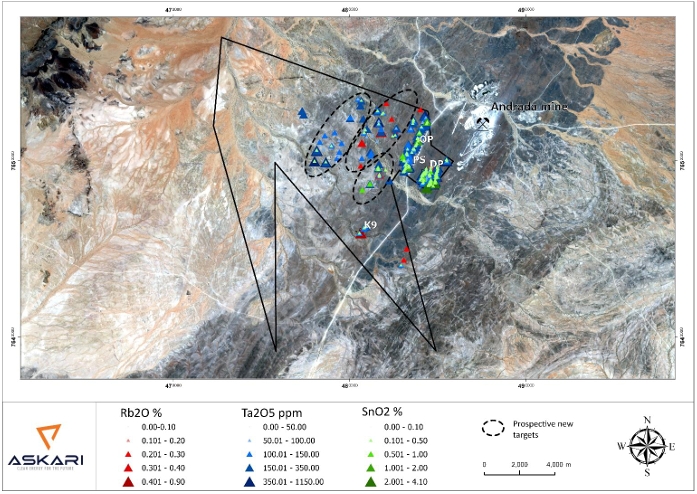
Map showing the interpreted corridor of interest on EPL 7345 along with pegmatite targets to be trenched in the Phase 1 Trenching programme.
Strategic location in a proven pegmatite belt
Askari’s latest results come from a Phase I trenching program at the DP target on EPL 7345, where the company says the main DP pegmatite extends for about 700 metres along strike with an average surface thickness of around six metres.
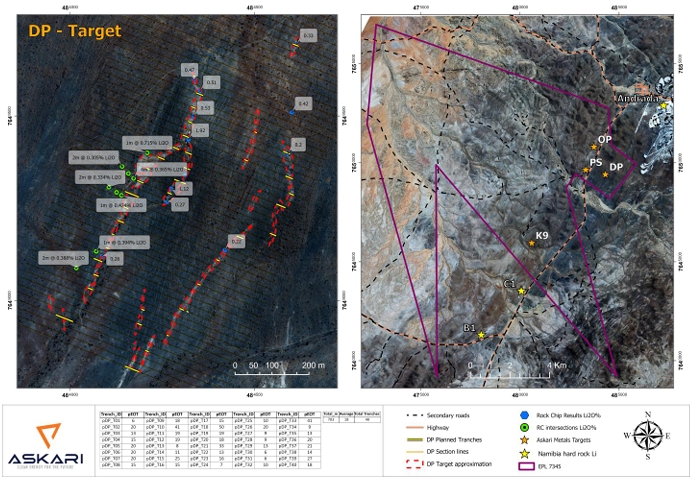
Map of the DP pegmatite target including historic exploration results.
Executive director Gino D’Anna said the trenching had strengthened confidence ahead of drilling.
"The Phase I trenching results from the DP Pegmatite Target are highly encouraging and confirm the presence of strong, continuous polymetallic mineralisation across a substantial strike length,” D’Anna said.
“These results materially strengthen our confidence in the scale and quality of the mineralised system at Uis and provide a clear technical foundation for drill targeting,” he added. “With RC drilling scheduled to commence in Q2 2026, we are now moving rapidly toward the next major value inflection point for the project.
“Given the Uis Project’s location directly adjacent to Andrada Mining’s operating Uis Tin Mine, and the growing importance of Tin, Lithium, Caesium, Rubidium and Tantalum in global supply chains, we believe the Uis Project has the potential to emerge as a strategically significant polymetallic asset.”
DP trenching builds a clearer drill picture
Askari said Phase I trenching across the broader Uis Project tested four priority pegmatite targets — OP, PS, DP and K9 — using systematic trenching and 1-metre channel sampling designed to firm up drill targeting and resource definition work.
Across EPL 7345, the program comprised 135 trenches totalling 7,269 metres and 2,098 1-metre channel samples. At DP, Askari completed 39 trenches for 749 metres, collecting 325 1-metre channel samples for assay.
The standout “peak” values at DP included:
- Tin: up to 3,360ppm
- Lithium oxide: up to 1.25%
- Tantalum: up to 364ppm
- Rubidium (Rb): up to 3,370ppm
- Caesium (Cs): up to 587ppm
In the more detailed results, Askari pointed to multiple tin intervals across the main pegmatite, including 13.10m at 930ppm Sn from 21m (DPTR11), 5.22m at 1,293ppm Sn from 13.45m (DPTR09) and 4.19m at 770ppm Sn from 9m (DPTR16). The company said this distribution supports confidence the tin mineralisation extends along the full length of the ~700m DP pegmatite.
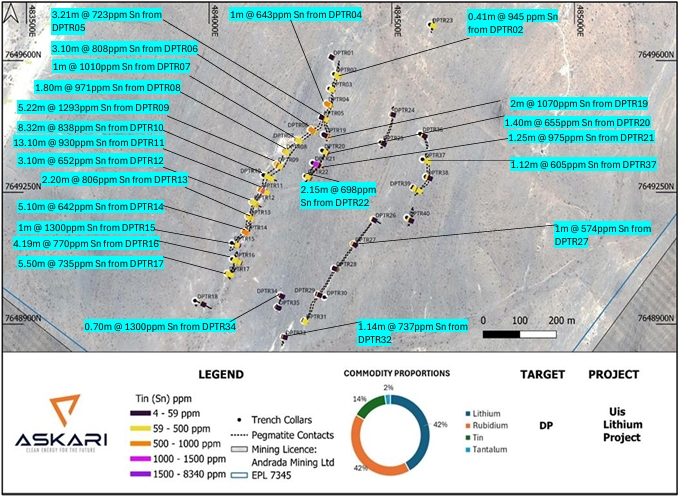
Best Tin (Sn) mineralisation intercepts on DP trenches Phase I.
For lithium, Askari highlighted consistent mineralisation across a run of trenches on the main pegmatite, including 9.29m at 0.61% Li₂O from 12.3m (DPTR12) with higher-grade internal zones reported, and 10.76m at 0.37% Li₂O from 17m (DPTR10) including 5.22m at 0.50% Li₂O.
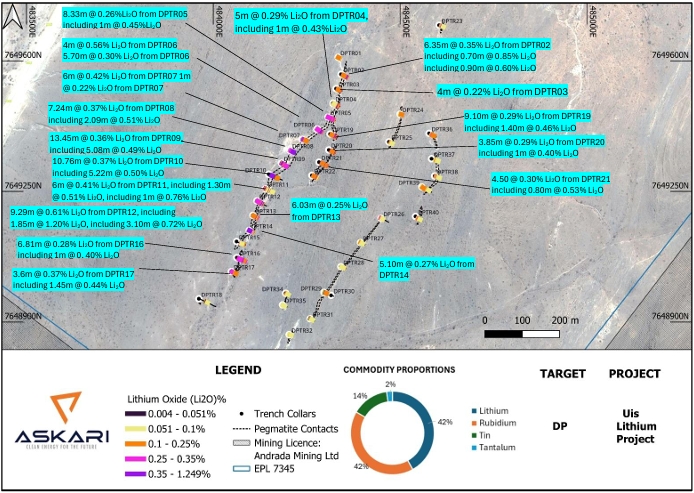
Best Lithium Oxide (Li2O) mineralisation intercepts on DP trenches Phase I.
Tantalum results were generally reported in the 80–364ppm Ta range, with examples including 2m at 236ppm Ta (DPTR12) and 13.10m at 134ppm Ta from 21m (DPTR11), as well as shorter higher-grade internal intervals — including a 0.50m at 364ppm Ta zone referenced within DPTR17.
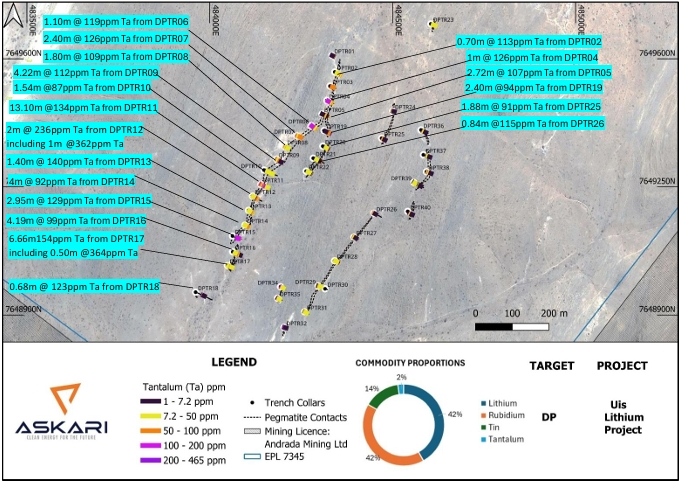
Map shows best Tantalum intercepts from DP trench results.
Askari also flagged rubidium as a notable contributor at DP, reporting multiple longer intervals around the 1,200–1,700ppm level, as well as higher-grade spikes.
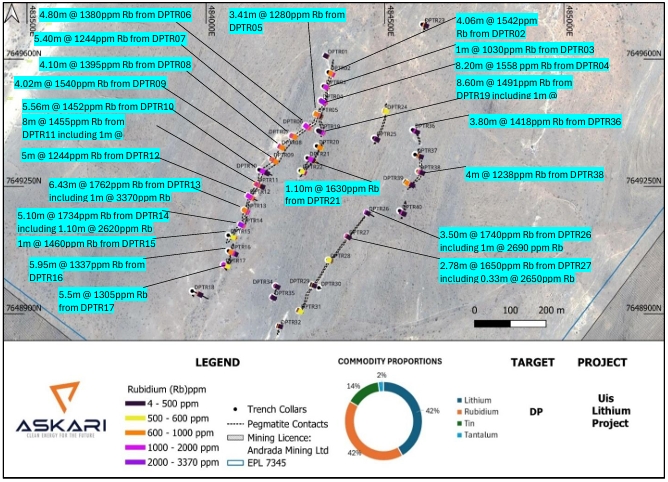
Map shows best Rubidium (Rb) intercepts from DP trench results.
Drilling plan and near-term newsflow
Askari said historic exploration across EPL 7345 has included mapping, sampling and two RC drilling campaigns (2022–2023) totalling 114 RC holes for 6,384m, with prior high-grade intercepts including 4m at 0.16% SnO₂, 4m at 314ppm Ta₂O₅, and 2m at 0.30% Rb₂O (including 1m at 0.38% Rb₂O).
However, the company noted that earlier drilling at DP was “not optimally positioned” and said the target “has not been adequately drill tested” — something it aims to address with RC drilling scheduled for Q2 2026.
Additional assay results from Phase I trenching at the OP, PS and K9 targets are still pending and are expected across February–March 2026, which Askari said should help maintain newsflow while it finalises drill targeting and follow-up fieldwork across the broader Uis Project.
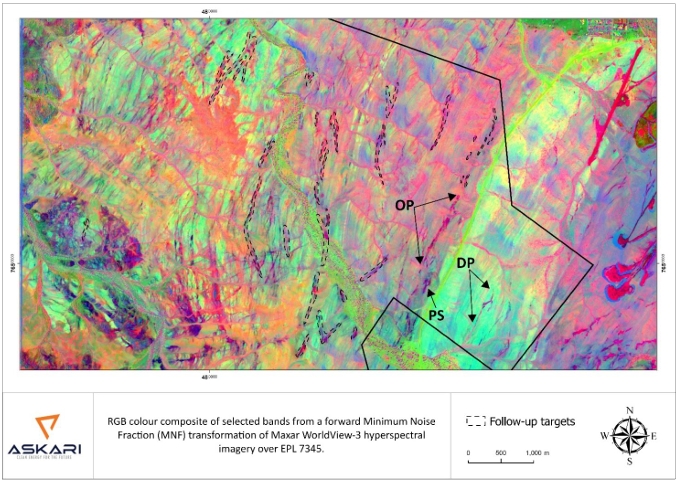
Hyperspectral imagery showing Askari Metals newly identified pegmatite targets on EPL 7345.