
Atomic Eagle Ltd (ASX:AEU, FRA:6QZ0) has refined multiple new uranium drill targets at its Muntanga North exploration area in Zambia after completing more than half of a planned ground radiometric survey program across the broader Muntanga Uranium Project.
The company said 53 line-kilometres of close-spaced ground radiometric surveying had now been completed across five of eight priority target areas, with the work confirming and refining several previously identified airborne anomalies.
The anomalies extend for up to four kilometres along strike and sit between 15 and 25 kilometres from the company’s existing Muntanga and Dibbwi East uranium deposits.
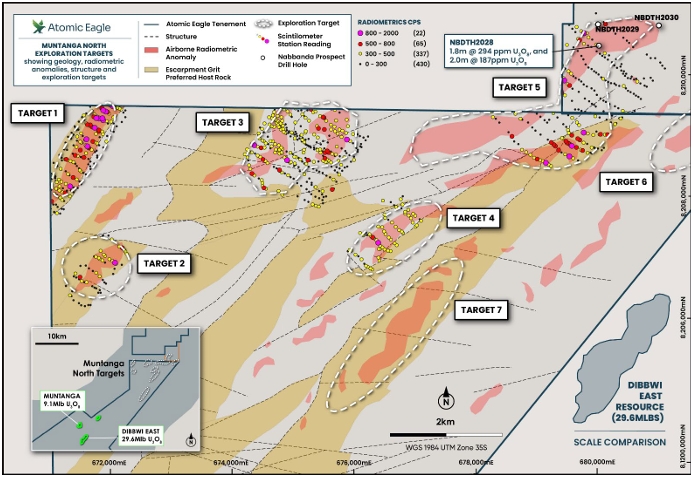
Muntanga North exploration targets showing geology, airborne radiometric anomalies and recent ground radiometrics survey results.
Integrated targeting boosts confidence
Atomic Eagle said the survey had identified a number of higher-intensity radiometric zones within broader anomalous corridors, helping narrow near-term drill targets ahead of planned drilling at Muntanga North in coming weeks.
The company recorded 854 radiometric readings during the survey, with 424 readings above background levels of 300 counts per second (CPS) and 87 readings above 500 CPS.
Chief executive officer Phil Hoskins said the results reinforced the prospectivity of the Muntanga North corridor.
“We are encouraged by the initial results from ground radiometric surveys over the first five targets at Muntanga North,” Hoskins said.
“These anomalies occur along strike from the company’s existing resource areas and are hosted within the same favourable Escarpment Grit Formation.
“The detailed ground surveys have not only confirmed the historical airborne anomalies in target areas 1 to 5 but, importantly, have helped identify the higher-intensity zones within these systems.”
Multi-target exploration campaign advancing
Atomic Eagle said the radiometric anomalies aligned with favourable geological structures, soil geochemistry and radon survey data, increasing confidence that the identified zones could host uranium mineralisation.
The Muntanga North targets lie within the Escarpment Grit Formation of the Upper Karoo Basin, the same geological unit hosting the company’s existing Muntanga, Dibbwi East and Dibbwi deposits.
The current survey uses 100-metre spaced lines and 50-metre station spacing to improve the resolution of radiometric patterns and isolate higher-priority drill zones within the broader anomalies.
The company also pointed to historical drilling completed in 2024 at the Nabbanda prospect within target area 5, where one hole intersected 1.8 metres at 294ppm U3O8 from 29.3 metres and 2 metres at 187ppm U3O8 from 36 metres’ depth.
Broader uranium growth strategy continues
The Muntanga North work forms part of a broader multi-front uranium exploration campaign under way across Atomic Eagle’s Zambian portfolio.
At Chisebuka, drilling is continuing to test extensions to recently defined higher-grade mineralisation, while new ground radiometric surveys are also set to begin at the Namakande 1 and 2 targets in June.
The company said surveys over the remaining Muntanga North target areas 6 to 8 would continue through the second and third quarters of 2026, while drilling at targets 1 to 5 is expected to commence shortly.
Atomic Eagle’s broader Muntanga Uranium Project currently hosts a combined mineral resource estimate of 58.8 million pounds of U3O8 across measured, indicated and inferred categories.
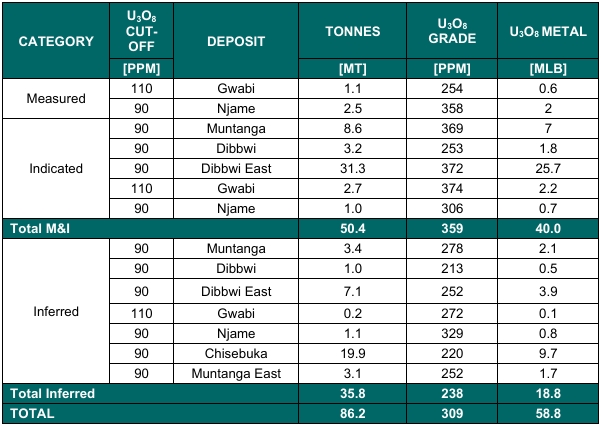
Mineral Resource Estimate for the Muntanga Uranium Project.
The project spans four mining licences and two exploration licences across a 146-kilometre strike corridor in southern Zambia near the Zimbabwe border, with access to road, rail and export infrastructure.