
Atomic Eagle Ltd (ASX:AEU, FRA:6QZ0) has moved to significantly expand its uranium footprint in Zambia, securing an option to acquire the large-scale Sitwe Uranium Project in the country’s northeastern Luangwa Valley as it continues building out a district-scale uranium portfolio in southern Africa.
The ASX-listed explorer said the 429-square-kilometre project would increase its Zambian tenement holdings by about 38% and strengthen its position alongside the company’s flagship Muntanga Uranium Project.
Sitwe sits within the prospective Luangwa Valley Karoo Basin, a geological setting that extends into Malawi and trends toward the Kayelekera uranium deposit, one of the region’s better-known uranium systems.
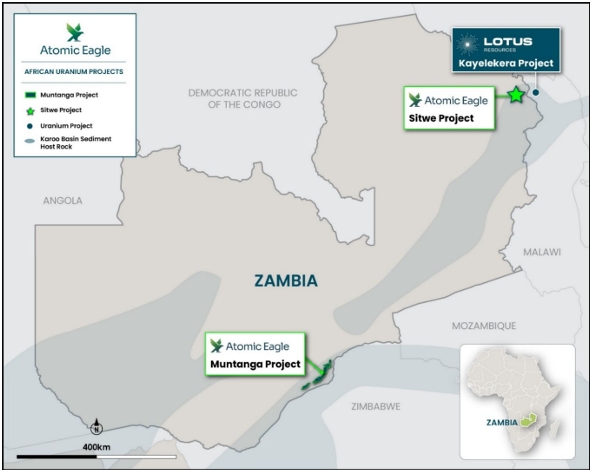
Location of Sitwe Uranium Project.
Low-cost entry strategy
The company has entered into a binding option agreement that gives it the right to acquire 100% of the project through its Zambian subsidiary. Under the terms, Atomic Eagle must spend at least US$200,000 on exploration and licence-related expenditure before June 30, 2027, after which it can exercise the option through a US$400,000 cash payment.
Chief executive officer Phil Hoskins said the transaction materially expanded the company’s exploration position in Zambia while maintaining a disciplined approach to growth.
“The addition of the Sitwe Uranium Project materially expands Atomic Eagle’s uranium footprint in Zambia and further consolidates our position as a leading uranium explorer and developer in the country,” Hoskins said.
“Sitwe complements our flagship Muntanga Project by adding a large, prospective licence position in a highly endowed basin, with encouraging historical results and clear potential for further discovery,” he added.
“Importantly, the option structure allows us to advance this opportunity in a disciplined manner while maintaining flexibility as we continue to grow our broader uranium portfolio in Zambia.”
Historical drilling highlights shallow uranium mineralisation
The project comes with a modest amount of historical exploration completed by African Energy Resources Ltd between 2010 and 2012, including airborne radiometric surveys, mapping, trenching and limited drilling.
At the most advanced prospect, Sitwe North, all seven historical drill holes intersected uranium mineralisation. Reported shallow intercepts included:
- 1 metre at 1,620ppm U₃O₈ from 35 metres;
- 1 metre at 1,080ppm from 42 metres;
- 6 metres at 735ppm from 61 metres; and
- 5 metres at 566ppm from 7 metres.
The drilling identified uranium mineralisation hosted within sheared feldspathic gneisses near the unconformity between older basement rocks and younger Karoo sediments. The mineralised horizons were tested over about 450 metres of strike and remain open in both directions and at depth.
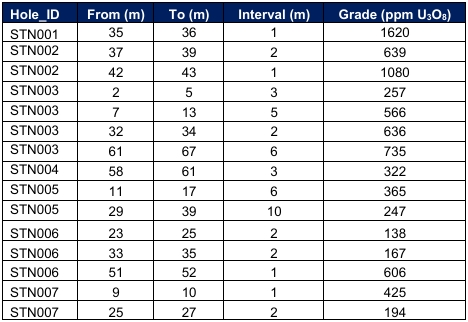
Significant drill hole intercepts from Sitwe North.
Atomic Eagle said the broader licence area remains largely underexplored, with several airborne radiometric anomalies still untested and large sections yet to undergo systematic radiometric surveying.
The company also sees additional potential in the Karoo Basin sedimentary rocks that occur across the southern portion of the licence area. Those rocks host uranium mineralisation elsewhere in the region, including at Atomic Eagle’s Muntanga deposit and Lotus Resources’ Kayelekera project in Malawi.
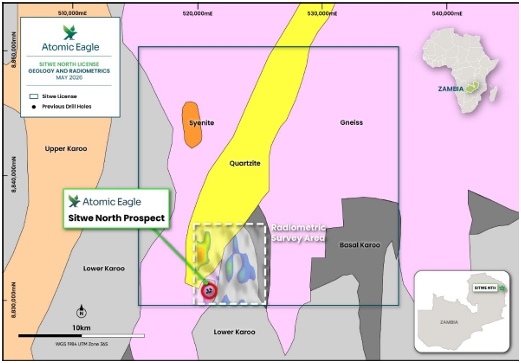
Sitwe licence area geology, showing location of drilling and other untested radiometric anomalies.
Building scale in Zambia
The Sitwe transaction continues Atomic Eagle’s broader push to establish a multi-asset uranium platform in Zambia amid strengthening long-term interest in nuclear energy and uranium supply security.
The company said the acquisition aligned with its strategy of consolidating highly prospective Karoo Basin geology while diversifying project risk across multiple basins and operating areas.
Sitwe also adds to the scale of the company’s existing Muntanga Uranium Project, where a 30,000-metre drilling campaign is already under way targeting resource growth. Further drill results from Muntanga are expected in coming weeks.
Muntanga currently hosts a combined resource of 58.8 million pounds of U₃O₈ across Measured, Indicated and Inferred categories, making it one of the larger uranium development projects on the ASX with a focus on Zambia.
Atomic Eagle said initial work at Sitwe would likely include mapping and ground radiometric surveys aimed at refining drill targets across the large licence area.