
AuKing Mining Ltd (ASX:AKN) is moving deeper into critical minerals, striking a deal to acquire the Tundulu Rare Earths Project in Malawi from Tusker Minerals Ltd (ASX:TSK) in a transaction valued at up to $5.55 million.
The acquisition, supported by a planned $3 million capital raise, gives AuKing control of a large, underexplored carbonatite-hosted rare earth elements (REE) system, while Tusker secures non-dilutive funding and retains exposure to future upside through equity in AuKing.
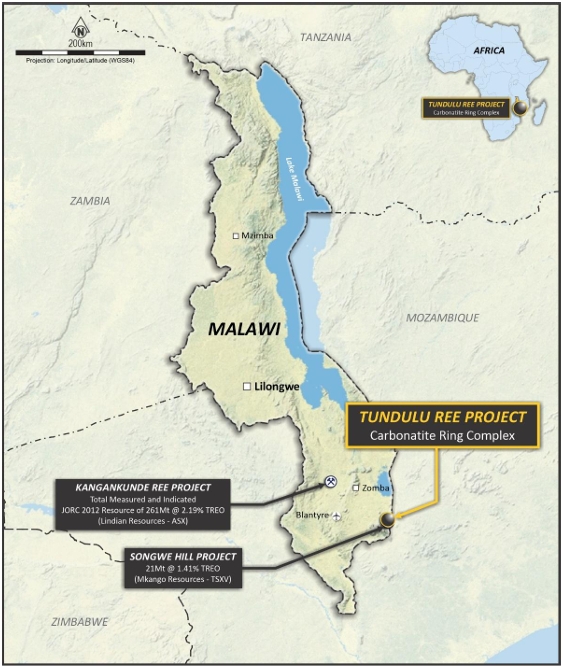
Tundulu Project location
“The proposed acquisition of the Tundulu Rare Earths Project represents a further exciting step in AuKing’s strategy to build exposure to critical minerals through high-quality exploration assets,” AuKing managing director Paul Williams said.
“Tundulu is a district-scale carbonatite ring complex in southern Malawi with an interesting profile of bastnaesite and apatite containing abundant rare earth mineralisation and easily accessible by road,” he added, noting that the company is targeting an initial mineral resource estimate within 12 months.
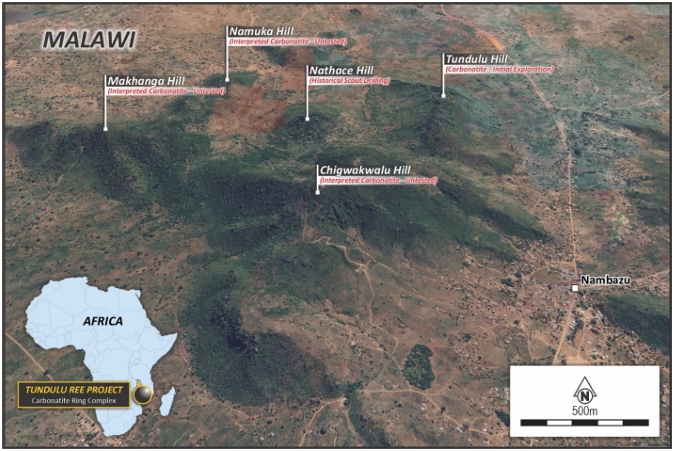
Google Earth view of Tundulu Hill and surrounding prospects, near the township of Nambazu.
Deal structure balances cash, equity and performance upside
Under the binding agreement, AuKing will acquire 100% of the Tundulu project through a staged consideration package combining cash, shares and performance rights.
The consideration includes:
- $50,000 non-refundable deposit (already paid);
- $1 million in cash at completion;
- $1.25 million in AuKing shares (subject to escrow);
- Two deferred cash payments of $1.1 million at six and 12 months; and
- $1 million in performance rights tied to a resource milestone.
The performance rights are linked to the delivery of a JORC-compliant resource of at least 25 million tonnes at 1.25% total rare earth oxide (TREO), aligning part of the deal value with exploration success.
Completion remains subject to standard conditions, including regulatory approval for licence transfer in Malawi.
Tusker pivots to mineral sands while keeping REE exposure
For Tusker, the divestment provides a funding boost expected to support exploration and development programs through 2026 without equity dilution.
The company plans to redirect capital towards its core rutile and heavy mineral sands (HMS) projects in Malawi and Cameroon, where it sees stronger near-term development potential.
At the same time, Tusker will retain exposure to Tundulu through its shareholding in AuKing and the performance-linked consideration, maintaining leverage to the rare earths sector without committing further capital.
Management described the move as a “disciplined capital allocation decision” following a strategic review of its Malawi REE assets.
Large, underexplored REE system with historical scale
The Tundulu project is a 5-kilometre-diameter carbonatite complex in southern Malawi, recognised as one of the larger and less explored rare earth systems in the region.
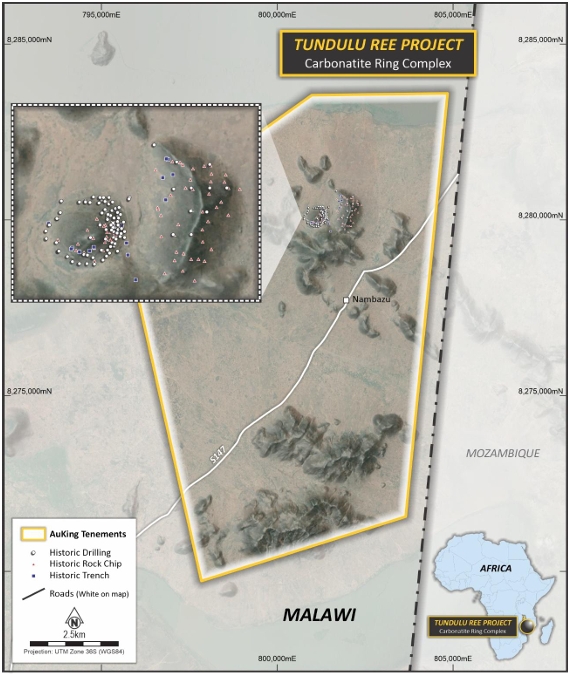
Map of historical drilling at Tundulu – Note the drillholes are from the JICA drilling in 1987 and Mota-Engil/Optichem drilling in 2014-15, the rock ships by JICA, and the DY6/Tusker trenching further details of which are set out in Appendix C.
Historical drilling — originally targeting phosphate — has highlighted consistent high-grade REE mineralisation, including:
- 41 metres at 3.7% TREO from 8 metres;
- 35 metres at 2.7% TREO, including 14 metres at 4.1% TREO;
- Multiple intercepts above 2% TREO, with several holes ending in mineralisation.
The project sits within an emerging rare earths district, near Lindian Resources Ltd (ASX:LIN, OTC:LINIF)’s Kangankunde Project and Mkango Resources Ltd (AIM:MKA, TSX-V:MKA, OTC:MKNGF)’s Songwe Hill project, both considered globally significant REE assets.
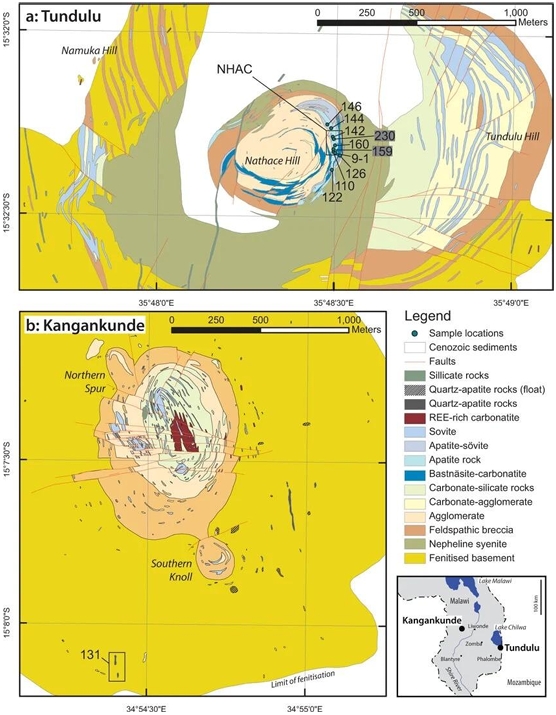
Geological maps of Tundulu and Kangankunde (owned by Lindian ~A$1.68b), Source – Broom-Fendley, Styles, Appleton, Gunn and Wall “American Mineralogist Vol 101, 2016”. Note – the samples shown in Figure 4a were taken by Appleton in 1988 and Broom-Findley in 2011 and are detailed on pages 620, 603 and 607 of that Report.
Mineralisation is interpreted to be rich in valuable heavy and medium rare earth elements, with relatively low uranium and thorium levels — a favourable characteristic for downstream processing.
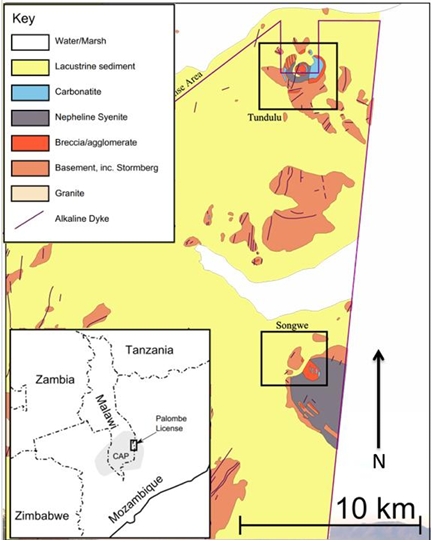
Geological maps of Tundulu and Songwe Hill (owned by Mkango ~A$308m), Source – Broom-Fendley et al “2013/Sweden August 2013 SGA Conference Extracts.”
AuKing to fast-track exploration and resource definition
AuKing plans to move quickly once the acquisition completes, targeting an initial drilling program and aiming to define a maiden resource within 12 months.
Early work will also include airborne geophysics and structural mapping to refine drill targeting across multiple prospective zones within the broader system.
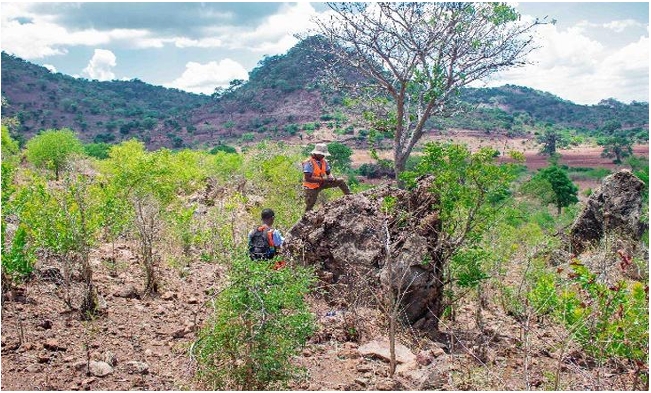
Tundulu Hill geological setting enriched with carbonatite outcrops and Nathace Hill in the background.
The acquisition forms part of a broader diversification strategy for AuKing, which already holds assets spanning uranium exposure in Tanzania, copper-zinc in Western Australia and tin-tungsten in Tasmania.
Capital raise to fund acquisition and drilling
To support the transaction and upcoming work programs, AuKing has secured commitments to raise about $3 million from institutional and sophisticated investors.
Funds will be directed towards:
- Completing the Tundulu acquisition;
- Funding initial exploration and drilling at the project; and
- Supporting broader exploration across its portfolio.
Strategic reset on both sides
The transaction highlights diverging but complementary strategies.
AuKing is stepping further into the rare earths space with a project that already carries geological scale and historical results, while Tusker is consolidating its focus on mineral sands and titanium feedstocks.
With capital in place and drilling planned, the focus for AuKing now shifts to turning historical results into a defined resource — and establishing Tundulu’s place within Malawi’s emerging rare earths corridor.