
Lindian Resources Ltd (ASX:LIN, OTC:LINIF) has begun a Stage 2 resource definition drilling and mine geotechnical program at its Kangankunde Rare Earths Project in Malawi, aiming to lift resource confidence and support potential expansion planning.
The program is designed to convert approximately 20–40 million tonnes of existing Inferred Mineral Resource material to Indicated classification within the current resource footprint, subject to drilling outcomes and Competent Person review. Work is focused beneath and around the edges of the current Indicated Resource, targeting areas expected to fall within a potential Stage 2 mine design.
Drilling is now under way using two diamond core rigs operating day and night shifts and one reverse circulation (RC) rig on day shift. The program totals around 3,400 metres of diamond drilling and 2,700 metres of RC drilling, alongside a dedicated mine geotechnical drilling and study program intended to support expanded pit design criteria.
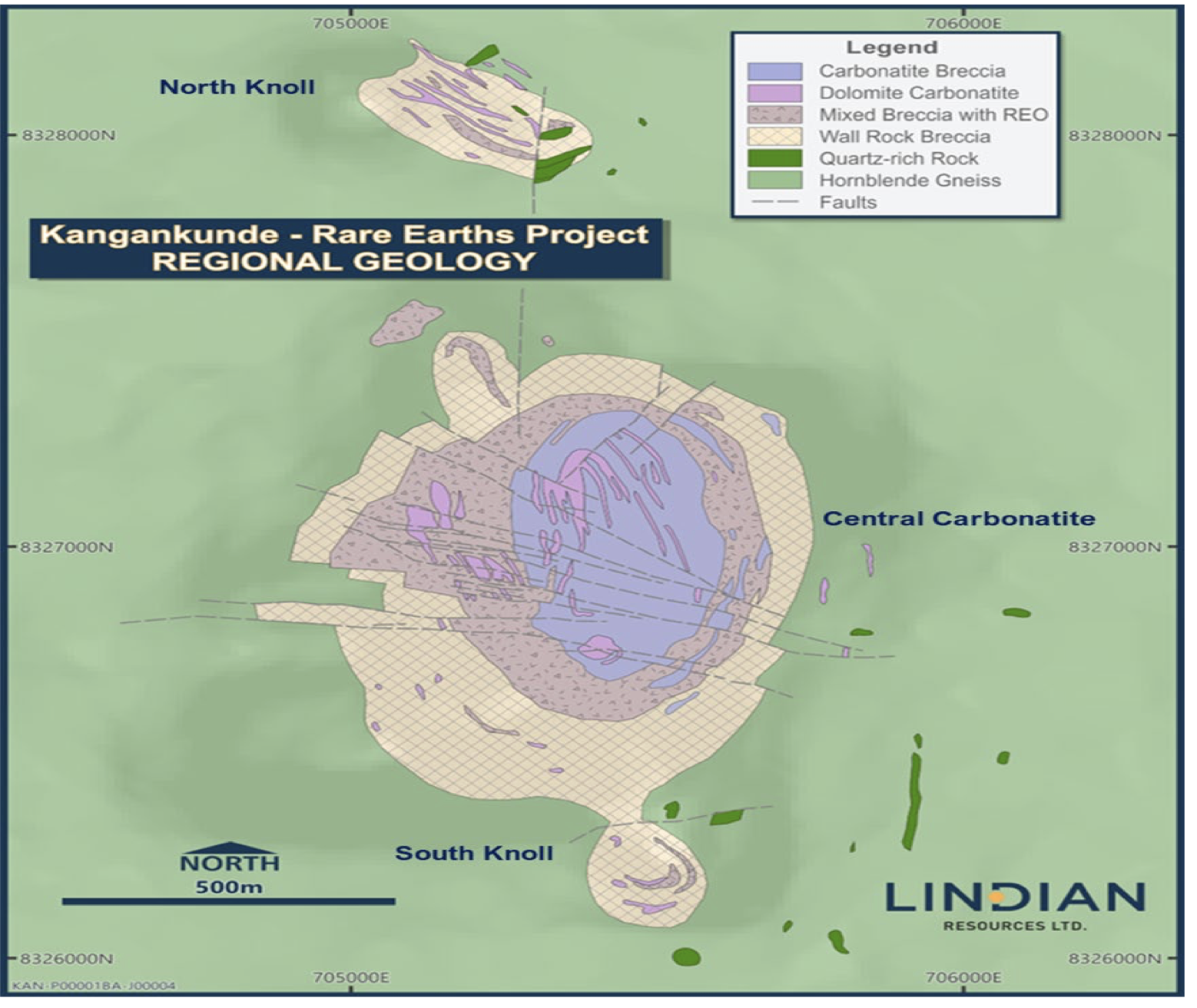
Kangankunde Regional Geology interpreted carbonatite complex highlighting the Central Carbonatite and North/South Knolls, with mapped breccias, REO-bearing mixed breccia zones and major faults that inform Stage 2 drill targeting and pit expansion studies.
Lindian expects drilling to continue through April 2026. The company has flagged assay turnaround by the end of May 2026 and is targeting an updated resource model by the end of June 2026.
“Stage 2 is about scale and mine life, and that starts with confidence in the resource model and the design inputs that sit behind it," Lindian Resources executive director Zac Komur said. "This program is focused on the parts of the orebody most likely to define the Stage 2 expansion case, converting targeted Inferred material to Indicated where the drilling supports it, and completing the geotechnical work required for robust pit design. Stage 2 is fully permitted and this current drilling will help define our speed to move to stage 2 production. We will update the market as assays are received and the model work is finalised and Stage 2 study work progresses.”
Stage 2 focus on resource confidence and pit design
The Stage 2 campaign is intended to tighten spacing and improve geological confidence in zones where the company requires greater certainty in continuity and grade distribution to underpin mine scheduling and pit design parameters.
Lindian’s stated objective is to define a Stage 2 pit design and associated mine scheduling scenario, centred on conversion of material already within the broader mineralised envelope rather than step-out drilling aimed at expanding the overall footprint.
In parallel, the mine geotechnical program is expected to generate additional inputs for pit wall design and other expanded pit design criteria, which are typically required as studies move from concept-level design to more detailed mine planning.
Throughput expansion case linked to monazite output
The Stage 2 work is being carried out as Lindian considers the next phase of development options at Kangankunde, including an expansion case that would lift throughput to 4 million tonnes per annum (Mtpa) of ore.
Under the stated Stage 2 goal, Lindian is assessing a scenario that could produce an additional 100,000 tonnes per annum (tpa) of monazite concentrate from the project. The company framed the drilling and geotechnical work as key inputs into evaluating that expanded pit design and production profile.
Geological setting and drilling targets
Kangankunde is a carbonatite-hosted rare earth system located within fenitised (alkali-metasomatised) gneiss country rock. Lindian described the complex as comprising a main oval-shaped “Central Carbonatite” body with outlying or connected smaller bodies or spurs referred to as the North and South Knolls.
The system is interpreted to exhibit concentric zoning, from a carbonate-rich core outward through breccias and feldspathic fenite units, a geological framework that commonly requires detailed drilling density to support confidence in grade distribution and continuity across mine scheduling domains.
Lindian said Stage 2 drilling will target areas where additional confidence is needed to support pit design and scheduling within and adjacent to the current resource envelope. The company is expected to provide further updates as drilling progresses and results are received.