
AuKing Mining Ltd (ASX:AKN) has agreed to acquire 100% of two tin and silver exploration licence applications in northwestern Tasmania, securing ground adjacent to the world-class Renison Bell tin mine at a time of strong prices and tightening global supply.
The proposed acquisition gives AuKing exposure to a district-scale landholding of around 203 square kilometres near the historic mining town of Rosebery, within one of Australia’s best-known tin provinces. The licence applications sit close to both the operating Renison Bell mine — jointly owned by Metals X and Yunnan Tin — and Critica Ltd’s undeveloped Mt Lindsay tin project.
Tin prices have surged over the past five years, with the London Metal Exchange price sitting around US$55,000 per tonne — more than five times higher than levels from just five years ago — reflecting strong demand and limited new supply. AuKing said the transaction provides a rare opportunity to secure high-grade tin exposure in a well-established Australian mining jurisdiction.
Managing director Paul Williams said the company was pleased to secure the licences amid rising interest in tin exploration and development.
“With very few new tin projects around the world, this kind of high-grade, potentially high-value opportunity in a well-known Australian mining district is relatively rare,” Williams said.
“Upon completion of the acquisition, AuKing will seek to have the licences granted as soon as possible and, in the meantime, commence preparatory work on proposed exploration activities.”
Strategic location near world-class assets
The licence applications, ELAs 22/2025 and 23/2025, are located in northwestern Tasmania within trucking distance of established infrastructure and benefit from excellent access via sealed and well-maintained roads, AuKing noted.
The surrounding region hosts the Renison Bell mine, with about 292,000 tonnes of contained tin, as well as the Mt Lindsay project, which holds an estimated 81,000 tonnes of tin and 32,000 tonnes of tungsten oxide.
AuKing said the area has a long history of tin production but remains underexplored using modern techniques, offering potential for new discoveries.
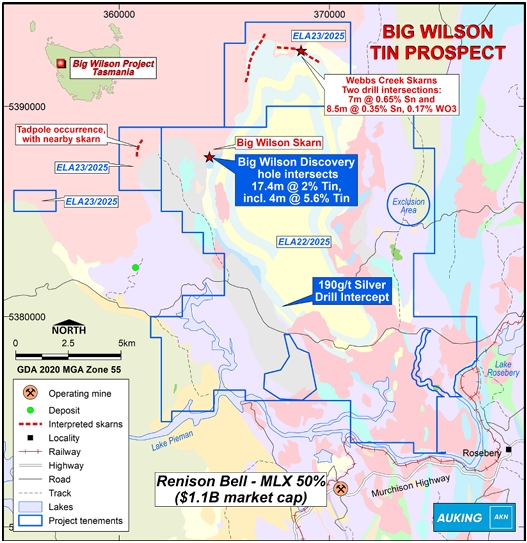
Location Diagram illustrating both EL applications 22/2025 and 23/2025 and proximity to Renison Bell and Rosebery township.
High-grade tin intersections at Big Wilson
One of the key prospects within the licence application area is Big Wilson, where historical drilling by Venture Minerals intersected high-grade tin mineralisation associated with greisen and skarn systems.
A maiden drill hole at the prospect, BW001, returned 17.4 metres at 2.0% tin from 209.6 metres, including a higher-grade interval of 4 metres at 5.6% tin. The hole intersected about 32 metres of greisen with quartz-cassiterite veining, along with skarn-style mineralisation containing tin, tungsten and minor copper.
Greisen-hosted tin systems are found in several major tin provinces globally, including Cornwall in the UK and the Erzgebirge region of Germany and the Czech Republic. In Tasmania, similar styles of mineralisation are present at the historic Mt Bischoff tin deposit.
A total of 13 holes were drilled historically at Big Wilson, testing both northern and southern zones, with multiple mineralised intersections reported.
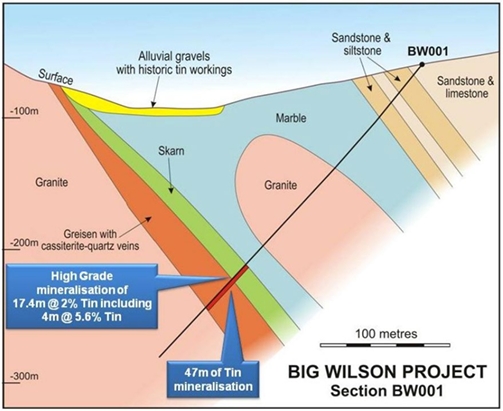
Big Wilson Discovery Hole (BW001) Cross-Section.
Additional targets: Merton Hill and Laurel Creek
Further south, the Merton Hill prospect was explored intermittently in the late 20th century, with Renison Ltd drilling beneath early 1900s workings. That program identified tin, lead, zinc and silver mineralisation, including intersections of up to 3 metres at 0.19% tin with elevated base metals and silver.
At Laurel Creek (also known as Webb’s Creek), historical drilling by Gold Fields Exploration in the 1980s confirmed the presence of tin- and tungsten-bearing magnetite skarns, with shallow intersections including 7 metres at 0.65% tin.
AuKing emphasised that all exploration results referenced are historical in nature, have not been reported under the JORC 2012 Code, and have not yet been independently verified by the company.
Acquisition terms and next steps
AuKing will acquire the assets via the purchase of Goldtrace Exploration Pty Ltd, which holds 100% of the two licence applications. The company will pay a non-refundable A$25,000 fee on signing and conduct a 30-day due diligence review.
Subject to shareholder approval, AuKing will issue approximately 143 million shares at an issue price of 0.35 cents to Goldtrace shareholders, representing a purchase price of A$500,000.
While the company intends to prioritise exploration planning for the Tasmanian licences once granted, it said it will continue assessing activity across its broader portfolio, including planned uranium drilling at its Mkuju project in Tanzania.