
Critical Resources Ltd (ASX:CRR, FRA:9S70) is preparing to kick off a new field exploration program at the Corona Pegmatite Field in Ontario, Canada, targeting a largely underexplored lithium corridor that could extend the scale of its flagship Mavis Lake project.
The program, set to begin following seasonal snow melt, will focus on a roughly 5-kilometre strike of prospective LCT (lithium–caesium–tantalum) pegmatites located about 4 kilometres north of the existing Mavis Lake Mineral Resource.
Early work has already identified wide pegmatite bodies — up to around 70 metres across — within the same geological corridor that hosts Mavis Lake’s current 8-million-tonne resource grading 1.07% lithium oxide (Li₂O).
“Mavis Lake has the potential to evolve from a single-deposit asset into a multi-deposit lithium district. Corona has the potential to be a key part of that story,” Critical Resources managing director Tim Wither said.
“As we advance systematic fieldwork across this trend, we see a significant opportunity to define new drill targets and further support the development of Mavis Lake as a broader lithium district.”
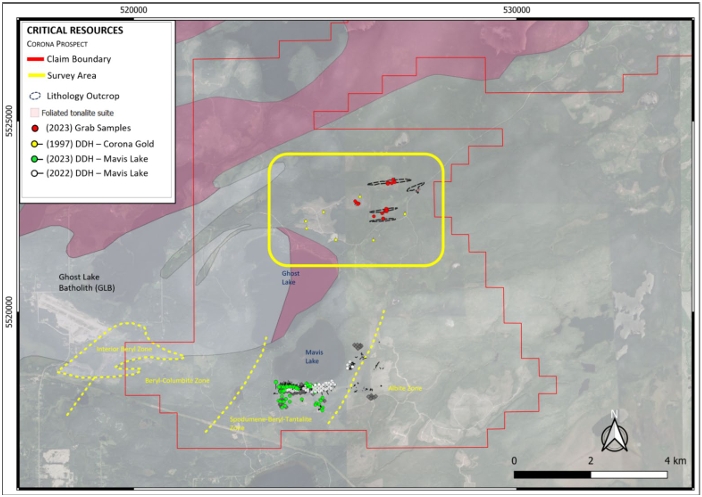
Corona Pegmatite Field with traced out pegmatites and historical drill collar locations shown in yellow. The target area lies within the interpreted Spodumene-Beryl-Tantalite Zone trend.
Building the next wave of drill targets
The upcoming program will centre on systematic surface mapping, prospecting and geochemical sampling, designed to generate drill-ready targets ahead of a broader 2026 exploration push.
Critical Resources has engaged an experienced field crew familiar with the project, with mobilisation expected in late April. Initial geochemical results are anticipated in late Q2 2026 and will help prioritise follow-up drilling targets.
Importantly, the work builds on an extensive dataset already assembled across Mavis Lake, including lithogeochemistry, LIBS-based pegmatite fractionation and high-resolution aeromagnetic surveys.
That integrated approach is expected to sharpen targeting across the Corona trend, particularly given the limited outcrop exposure across the area due to overburden and wetlands — a setting that can mask underlying spodumene-bearing systems.
Expanding a district-scale lithium strategy
Corona forms part of a broader push across the Northern Prospects at Mavis Lake, where the company is advancing multiple targets in parallel to support long-term resource growth.
These include the Gullwing pegmatite — already defined by an exploration target of 7 million–10 million tonnes at 0.3–1.2% Li₂O — alongside other prospects such as Tot, Little Wing, Coates and Drope.
Together, these targets underpin a strategy to build a pipeline of deposits rather than relying solely on the existing Mavis Lake resource, which sits close to infrastructure in northwestern Ontario and remains open to expansion.
The broader project also carries a conceptual exploration target of 18 million–29 million tonnes at 0.8–1.2% Li₂O, highlighting the scale of the opportunity across the wider landholding.
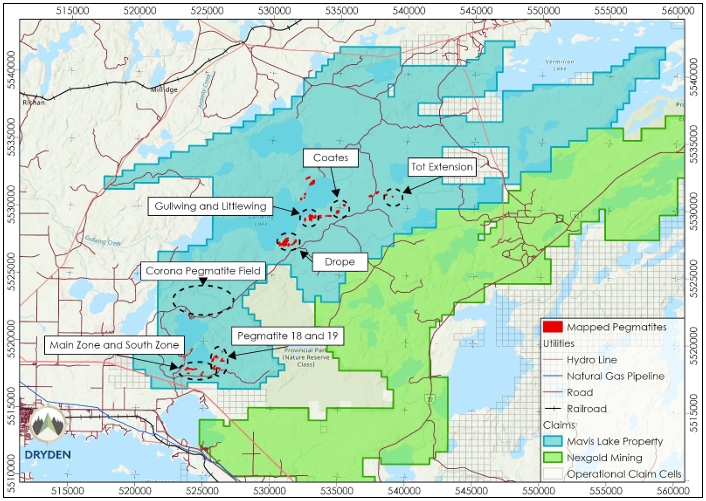
Mavis Lake Property Map with regional targets that require further exploration works.
Momentum building across the portfolio
The latest field program follows a series of developments across Critical Resources’ portfolio in recent months.
The company has recently secured key approvals to expand gold exploration activities in New Zealand, while also flagging high-grade tungsten potential as part of its growing exposure to critical minerals beyond lithium.
At Mavis Lake, the focus remains firmly on growing the resource base and advancing multiple targets towards drilling, with Corona now emerging as a potentially important piece of that pipeline.
With fieldwork about to begin, the coming months are expected to deliver new geochemical data and refine targets — setting the stage for the next phase of drilling across what the company sees as a developing lithium district.