
Critical Resources Ltd (ASX:CRR, FRA:9S70) has reported exceptional historical tungsten grades of up to 42.6% WO₃ at its Croesus Project in New Zealand, as the company begins field exploration across its recently secured permits in the Otago and Reefton regions.
The headline result comes from historical sampling at the Croesus Project, where scheelite-rich quartz rubble returned grades of up to 42.6% WO₃, equivalent to 337,642ppm tungsten. Additional float samples graded 26.6% and 19.9% WO₃, reinforcing the presence of a potentially significant high-grade system.
The mineralisation is interpreted to be part of a greisen-hosted tungsten system associated with granitic intrusions — a recognised geological setting for high-grade tungsten deposits globally. Supporting this, greisenised granites in the project area have returned values of up to 0.9% WO₃, suggesting a potential bedrock source to the high-grade surface material.
Importantly, the Croesus area has seen only limited modern exploration despite these standout historical results. Initial work will focus on mapping the extent of greisen alteration, confirming tungsten sources and conducting systematic geochemical sampling across granite margins and structural corridors.
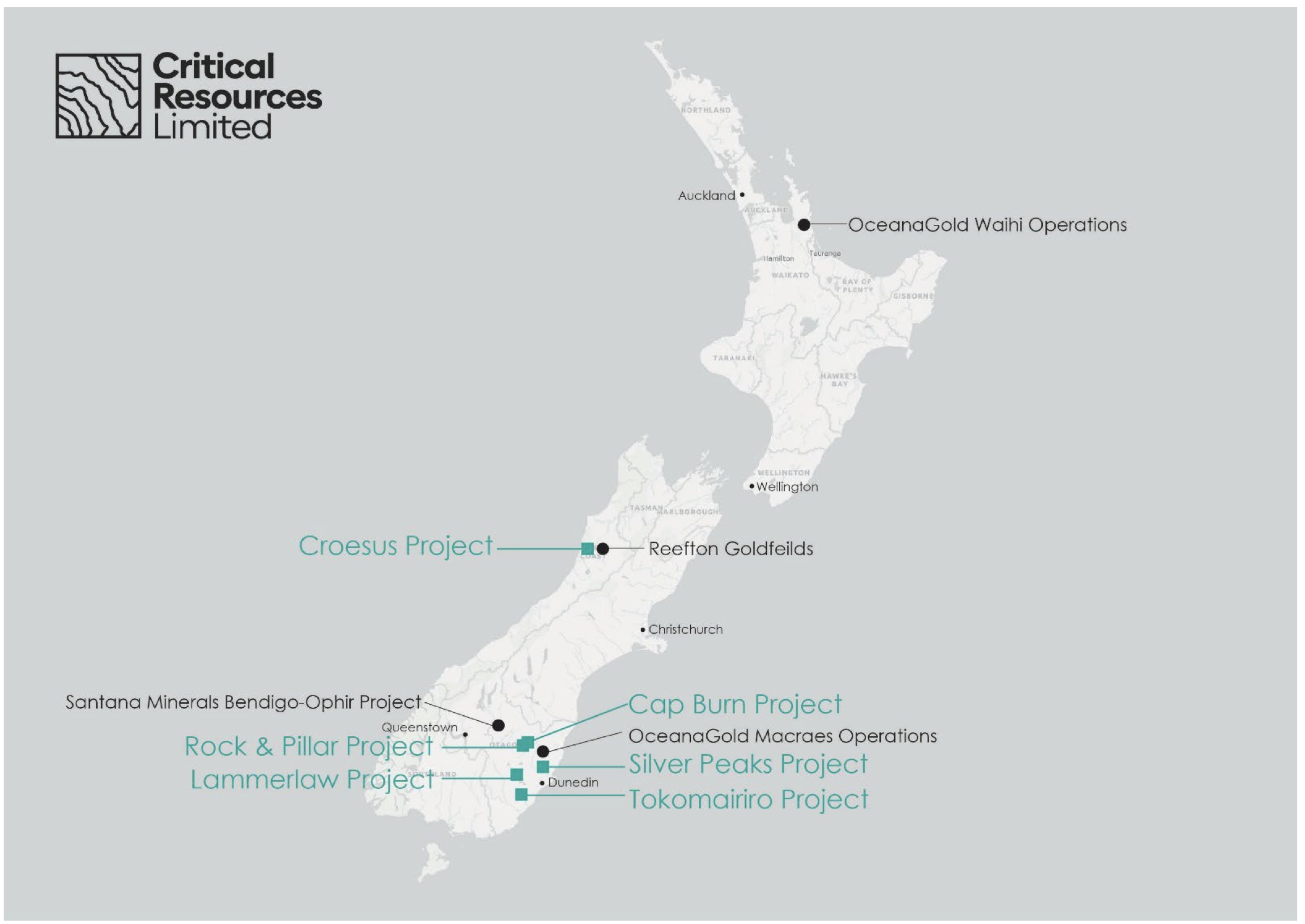
Location of Critical Resources’ New Zealand gold projects with major gold mining projects.
"Receiving approval for the transfer of our New Zealand permits and having the field team at Lammerlaw within days reflects the pace we have committed to in New Zealand," Critical Resources managing director Tim Wither said.
"The high-grade tungsten samples from the Croesus project are a standout. Croesus is where the field team heads next. The gold-antimony trend at Garden Gully and Croesus Reef is a priority target, with historical production at grades up to 17 g/t Au and legacy rock chips returning up to 28.9 g/t Au and 7.4% Sb over a corridor extending more than 5 kilometres along strike."
Tungsten price surge underpins strategic appeal
The timing of the exploration push coincides with a sharp rise in tungsten prices, which have surged from around US$335 per metric tonne unit (MTU) in January 2025 to between US$2,100 and US$2,400/MTU as of March 2026.
This increase has been driven largely by tightening supply conditions, particularly following Chinese export restrictions introduced earlier this year. China currently accounts for around 82% of global tungsten supply, leaving Western economies increasingly exposed to supply chain risks.
At the same time, demand for tungsten continues to grow across defence, semiconductor, energy and advanced manufacturing sectors, where the metal’s hardness and heat resistance are critical.
With tungsten now formally designated as a critical mineral by several Western governments, including the US, EU and Australia, new supply sources in stable jurisdictions are attracting increasing attention. In this context, New Zealand’s historical tungsten production and favourable regulatory environment position it as an emerging strategic supplier.
"Tungsten and antimony are formally designated critical minerals by Western governments, with China controlling the majority of global supply. New Zealand is an increasingly strategic jurisdiction for critical minerals development. With 1,694 km² of highly prospective ground firmly under our control in a Tier-1 jurisdiction, the New Zealand portfolio represents a compelling early-stage gold and critical minerals opportunity," Wither said.
New Zealand exploration ramps up
Critical Resources has now transitioned its New Zealand portfolio into active exploration following permit approvals, with fieldwork underway at the Lammerlaw Gold Project and Croesus next in line.
The company controls a substantial 1,694km² landholding across two highly prospective regions, targeting both gold-antimony systems and critical minerals including tungsten.
At Lammerlaw, work is focused on structurally controlled gold systems, with historical results including rock chips up to 2.72g/t gold and tungsten anomalies of up to 340ppm in stream sediments. While primarily a gold target, the presence of tungsten and antimony highlights a broader mineral system.
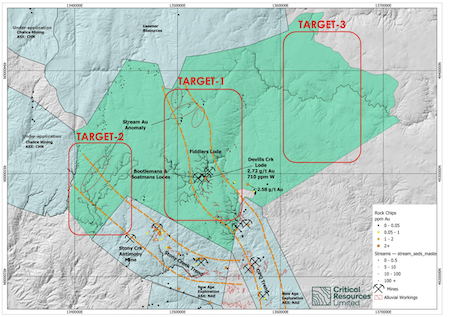
Lammerlaw permit showing locations of prospect targets and historic mine workings.
At Croesus, exploration will target both the high-grade tungsten system and a parallel gold-antimony trend extending over more than 5 kilometres, where historical production exceeded 4,500 ounces at grades of up to 17 grams per ton (g/t) gold.
Field programs will include mapping, rock chip and soil sampling, as well as validation of historical targets, with initial results expected from Lammerlaw in May and Croesus later in the June quarter.
With modern exploration yet to be systematically applied, upcoming fieldwork will be key in determining whether these high-grade surface results translate into a coherent and scalable tungsten system.
What's next?
- Lammerlaw: First-pass geological mapping and rock and stream sampling is underway across the Devils Creek and Stony Creek target areas. Water sampling will also be conducted to test for arsenic anomalism. Field data will be integrated with desktop studies to refine priority targets, with initial geochemical results expected in May 2026, subject to laboratory turnaround times.
- Croesus: Field work is set to commence following completion of the Lammerlaw program, targeting both the gold-antimony lode system and greisen-hosted tungsten mineralisation. Planned activities include structural mapping, rock chip and soil sampling, and validation of geophysical and historical targets, with results expected in Q2 2026.
- Cap Burn / Rock and Pillar: First-pass RC drilling has confirmed structurally controlled gold mineralisation within TZ4 schist beneath the Cap Burn Fault, consistent with the Rise and Shine model. The down-plunge extension remains open and is the focus of a follow-up RC drill program currently being designed. Ongoing soil geochemistry mapping is assessing strike continuity along the Cap Burn Fault and into the adjacent Rock and Pillar permit ahead of further drilling.