
Critical Resources Ltd (ASX:CRR, FRA:9S70) has confirmed a structurally controlled orogenic gold system at its Cap Burn project in New Zealand, with first-pass reverse circulation (RC) drilling validating its exploration model and highlighting clear upside at depth.
The 12-hole program intersected broad zones of gold mineralisation associated with the Cap Burn Fault, part of a regionally significant structural corridor in the Otago Schist Belt, around 11 kilometres from OceanaGold’s Macraes operation.
“These are encouraging first-pass results that validate our Cap Burn exploration model,” Critical Resources managing director Tim Wither said. “Broad gold mineralisation with strong arsenic-gold association beneath the fault is exactly the geochemical signature we were targeting — and several holes were still in mineralisation when we had to stop drilling.”
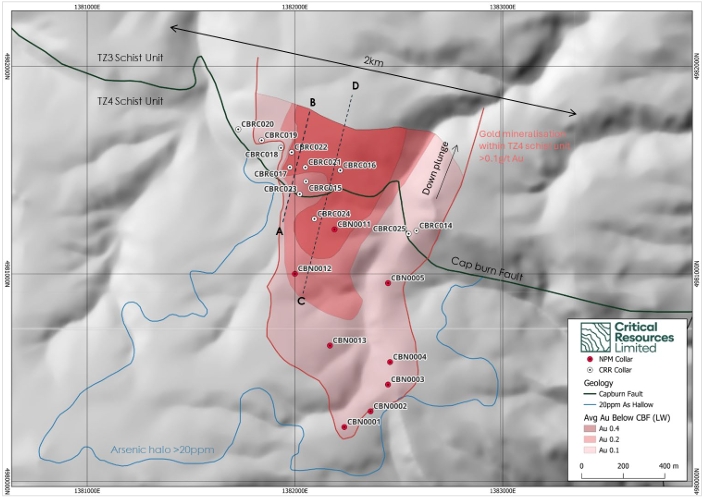
Cap Burn Project – Drill Collar Locations, Gold Mineralisation and Arsenic Anomaly. Plan view showing completed drill collars (white) and legacy drill collars (red) relative to the Cap Burn Fault (green), with gold mineralisation footprint (red shading) derived from drilling. The blue outline defines the outer boundary of the arsenic-in-soil anomaly (>20 ppm As), with a higher-intensity core anomaly (>150 ppm As) spatially associated with the Cap Burn Fault and the defined mineralisation. Mineralisation remains open along strike.
Broad mineralised system confirmed
Drilling has outlined a coherent mineralised footprint hosted within the TZ4 schist unit, with results including:
- 7 metres at 0.37 g/t gold from 65 metres, including 1 metre at 1.29 g/t (CBRC017)
- 16 metres at 0.22 g/t gold from 46 metres (CBRC021)
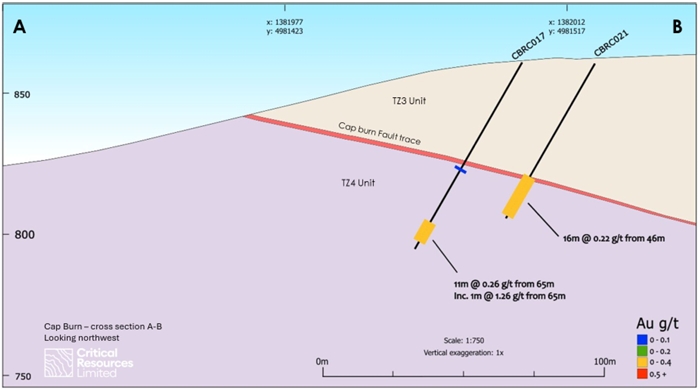
Cap Burn Cross Section A-B (-/+ 50m window) showing gold mineralisation beneath the Cap Burn Fault - looking northwest.
Several holes ended in mineralisation due to groundwater and rig depth limits, reinforcing that the system remains open at depth.
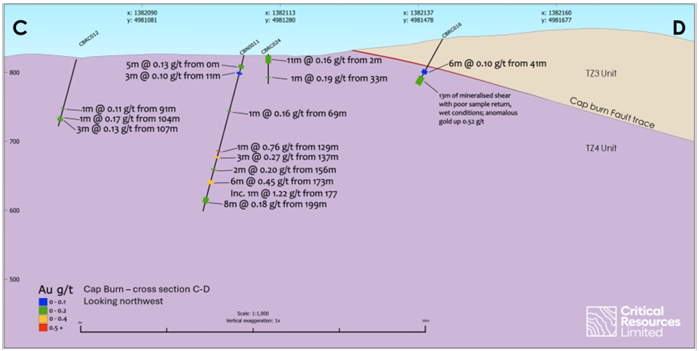
Cap Burn Cross Section C-D (-/+ 50m window) showing broadly distributed gold mineralisation within the TZ4 schist unit.
Importantly, gold mineralisation shows a consistent association with elevated arsenic, forming a geochemical footprint exceeding 1 square kilometre. This arsenic anomaly provides a clear vector for further targeting along the Cap Burn Fault corridor.
The company said the results are analogous to the early-stage signature seen at Santana Minerals’ Rise and Shine discovery, where initial broad, low-grade intersections preceded higher-grade zones identified further down-plunge.
District-scale potential emerging
Cap Burn sits within a ~10-kilometre structural corridor that remains largely untested, with current drilling covering only a small portion of the system.
Geological interpretation suggests mineralisation is distributed across a broad shear-hosted structural package rather than confined to a single discrete zone — a characteristic typical of early-stage orogenic systems.
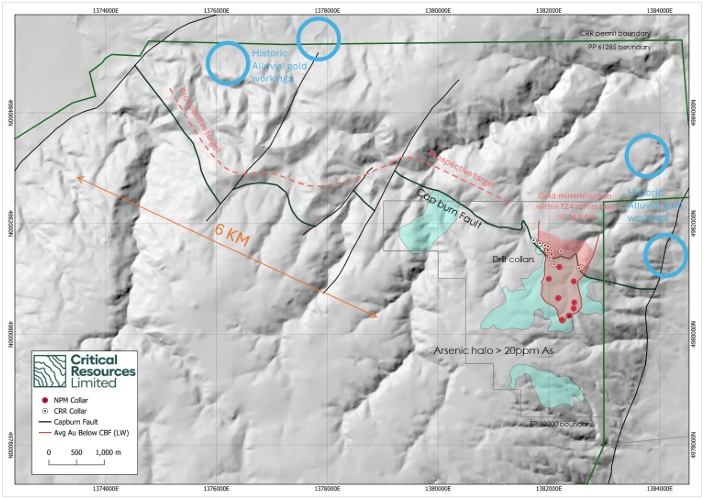
Cap Burn Regional Structural Setting and Strike Extent of the Cap Burn Fault. Plan view showing the interpreted trace of the Cap Burn Fault across the project tenure, highlighting the limited extent of current drilling relative to the overall strike length of the structure. Existing drilling and defined mineralisation represent a small portion of the broader prospective corridor.
The project’s location within the Otago Schist Belt, which hosts major deposits including Macraes and Bendigo–Ophir, further supports its prospectivity.
Critical Resources has been building its New Zealand gold portfolio alongside other assets, recently flagging fresh targets at its Lammerlaw project and outlining district-scale potential at Halls Peak in New South Wales.
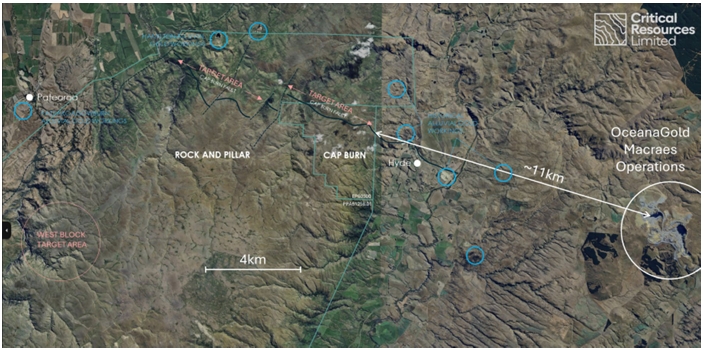
Cap Burn Project location ~11km from OceanaGold Macraes Gold Operations with major and minor interpreted structures (black lines)and historic alluvial gold workings (blue circles)(Google Earth image).
Clear path to follow-up drilling
With mineralisation confirmed and remaining open, the next phase of work will focus on testing down-plunge extensions beneath the Cap Burn Fault — considered the primary target.
Planned activities include:
- Step-out drilling along strike and at depth
- Deeper drilling below current intercepts
- Expanded soil geochemistry surveys to refine arsenic anomalies
- Detailed structural mapping to target higher-grade zones
Drilling depth in the initial program was limited to around 60 metres, meaning the core target zone remains largely untested.
“The down-plunge zone beneath the Cap Burn Fault remains untested, and there are some encouraging grade vectoring into a narrower search area,” Wither said.
Portfolio breadth supports exploration strategy
The Cap Burn results add to Critical Resources’ broader exploration and battery program push across multiple commodities and jurisdictions.
Alongside its New Zealand gold assets, the company continues to advance its Mavis Lake lithium project in Canada and has recently reported progress in battery technology development, including electrolyte breakthroughs aimed at solid-state batteries.
With a confirmed mineralised system, a large-scale structural setting and clear next steps, Cap Burn now moves into a more targeted phase of exploration aimed at unlocking higher-grade zones within the broader system.