
Imugene Ltd (ASX:IMU, OTC:IUGNF) has reported further positive clinical data from its Phase 1b trial of azer-cel, an allogeneic, off-the-shelf CD19 CAR T therapy, in patients with relapsed or refractory diffuse large B-cell lymphoma (DLBCL).
The overall response rate (ORR) —the proportion of patients achieving either a complete or partial response — has now increased to 81% following two new partial responses and a patient transitioning from partial to complete response at their 90-day scan. This is up from the 79% rate reported in August and brings total responses to 13 out of 16 patients, comprising seven complete responses (CRs) and six partial responses (PRs).
Read more: Imugene posts 79% overall response rate in azer-cel Phase 1b trial
Durable outcomes in high-need patients
The company noted that all patients enrolled had failed at least three prior lines of therapy, with many having received four to six regimens, including autologous CAR T. Despite this, one patient dosed in early 2024 remains cancer-free more than 17 months later, with others showing ongoing responses at four, five, eight and 13 months and counting.
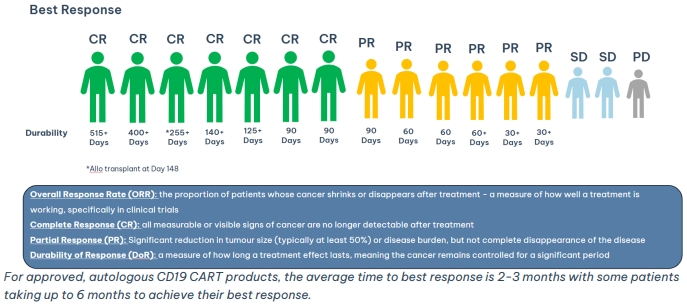
The trial is evaluating azer-cel in combination with interleukin-2 (IL-2), which enhances CAR T-cell survival and activity. Imugene said the safety profile remains manageable and generally well tolerated.
The company said the results reinforce the potential of azer-cel as an off-the-shelf CAR T therapy, with response rates continuing to deepen as the trial progresses.
Trial expansion and next steps
Imugene is actively enrolling patients at 10 sites across the US, with up to six Australian sites planned. The first Australian patient, treated at Sydney’s Royal Prince Alfred Hospital earlier this year, achieved a complete response.
The Phase 1b study has also expanded to enrol CAR T-naïve patients across a broader range of non-Hodgkin’s lymphomas, including:
- Primary central nervous system lymphoma (PCNSL), which currently has no approved CAR T therapies;
- Chronic lymphocytic leukemia (CLL)/small lymphocytic lymphoma (SLL);
- Marginal zone lymphoma (MZL);
- Waldenström macroglobulinemia (WM); and
- Follicular lymphoma (FL).
“Treatment with azer-cel, lymphodepletion (LD) and IL-2 is showing promising results with evidence of meaningful clinical activity and durability of response,” Imugene said. “Additionally, the safety profile is manageable and generally well tolerated.”
Additional trial updates are expected in the coming months.
Addressing a large unmet need
DLBCL is the most common form of non-Hodgkin’s lymphoma, with about 160,000 global cases each year and 30,000 new cases in the US alone. Around 60% of patients relapse after currently approved autologous CAR T therapy, underlining the need for alternatives that are more accessible and durable.
Unlike autologous CAR T therapies, which require patient-specific cell manufacturing, azer-cel is designed as an “off-the-shelf” treatment — reducing manufacturing complexity and potentially making advanced CAR T therapies available on demand.
To support the continued development of azer-cel, Imugene in August secured A$2.42 million through a share purchase plan, adding to its resources for advancing the program.
Read more: Imugene raises A$2.42M in SPP to go towards azer-cel program
Beyond azer-cel, Imugene’s pipeline includes oncolytic virotherapy, B-cell vaccines and further CAR T programs targeting solid tumours, as the company works to build a broad portfolio of immuno-oncology assets.