
Imugene Ltd (ASX:IMU, OTC:IUGNF) has reported a 79% overall response rate (ORR) in its Phase 1b trial of azer-cel (azercabtagene zapreleucel), an allogeneic CD19 CAR T therapy for relapsed/refractory diffuse large B-cell lymphoma (DLBCL). The trial now shows six complete responses and five partial responses from 14 patients, including two newly evaluable cases.
In further good news, the first patient dosed in 2024 remains cancer free after 15 months, with other patients also showing durable responses beyond 3, 7, and 11 months. All participants had previously failed at least three lines of therapy.
The trial has now expanded to include CAR T-naïve patients with niche lymphoma subtypes, with updates expected in coming months.
Improved response rate in azer-cel trial
The improved ORR in Imugene’s ongoing Phase 1b trial of azer-cel follows the evaluation of two additional patients. As of July 2025, the company had recorded a 75% ORR, with nine out of 12 patients showing either a Complete Response (CR) — defined as the disappearance of all signs of cancer — or a Partial Response (PR), defined as a reduction in tumour size by at least 50%.
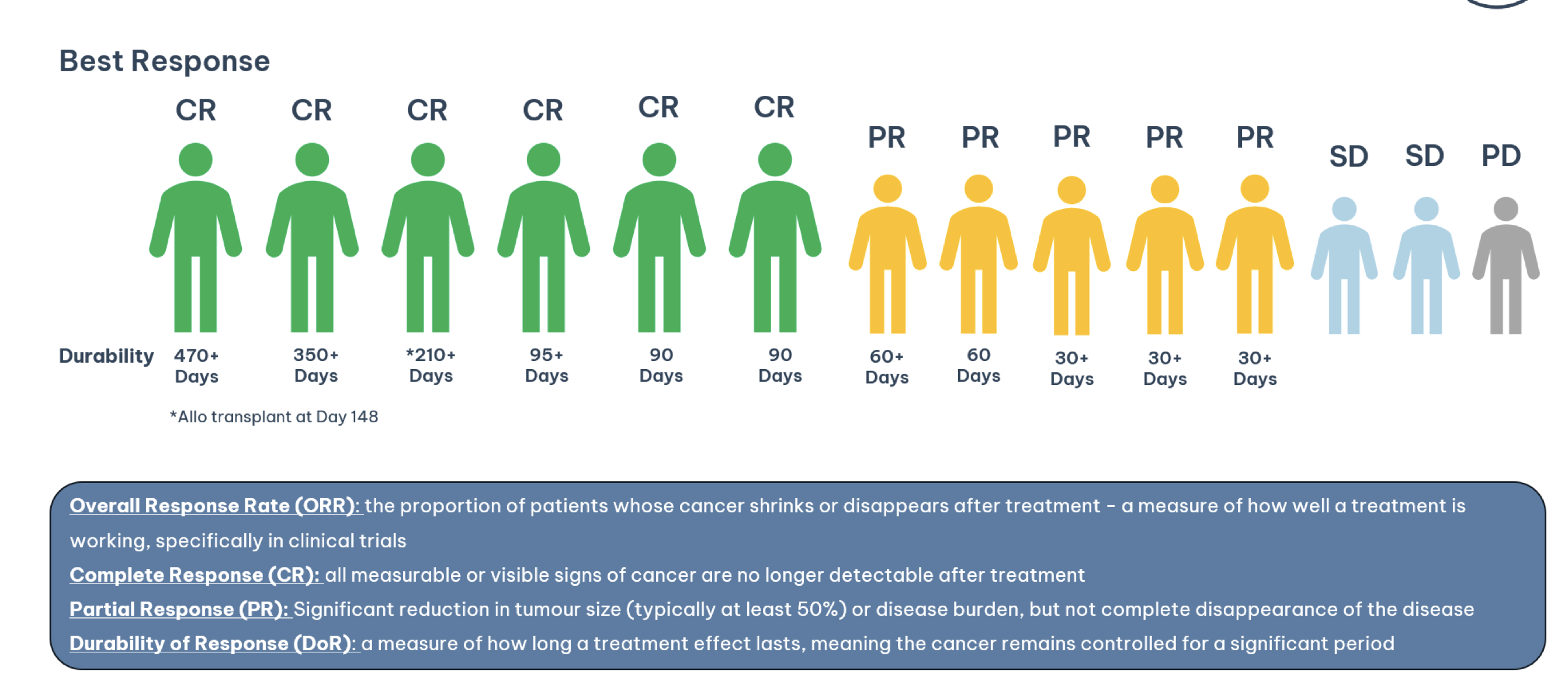
With two new evaluable patients both achieving a PR, the ORR has now increased to 79%, with 11 out of 14 patients responding to the combination treatment of azer-cel and interleukin 2 (IL-2). The duration of response is continuing to mature across the cohort.
Azer-cel is an allogeneic, off-the-shelf CAR T-cell therapy under development to overcome the limitations of currently approved autologous CAR T treatments, including delayed access, geographic barriers and manufacturing complexity.
The trial is actively enrolling at 10 clinical sites in the United States. Australian expansion is underway, with up to six sites planned. The first Australian patient was dosed in January 2025 at Royal Prince Alfred Hospital in Sydney and achieved a Complete Response.
About the Phase 1b azer-cel trial
The azer-cel allogeneic chimeric antigen receptor T-cell (CAR T) therapy is being assessed in an ongoing, open-label, multi-centre Phase 1b clinical trial across the United States and Australia.
Initially focused on CAR T-relapsed patients with diffuse large B-cell lymphoma (DLBCL), the study has recently broadened to include CAR T-naïve patients with a wider range of non-Hodgkin lymphoma (NHL) subtypes. These include primary central nervous system lymphoma (PCNSL), chronic lymphocytic leukemia (CLL)/small lymphocytic lymphoma (SLL), marginal zone lymphoma (MZL), Waldenström macroglobulinemia (WM) and follicular lymphoma (FL).
Treatment with azer-cel, lymphodepletion (LD), and interleukin 2 (IL-2) has so far demonstrated promising clinical activity and durable responses, with a manageable safety profile.
About diffuse large B-cell lymphoma (DLBCL)
DLBCL is the most prevalent and aggressive form of NHL, a type of blood cancer. Globally, around 160,000 new cases are reported each year, including approximately 30,000 in the United States. Despite the availability of autologous CD19 CAR T therapies, around 60% of treated patients relapse, underscoring the ongoing unmet need for more effective options in relapsed or refractory cases.
About primary central nervous system lymphoma (PCNSL)
PCNSL is a rare and aggressive subset of NHL, originating in the brain, spinal cord, leptomeninges or eyes, typically without systemic involvement.
In the United States, 1,500 to 1,800 new cases are diagnosed annually. With no CAR T-cell therapies currently approved for PCNSL, the condition represents a significant area of unmet medical need — offering azer-cel an opportunity to address this gap for CAR T-naïve patients.
About other types of B-cell lymphoma
The broader NHL category includes several indolent yet clinically challenging B-cell malignancies:
- CLL/SLL, the most common slow-growing leukaemia, often develops resistance to standard therapy
- MZL, an indolent lymphoma arising in mucosa-associated lymphoid tissue
- WM, a rare disorder involving excess IgM production, leading to complex clinical complications
- FL, a common slow-growing lymphoma with potential for transformation into a more aggressive disease
Although monoclonal antibodies and targeted therapies are available, relapse and resistance remain significant hurdles, reinforcing the need for new therapeutic innovations such as azer-cel.
About interleukin 2 (IL-2)
IL-2 is a cytokine that plays a key role in regulating immune responses, particularly in supporting the growth and persistence of T cells.
When used alongside CAR T-cell therapy, IL-2 enhances the function and longevity of T cells, improving their ability to detect and destroy cancer cells more effectively.