
While lithium, cobalt, rare earths and other battery metals dominate investor conversations thanks to their central role in renewable energy and advanced technologies, gold and copper continue to underpin the global economy — and may quietly offer stability and upside that some of the “flashier” critical minerals cannot match. Copper, in particular, faces rising demand from clean energy infrastructure at a time when supply is constrained, while gold continues to serve as a hedge against economic and geopolitical uncertainty.
The International Energy Agency (IEA) forecasts that copper demand will outstrip supply by up to 30% by 2035, driven largely by the energy transition — representing a structural gap that dwarfs projections for most other metals.
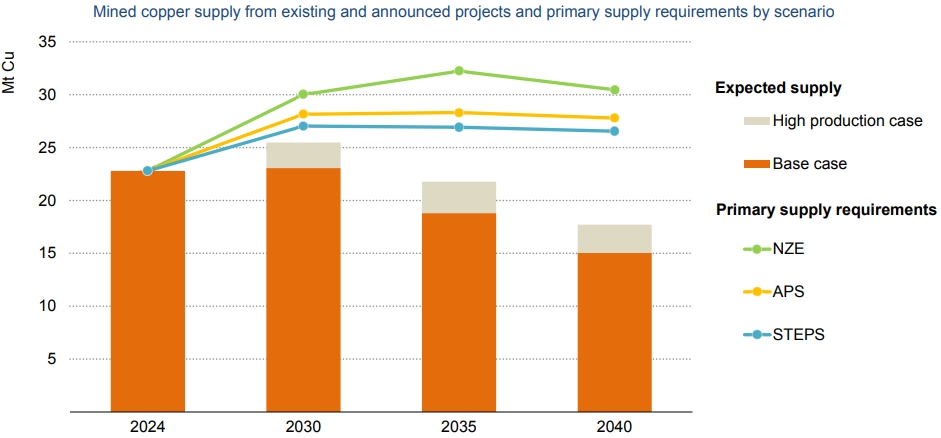
Supply: A major primary copper supply deficit develops later this decade (Source: IEA)
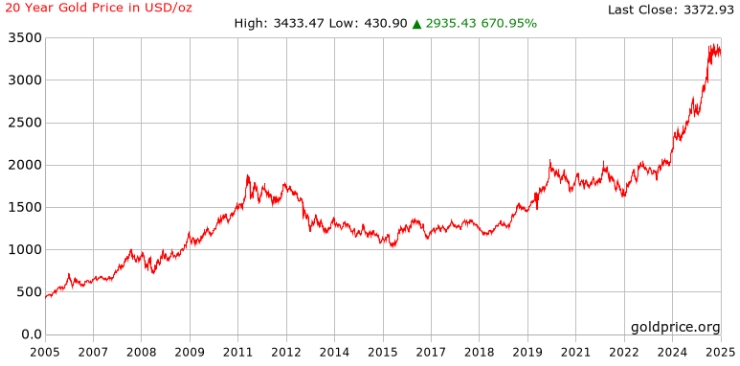
Gold, meanwhile, is underpinned by its enduring monetary and defensive characteristics, with the price having more than tripled over the past 20 years and central banks and investors continuing to maintain steady appetite.
These fundamentals serve as a reminder that even as critical minerals capture headlines for their role in batteries and electric vehicles, copper and gold are embedded in essential global supply chains. Copper signals industrial growth and energy transition progress, while gold offers a reliable hedge in volatile markets. Together, they provide a balance of growth and protection often missing from more speculative sectors.
Copper supply under pressure
Copper’s supply story is sobering. The IEA notes that while new lithium, nickel, and battery mineral projects have come online rapidly, copper production faces longer lead times, declining ore grades, and rising costs. Concentration risk compounds the problem, with Chile, Peru and China dominating supply and refining, meaning disruptions in these regions could ripple across global markets.
Moreover, the combination of high capital costs, permitting delays, and regulatory hurdles has meant that new copper projects take 7–10 years from discovery to production — a timeline that will struggle to keep pace with the energy transition.
Analysts now warn that without accelerated investment, global copper deficits could materialise as early as the early 2030s. Short-term supply is sufficient for current needs, but longer-term structural gaps are emerging, making established producers in politically stable jurisdictions, including Australia, increasingly valuable to global markets.
Gold’s enduring allure
While copper is central to industrial and energy demand, gold’s appeal remains tied to its monetary and defensive role. Central banks continue to add to reserves, and geopolitical uncertainty, interest rate volatility, and inflation concerns support demand from investors seeking a hedge.
Global gold production is relatively steady, but rising costs and declining grades mean new discoveries are crucial to maintain output, adding a layer of scarcity that supports prices over the medium term.
Unlike battery metals, gold is unlikely to experience explosive growth in industrial use; its value is anchored in financial markets. This stability makes it an attractive counterweight to the volatility often seen in the emerging battery mineral sector, where sentiment swings can dominate prices.
Australia’s sweet spot
Australia is strategically positioned to benefit from both gold and copper trends. The country is a top global producer of both metals while also expanding capacity in lithium, nickel, and rare earths. New copper projects across Queensland, South Australia, and Western Australia aim to address anticipated supply deficits, though the challenges highlighted by the IEA — long lead times, high costs, and concentrated global production — persist.
Domestic gold production is concentrated in Western Australia, where high-grade deposits such as Tropicana, Boddington, and Kalgoorlie provide reliable output.
Junior explorers are adding to the story: Antipa Minerals Ltd (ASX:AZY) recently delivered high-grade gold and copper hits at its Minyari Gold-Copper Project in the Paterson Province, while Pantoro Gold Ltd (ASX:PNR, OTC:PNTOD) reported strong production growth and exceptional grades at its Norseman operations, both in WA.
Read more: Antipa Minerals reports bonanza gold hits at Minyari’s Fiama prospect
Meanwhile, Novo Resources Corp (TSX:NVO, OTCQX:NSRPF, ASX:NVO) is actively hunting for next-generation gold and copper discoveries across Australia, with assets in New South Wales and Victoria in addition to WA.
At the same time, Australian miners are seeking opportunities abroad to diversify exposure. FireFly Metals Ltd (ASX:FFM, TSX:FFM, OTC:MNXMF) and AuMEGA Metals Ltd (ASX:AAM, TSX:AUM, OTCQB:AUMMF) are advancing projects in Canada, Sunstone Metals Ltd (ASX:STM) has reported robust copper-gold drill results from Ecuador, and Apollo Minerals Ltd (ASX:AON, OTC:APOMF) achieved high-grade results at its Salanie Gold Project in Gabon. In Côte d'Ivoire, Aurum Resources Ltd (ASX:AUE) has expanded its Boundiali gold resource by 50%, lifting total group resources to over 3.2 million ounces.
Read more: FireFly Metals unveils major greenfields targets at Green Bay copper-gold project
In addition, Solis Minerals Ltd (ASX:SLM, TSX-V:SLMN, OTCQB:SLMFF) has recently intersected copper mineralisation in its first drill hole at the Ilo Este Project in Peru, confirming the potential of a large porphyry system.
Read more: Solis Minerals intersects copper mineralisation in first Ilo Este drill hole
These overseas ventures tap additional high-quality deposits, complementing domestic production and providing investors with broader exposure to global gold and copper markets.
Combined with Australia’s regulatory stability and deep mining expertise, the country remains a comparatively safe harbour for investors seeking growth alongside security. For operators with scale and strong balance sheets, the outlook is encouraging, even as global demand for both critical minerals and industrial metals continues to climb.
Pricing dynamics and investor considerations
Copper prices have softened from peaks in 2021–22, but structural supply constraints suggest long-term upward pressure. The IEA notes that energy transition policies and grid expansions alone could lift demand by an additional 10–15% above baseline projections.
At the same time, gold has seen record highs in Australian dollars, providing local investors with a hedge against currency fluctuations and broader macro uncertainty.
Investors need to weigh the high growth potential of battery metals against their volatility and concentrated supply chains. Copper and gold offer more predictable market fundamentals: copper as a critical industrial input, gold as a financial hedge. For portfolios seeking both growth and resilience, these traditional metals remain compelling, especially for ASX-listed producers with near-term production expansions or high-grade projects in development.
Policy and geopolitical factors
Global governments are responding to the risk of critical mineral shortages, but copper and gold are often outside the most extreme supply-risk categories.
The EU, US and Australia have launched strategic programs to accelerate development and reduce dependency on concentrated supply chains, particularly for lithium, cobalt, and rare earths. Copper benefits indirectly, as policies encouraging domestic production, refining, and recycling create incentives for producers to expand capacity.
For gold, central bank purchases and safe-haven demand act as stabilising forces, independent of the more volatile battery metal markets. Meanwhile, export restrictions in cobalt, rare earths, and other critical minerals underscore the relative safety of holding exposure to gold and copper.
Bottom line
Gold and copper may not dominate the headlines in the same way as rare earths, but they continue to play vital roles in the global economy. Copper’s industrial necessity, combined with emerging supply constraints, positions it as a metal whose long-term demand is largely assured. Gold’s enduring monetary and defensive characteristics provide portfolio stability that no emerging battery metal can yet match.
For investors focused on the ASX, the lesson is clear: while exposure to critical minerals can offer high growth, gold and copper remain a reliable foundation. In a world of surging energy transition demand, constrained supply pipelines, and geopolitical uncertainty, these traditional metals are not just surviving — they are quietly thriving.