
Solis Minerals Ltd (ASX:SLM, TSX-V:SLMN, OTCQB:SLMFF) has intersected copper mineralisation in its first drill hole at the 100% owned Ilo Este copper-gold project in southern Peru, confirming the potential of a large porphyry system.
The diamond drill hole, IE-001-2025, reached a depth of 482.10 metres and intersected a sequence of intrusive rocks with multiple fault zones, breccias, alteration and mineralisation. Assay results are pending from ALS Global, with delivery expected in September 2025.
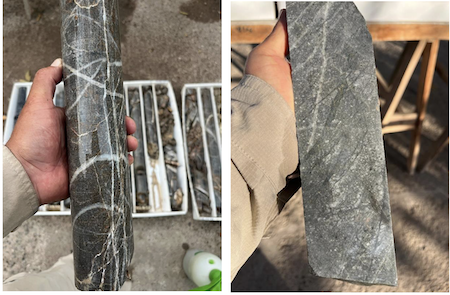
Left image: IE-001-2025 drill core from 177 to 180 metres showing potassic alteration and stockwork. Visually estimated grade 0.1 - 0.4% Cu. Laboratory assay results are due to be received in September 2025. Right image: IE-001-2025 drill core from 320 to 321 metres displaying granular microdiorite. Visually estimated grade 0.1 - 0.5% Cu. Laboratory assay results are due to be received in September 2025.
“We’re very excited by evidence of significant mineralisation at Ilo Este. First assays are expected in September 2025. We have encountered mineralisation across long intercepts of approximately 350 metres,” Solis CEO Mitch Thomas, said.
“While assays will determine grades and overall prospectivity, we are very encouraged by the geology, alteration, and visual results.”
Four mineralised zones identified
Visual inspection revealed four distinct mineralised zones. From surface to 51.3 metres, copper oxides were observed in joints and fractures. Between 51.3 and 103.3 metres, a mixed zone of copper oxides and disseminated chalcopyrite was encountered.
From 176.7 to 221.6 metres, a stockwork zone contained disseminated and minor vein-hosted chalcopyrite. The strongest mineralisation was logged from 266.3 to 406.3 metres, with chalcopyrite and molybdenite associated with quartz veins, continuing as disseminations down to 471.3 metres.
Alteration and structural features
IE-001-2025 intersected predominantly granular microdiorites, except for a porphyritic quartz diorite unit between 51.3 and 192.25 metres. At 461.5 metres, drilling cut into granodiorite of the Coastal Batholith, marking the footwall to mineralisation.
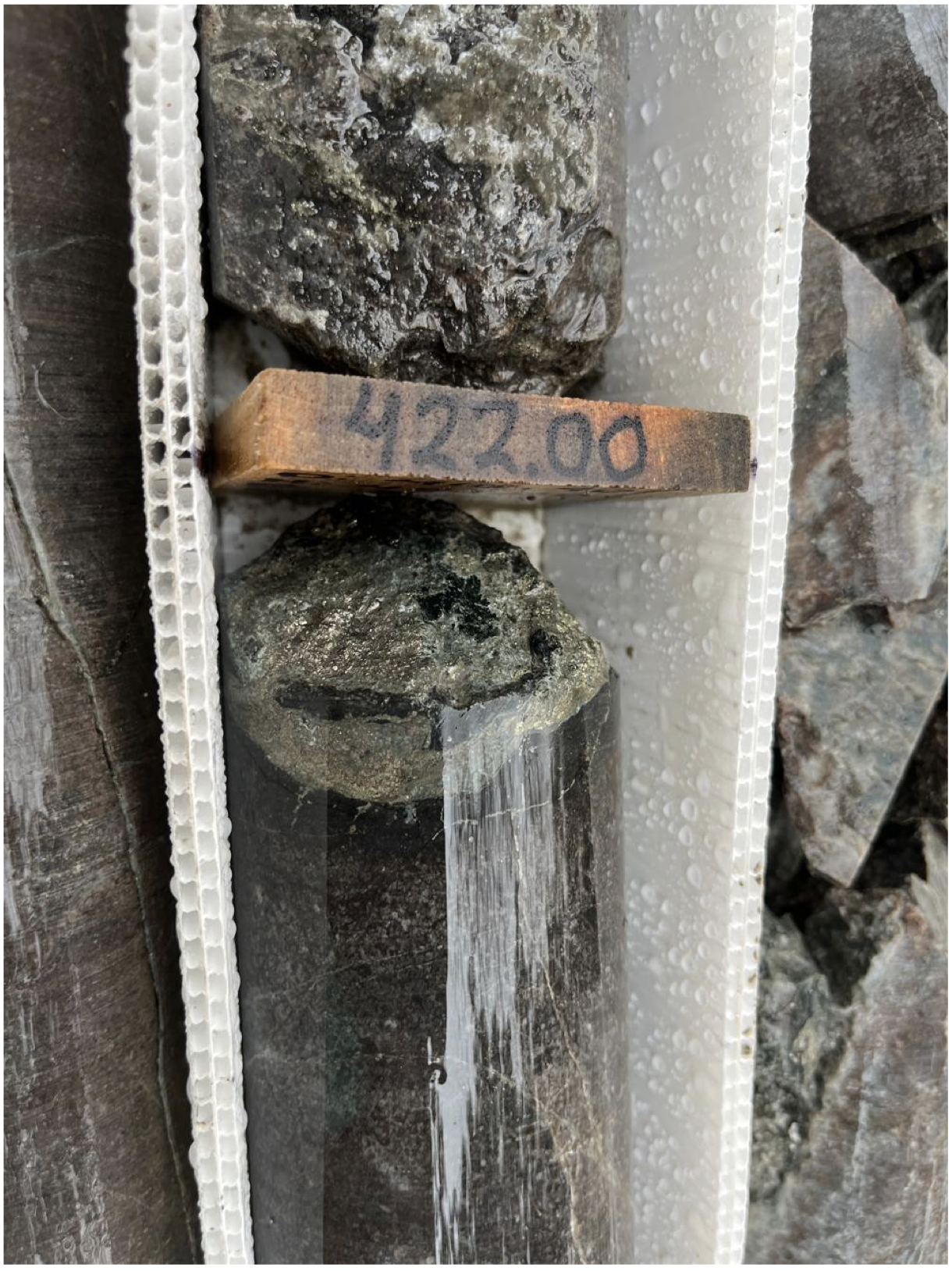
IE-001-2025 drill core at 422 metres displaying sulphides in quartz veining in granular diorite. Visually estimated grade 0.1 - 0.4% Cu in dissemination. Laboratory assay results are due to be received in September 2025.
Of particular note was an altered and partially mineralised stockwork from 177.5 to 266.3 metres showing three to five generations of quartz veining. Alteration increased with depth, beginning with moderate secondary biotite and quartz veining near surface, intensifying into potassic alteration with strong quartz veining to 461.5 metres.
Disseminated magnetite between 383 and 424.2 metres supports the presence of the northern magnetic anomaly, reinforcing the targeting model.
Second hole underway
A second drill hole has started about 200 metres south-southwest of the first, also targeting the northern magnetic anomaly. The broader campaign at Ilo Este is designed to drill approximately 10 diamond holes for a total of 5,000 metres.
The program is testing priority geophysical and geochemical anomalies interpreted to represent porphyry-style mineralisation systems. Key objectives include confirming copper mineralisation, mapping alteration systems, and evaluating structural controls such as faulting, brecciation and intrusive contacts.
Historical exploration and next steps
Ilo Este has a history of exploration from 2000–2001 and 2014–2016, which identified mineralisation consistent with a large porphyry system. Recent geochemical and geophysical surveys by Solis have outlined new targets in the northern and southern magnetic anomalies, considered prospective for higher-grade mineralisation.
The company has prioritised assays from Ilo Este ahead of its Chancho al Palo project. Results from the current program are expected to guide future step-out drilling and preliminary assessments of the project’s resource potential.