
Apollo Minerals Ltd (ASX:AON, OTC:APOMF) advanced its exploration strategy in Gabon during the June 2025 quarter, completing a 14-hole (1,695-metre) Phase 2 diamond drilling program across the A1, A3, and P6 prospects at the Salanie Gold Project. The campaign tested both previously reported shallow high-grade zones and newly identified structural targets.
Key results included:
- A1: 3.8 metres at 1.3 grams per tonne (g/t) gold (Au) from 17.5 metres.
- P6: 1.1 metres at 19.9 g/t Au from 56 metres; additional intercepts to 3.0 metres at 1.0 g/t Au.
- A1 South: A 6-metre-wide brecciated and veined zone intersected along the projected Salanie Fault.
The P6 system remains open to the east, and a regional soil sampling campaign has further highlighted gold anomalies across the 12-kilometre greenstone trend. All results are being reviewed to define the next phase of work.
Salanie Gold Project – 2025 Phase 2 drilling
The 2025 campaign expanded on 2024’s initial exploration, targeting untested zones at A2 and A3, and extending work at A1 and P6. Drilling intersected high-grade and structurally controlled quartz vein-hosted gold mineralisation, with a particular focus on understanding controls on mineralisation and potential extensions.
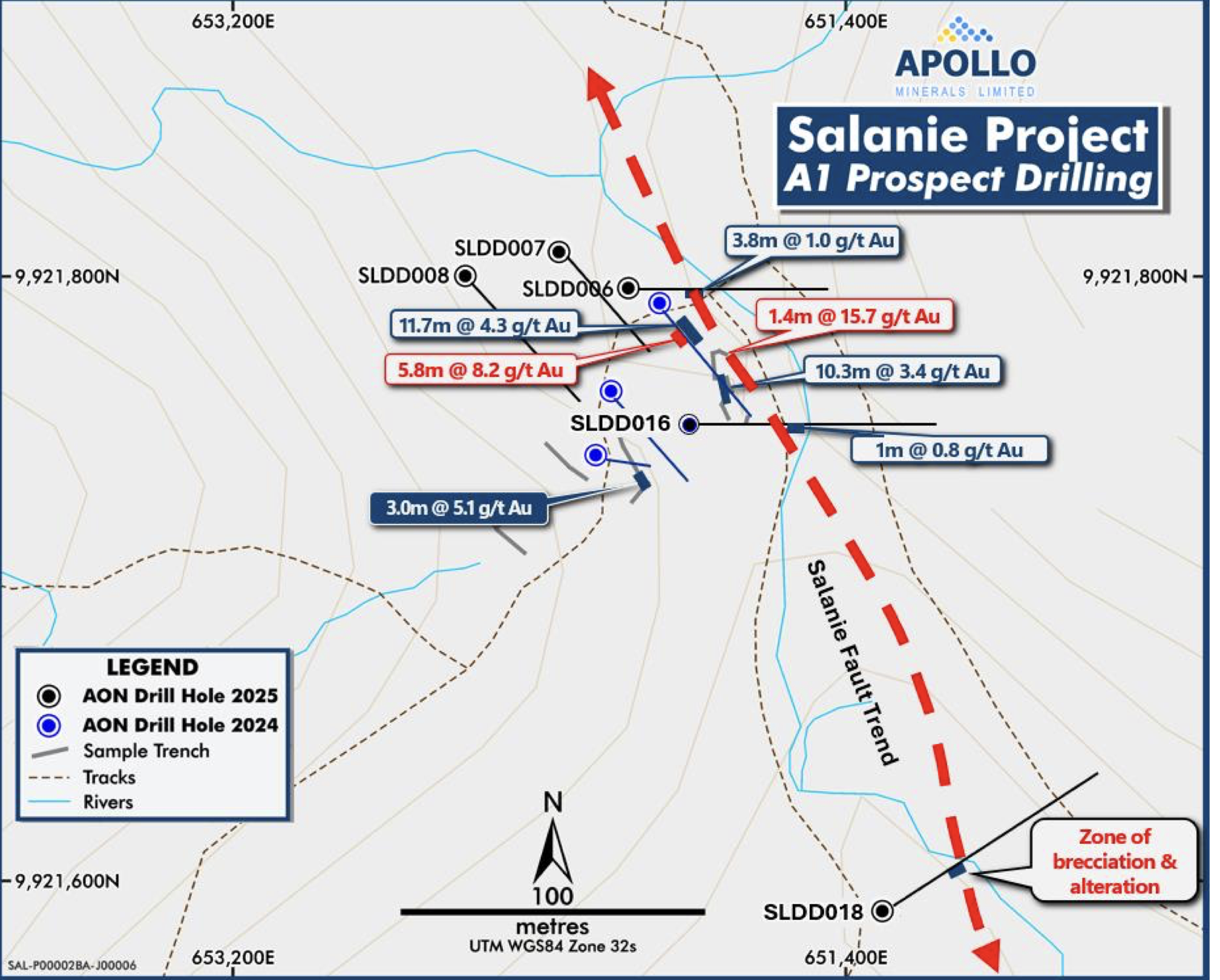
A1 Drilling Region.
At A1, follow-up drilling confirmed near-surface gold continuity, with key intercepts of 3.8 metres at 1.3 g/t Au and 1.0 metre at 0.8 g/t Au. Structural analysis supports a dominant north-south vein trend that remains open along strike.
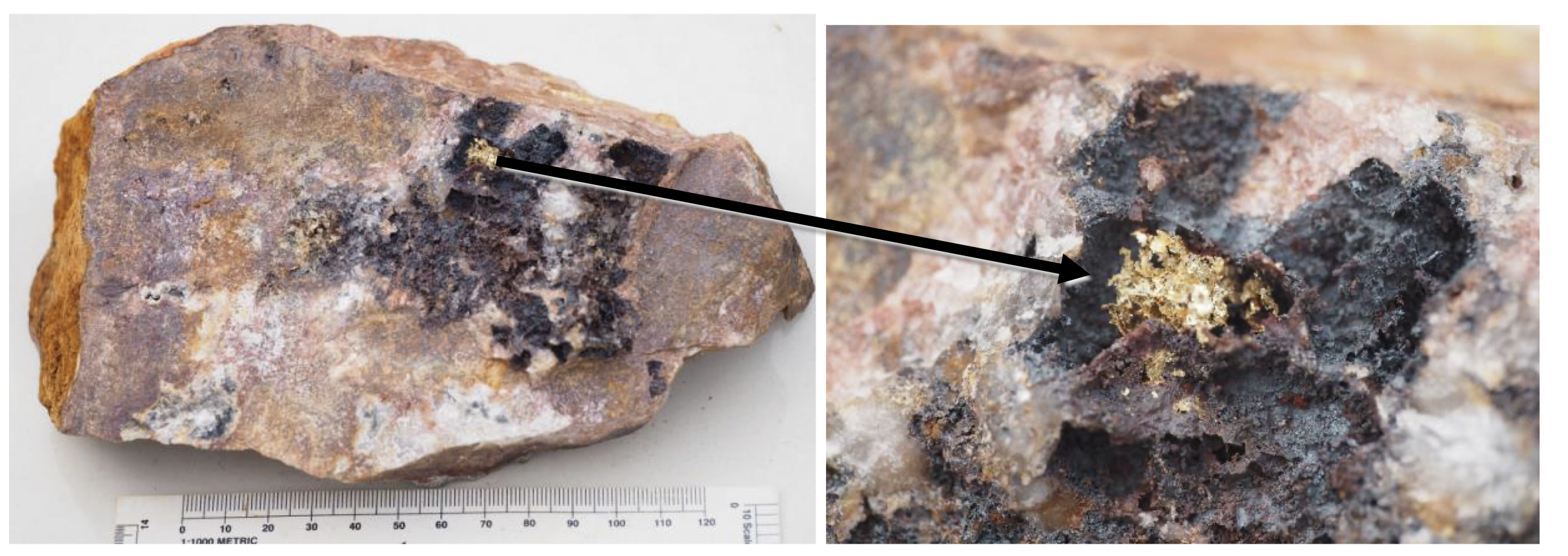
Mineralised quartz vein uncovered at A1 drill pad.
The A1 South hole, drilled 170 metres south of known mineralisation, intersected a 6-metre zone of brecciation and quartz veining, interpreted as a continuation of the Salanie Fault.
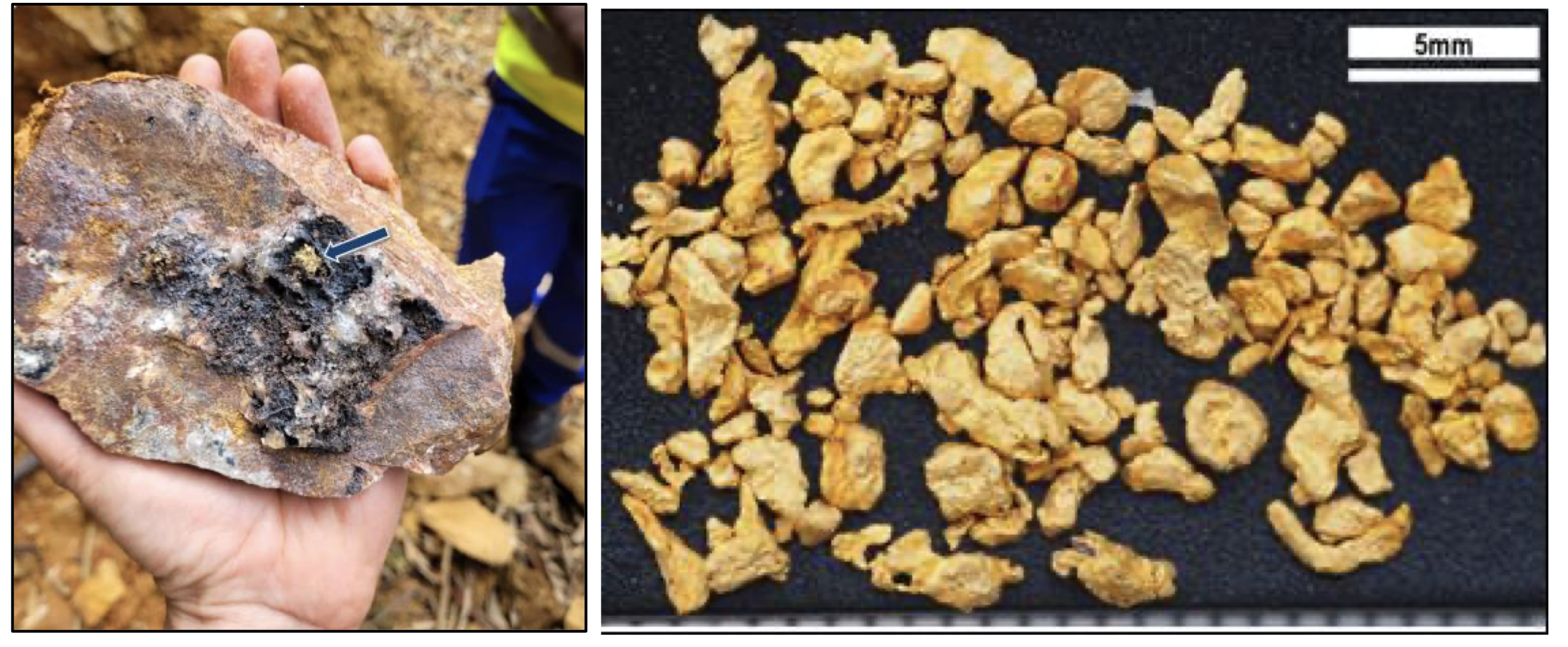
Insitu gold in veining at A1 drill pad (LHS) and artisanal gold grains from Binda artisanal working (RHS).
P6 Prospect – High-grade intercepts and geological continuity
P6 drilling targeted the extension of historical underground workings mined at reportedly 16 g/t Au. The program intersected multiple quartz-sulphide zones over a 180-metre trend, characterised by veined felsic intrusive contacts.
Significant results included:
- 1.1 metres at 19.9 g/t Au from 56 metres (SLDD013)
- 1.0 metre at 3.6 g/t Au from 38.7 metres
- 3.0 metres at 1.0 g/t Au from 74 metres (SLDD015)
- 0.6 metres at 2.5 g/t Au and 0.7 metres at 1.3 g/t Au
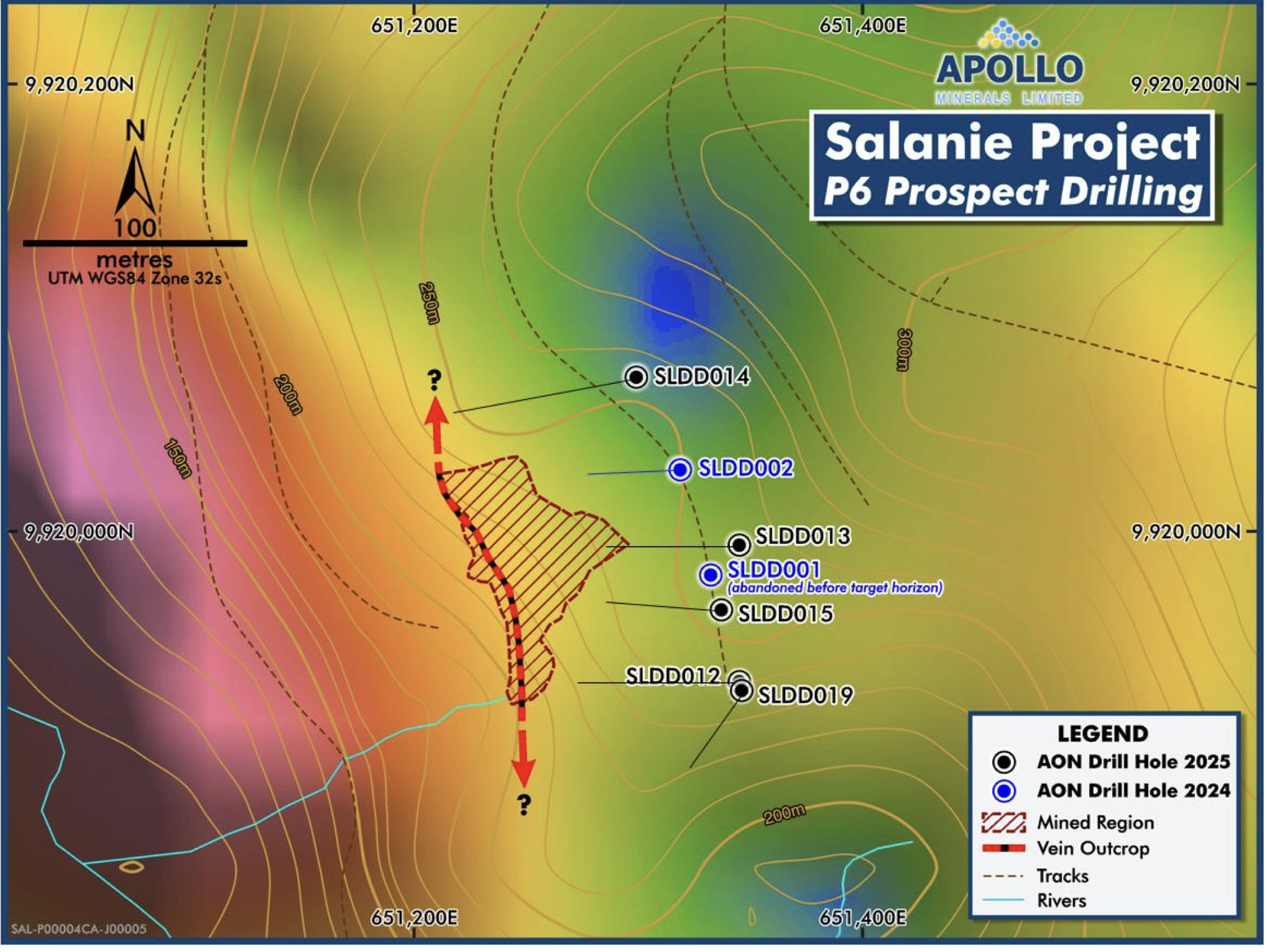
Location of P6 drilling.
The system remains untested to the east, with further structural analysis and geochemical sampling underway to identify continuation zones.
Regional soil sampling supports district-scale potential
A regional soil sampling program covering over 3,000 samples was conducted across the 12-kilometre Salanie greenstone belt. Results revealed multiple gold-in-soil anomalies, including Binda — 3 kilometres north of A1 — with up to 1.9 g/t Au and evidence of active artisanal workings.
Soil anomalies exhibit tenor consistent with known mineralised areas (15–50 parts per billion Au), supporting the potential for further discovery across the Salanie corridor. These findings will help refine future drill targets.
Kroussou Zinc-Lead Project – Exploration target reaffirmed
At the Kroussou Zinc-Lead Project, an initial JORC-compliant exploration target was previously defined at 140–300 million tonnes grading 2.0–3.4% zinc plus lead (Zn+Pb). Only six of 23 identified target prospects have been drill tested, highlighting the broader potential.
The Ndolou permit, which hosts key targets including Dikaki and Niambokamba, was renewed until March 2028. With over 9,000 metres drilled and strong shallow mineralisation (<20 metres depth), future programs aim to expand on this scale and grade.
Belgrade Copper Project – Divestment and ongoing exploration
Apollo completed three diamond holes (600 metres) at the Studena copper prospect in Serbia, targeting a 500-metre anomaly. Drilling intersected overlying units but did not locate significant mineralisation due to interpreted structural displacement.
The company is pursuing renewal of the Studena licence and awaiting approval for the Kopajska Reka application. Meanwhile, a conditional agreement was signed with Bindi Metals to divest the Donja Mutnica Licence and Lisa Licence Application, with staged payments and share consideration subject to approvals.
Corporate and financial position
As of June 30, 2025, Apollo held A$1.3 million in cash and securities valued at A$0.3 million. Total exploration expenditure for the quarter was A$890,000, including drilling, sampling and logistics.
Apollo continues to review new project opportunities in Gabon and internationally. However, changes to Gabon’s Mining Code regarding sovereign minerals are under legal review, particularly relating to state equity participation of up to 35% in mining projects.
The company is managing expenditures and exploring funding options to support ongoing operations and development plans.