
The ASX has had a difficult week, shedding 1.01% over the last five days to fall to 3.50% below its 52-week high.
The Hang Seng joined us in the red (-1.49%) alongside the Nikkei 225 (-0.46%) but the other indices resisted, with the S&P 500 climbing 0.22%, the Nasdaq 0.56% and the FTSE100 1.28%.
The ASX sectors were also a mixed bag, buoyed by Communication Services (+2.33%), Utilities (+1.15%) and Consumer Discretionary (+1.13%) but dragged down by Financials (-4.09%) and Energy (-1.43%).
Commodities were in the red almost across the board, with only West Texas Intermediate Crude managing a positive showing with a 1.08% gain and palladium taking the most damage, shedding a sizable -10.58% as platinum (-4.41%), nickel (-4.49%), tin (-4.49%) and zinc (-4.17%) also languished.
What’s in the news this week?
RBA Governor Phllip Lowe defends rate hikes
Reserve Bank of Australia governor Phillip Lowe has laid out the RBA’s reasoning for recent rate hikes in an address to the House of Representatives Standing Committee on Economics.
“Most advanced economies are in a similar position to Australia, and have responded with higher interest rates, in some cases to a level substantially higher than that in Australia,” Lowe said in his opening statement to the committee.
“In broad terms, the RBA and many other central banks are managing two risks.
“One is the risk of not doing enough, which would result in high inflation persisting and then later proving very costly to get down.
“The other is the risk that we move too fast, or too far, and that the economy slows by more than is necessary to bring inflation down in a timely way.
“The path here is a narrow one.”
Lowe emphasised the corrosive nature of a high inflation environment, underlining the effect on household budgets and savings accounts, and pointing to a combination of supply side and demand-side factors such as COVID supply chain disruptions, Russia’s invasion of Ukraine, and stimulus policy as the main culprits driving inflation.
“As the central bank, we have a critical mandate to preserve medium-term price stability and we are committed to that objective,” Lowe stated.
“If we don’t get on top of inflation and bring it down in a timely way, the end result will be even higher interest rates and more unemployment in the future.”
Lowe agreed that banks have been the short-term winners of interest rate hikes, passing on increases to mortgages far more quickly than rate rises on savings and deposit accounts.
“The banks are profitable, it’s true,” Lowe said, “We want resilient banks. I know it’s hard for people to accept when they’re suffering. But the country is better off having strong, resilient banks that can provide the financial services that we need.”
Federal treasurer Jim Chalmers has tapped the Australian Competition and Consumer Commission to investigate why the mortgage-savings rate gap exists, an inquiry governor Lowe fully supports.
Given his statements that unemployment must rise (up 0.2% to 3.7% in January) before inflation falls, and that more rate hikes are likely necessary, Lowe isn’t likely to a be a popular person around the dinner table for some time to come.
Australians weigh-up immigration impacts
An independent survey commissioned by Send Money Australia has revealed that 84% of Australians believe the Federal Government’s immigration program is beneficial, offering one of the following advantages:

The Federal Government will no doubt welcome the revelation, as the immigration office gears up for the 2023-2024 Migration Program (currently accepting public submissions).
The program has already had a positive effect on job vacancies, dropping the total number from 480,000 in May to 444,200 in November last year.
While still a far cry from February 2020’s numbers (277,000), the program is likely to have a beneficial effect on the struggling Australian labour economy.
The government intends to increase permanent intake to 195,000 placements in the 2023 financial year, up from 160,000 the previous year.
Under the arrangement, up to 142,400 skilled placements are being approved to "improve the productive capacity of the economy and fill skills shortages in the labour market, including in regional Australia."
In addition, up to 52,500 Partner visas are being approved to reunite people in Australia with family members from overseas.
Australians appear to be welcoming the move, especially younger generations, with some 88% of under-35s stating they believe immigration has positive benefits, compared to 86% of 31-54 year-olds and 77% of over-55s.
Despite the overall optimism, the majority of Australians were also aware of the potential downsides of immigration, with some 92% saying they believe the immigration program will involve at least one disadvantage.
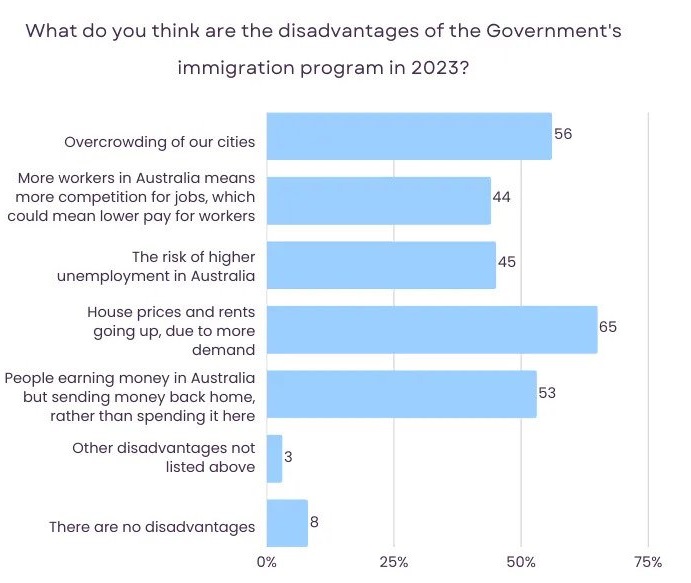
Increased housing and rent prices was the main concern among Australians, with 65% referencing it as a potential disadvantage.
Given rent increases are breaking national records and rental vacancies are already at an all-time low, the concern may be warranted.
Small cap wins for the week
Sunstone Metals gains 13.3%
Sunstone Metals Ltd (ASX:STM) shares were up 13.3% over the week on “extremely promising” gold and copper assays from drilling at the El Palmar porphyry gold-copper discovery in northern Ecuador.
Buru Energy climbs 11.7%
Buru Energy Ltd (ASX:BRU) shares lifted 11.7% this week after securing an agreement to acquire Origin Energy Limited’s joint venture exploration permits in the Canning Basin.
Kingston Resources lifts 11.7%
Kingston Resources Ltd (ASX:KSN) shares also gained 11.7% following news the company’s Mineral Hill Mine in NSW producing record gold numbers, and that Kingston had kicked off the 2023 exploration season with an induced polarisation (IP) geophysics program at its Mineral Hill targets in western New South Wales.
Jindalee Resources rises 11.25%
Jindalee Resources Ltd (ASX:JRL) shares rose 11.25% after the company teamed up with major Korean lithium producer and NYSE-lister POSCO Holdings to investigate processing methods for the McDermitt Lithium Project in Oregon, US.
Piedmont Lithium up 9.8%
Piedmont Lithium Inc (ASX:PLL, NASDAQ:PLL, XETRA:) gained 9.8% to its share price over the last five days after signing equity investment and binding offtake agreements with LG Chem for the purchase of some 200,000 tonnes of spodumene concentrate over four years, and an investment of $75 million to acquire PLL common shares.