
If there’s one thing we can all agree on, it’s that finding a cure for cancer – in its many and varied forms – is top of most people’s bucket lists and certainly on the wish lists of those who have been directly or indirectly affected.
According to the Cancer Council of Australia, there were just under 150,000 new cases of cancer diagnosed and just under 50,000 deaths from cancer in 2020, with one in two Australian men and women to be diagnosed with cancer by the age of 85.
That’s pretty grim.
Prostate, breast, colorectal (bowel), melanoma and lung cancer are the five cancers that account for about 60% of all cancers diagnosed in Australia.
Looking globally, the International Agency for Research on Cancer estimates there were 19.3 million new cancer cases (18.1 million excluding non-melanoma skin cancer) in 2020 and almost 10 million cancer deaths (9.9 million excluding nonmelanoma skin cancer).
Female breast cancer surpassed lung cancer as the most commonly diagnosed cancer, with an estimated 2.3 million new cases (11.7%), followed by lung (11.4%), colorectal (10.0 %), prostate (7.3%) and stomach (5.6%) cancers.
Lung cancer remained the leading cause of cancer death, with an estimated 1.8 million deaths (18%), followed by colorectal (9.4%), liver (8.3%), stomach (7.7%) and female breast (6.9%) cancers.
Growth in cancer treatment creates a major market
So, what can be done to turn the tide?
While a cure is yet to be found, innovation in cancer treatment continues to strengthen.
As such, the market continues to grow.
Mordor Intelligence suggests the global cancer therapy market was valued at approximately US$158 billion in 2020 and is expected to witness a revenue of US$268 billion in 2026, with a CAGR of 9.15% over the forecast period.
Interestingly, during the COVID-19 pandemic doctors from Dana Farber Cancer Institute found there was a 46% decrease in the diagnoses of the six most common cancer types. However, this is an anomaly and the numbers are expected to readjust in the coming years.
Which will bring therapeutics companies back into the frame.
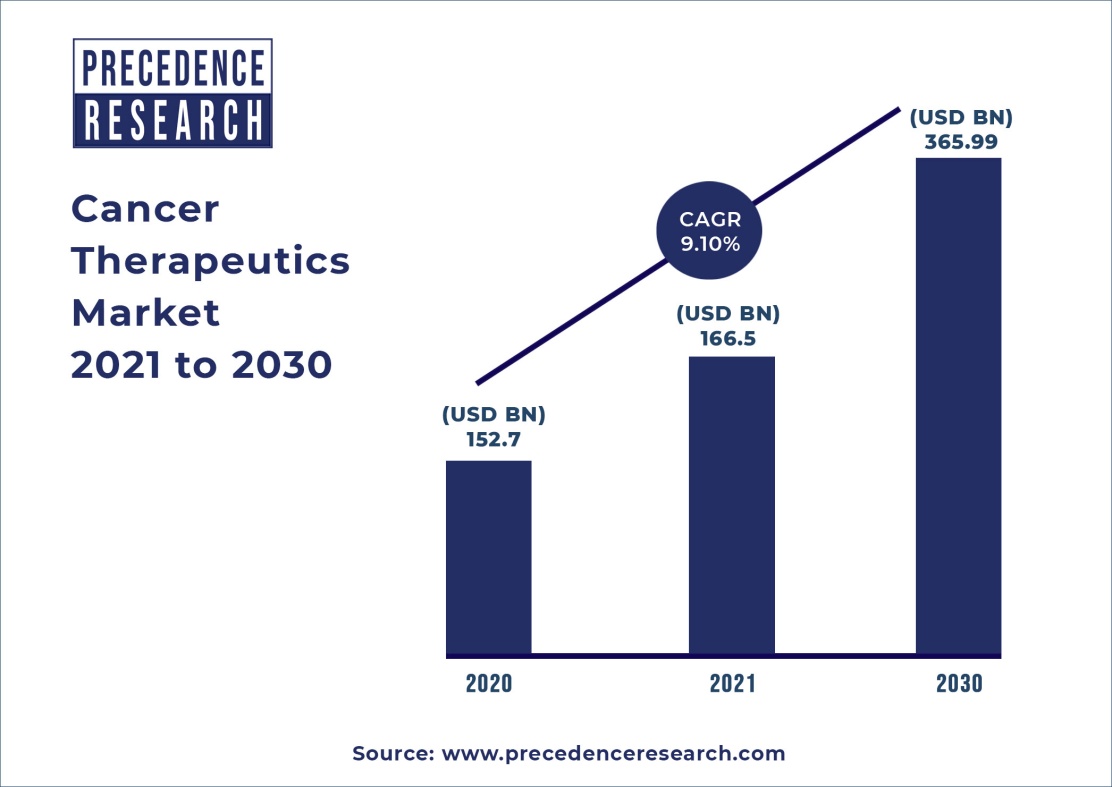
Precedence Research suggests the global cancer therapeutics market size is predicted to surpass US$365.99 billion by 2030 and expand growth at a CAGR of 9.1% from 2022 to 2030.
There have been some interesting developments of late.
Turning down the thermostat seems to make it harder for cancer cells to grow, according to a new study in mice.
Scientists have developed a novel 3D tissue-engineered model of the glioblastoma tumour microenvironment that can be used to learn why the tumours return and what treatments will be most effective at eradicating them -- right down to a patient-specific level.
Australian companies are also well entrenched in cancer treatment innovation. While we will look more deeply into several ASX companies making waves, here’s a highlights package:
- Race Oncology Ltd (ASX:RAC)'s Zantrene drug found to protect the hearts of mice from the permanent damage caused by the chemotherapeutic anthracycline doxorubicin;
- Race Oncology’s R/R AML trial in Israel advances to Phase 2 with encouraging clinical results in a very heavily pre-treated patient population;
- Prescient Therapeutics Ltd (ASX:PTX)’s new clinic-ready CellPryme-M platform for enhancing cell therapies developed with Peter MacCallum Cancer Centre Melbourne was unveiled;
- Imugene Ltd (ASX:IMU, OTC:IUGNF) secured human Research Ethics Committee approval to commence a Phase 2 clinical trial of immunotherapy candidate, HERVaxx in combination with pembrolizumab;
- Imugene released positive final HER‐Vaxx Overall Survival Results from the HERIZON study, a Randomized Phase 2 Trial in Advanced Gastric Cancer;
- Kazia Therapeutics Ltd (ASX:KZA, NASDAQ:KZIA)’s Alliance study in brain metastases has transitioned to an expansion stage after promising data in the initial exploratory stage;
- Arovella Therapeutics Ltd (ASX:ALA) inked an agreement to initiate manufacturing of ALA-101.
In the spotlight: ASX cancer treatment stocks
Amplia Therapeutics
Amplia Therapeutics Ltd (ASX:ATX) dosed its first patient in its Phase 1b/2a ACCENT clinical trial of focal adhesion kinase inhibitor AMP945. AMP945 targets focal adhesion kinase (FAK) and its use in the ACCENT trial is intended to enhance the efficacy of gemcitabine/nab-paclitaxel chemotherapy for people with advanced pancreatic cancer undergoing first-line treatment.
During the quarter, Amplia received positive pre-IND (Type B) feedback from the US FDA on its proposed development plans for its investigational focal adhesion kinase inhibitor, AMP945, in people with pancreatic cancer.
The company also sought the FDA’s specific feedback on the design of its ACCENT clinical trial of AMP945 in first-line patients with advanced pancreatic cancer. The FDA agreed that the available and planned pre-clinical data appear to support both the trial and a future marketing application in the proposed indication.
Amplia has continued to make progress towards the initiation of a Phase 2 clinical study in Idiopathic Pulmonary Fibrosis patients with completion of dosing in the enabling 3-month toxicology studies of AMP945. Draft reports from these studies are expected in August 2022.
On the financial front, Amplia finished the June 2022 quarter with cash of $12.7 million slightly down from the $14.6 million in the March quarter. Research and development expenditure is forecast to increase in the coming quarters in line with the commencement of a Phase 2 clinical trial for AMP945.
Looking forward, Amplia expects to report on recruitment progress in the ACCENT trial as well as updates on progression towards optimal dose selection. The company also expects to receive draft study reports from 3-month toxicology studies and will report top-line outcomes from these studies.
Work on Amplia’s second FAK inhibitor, AMP886, is ongoing and outcomes from preclinical and manufacturing development work will be provided when ongoing studies are completed.
Imugene
During the quarter Imugene Ltd (ASX:IMU, OTC:IUGNF) presented positive final overall survival data from its Phase 2 study of HER‐Vaxx in HER‐2/Neu overexpressing advanced/metastatic gastric/GEJ cancer following analysis of safety and efficacy data.
The final analysis results from the randomised clinical HERIZON study, which was designed with a specified 1‐sided false positive probability of 0.10, showed a 41.5% survival benefit for patients treated with HER‐Vaxx plus standard of care (SOC) chemotherapy compared to SOC chemotherapy alone.
There was plenty going on in the Imugene offices with the appointment of a CFO and executive director, clinical scientist.
Other highlights for the quarter included: The first Cohort 2 Patient was dosed in a clinical trial of CHECKvacc; the first patient was dosed in the Phase 1 Trial to test oncolytic virus against solid tumours; and the company also received ethics approval to start Phase 2 next HERIZON Clinical Trial of HER‐Vaxx.
As for its financial position, at the end of the period, Imugene had $99.9 million in cash or equivalents, providing a runway to support its clinical pipeline and operations into 2025.
Net cash used in operating activities amounted to $10.2 million, with direct research and development amounting to $8.5 million and staff costs accounting for over 99% of the $10.2 million for the quarter.
Patrys
Patrys Ltd (ASX:PAB) delivered several highlights over the quarter.
“Patrys has made substantial progress this quarter building out and expanding the base of evidence supporting the range of potential clinical applications for our deoxymabs. This culminated in the successful completion of the second engineering run for PAT-DX1 in early July which resolved the technical issues we experienced in the engineering run earlier this year, Patrys CEO and managing director Dr James Campbell said.
“Pleasingly, we have ample material to conduct the remaining preclinical GLP toxicology studies and are currently testing to confirm that it meets specifications.
"With this successful result, we now have a very clear line of sight for getting PAT-DX1 into the clinic in 2023 and with the recent appointment of Dr Rebecca Tunstall as vice president, Corporate Development, we are actively starting to resource Patrys to achieve that significant milestone for the company.”
Broken down the highlights included:
- $250,000 non-dilutive funding to support research by the Telethon Kids’ Institute into potential therapeutic applications for Patrys’ deoxymabs.
- New research published showing potential to use PAT-DX1 to regulate Neutrophil Extracellular Traps that play a role in cancer metastasis and inflammation.
- Update on research collaboration with Imagion to develop new targeted antibody-based imaging agents for brain cancer.
- Subsequent to the quarter, successful engineering run of PAT-DX1 completed and granting of Canadian deoxymab patent.
- Balance sheet capacity with closing cash balance of $7.8 million at June 30 2022, with an additional $2 million in short-term investments.
Prescient Therapeutics
Prescient Therapeutics Ltd (ASX:PTX) finished the quarter in a strong cash position with a cash balance of $12.3 million.
Costs for the quarter included ongoing clinical trials and manufacturing for PTX-100 and PTX-200 as well as the OmniCAR next-generation CAR-T platform and newly unveiled high-performance cell therapy manufacturing technology CellPrymeM.
Total cash outflows for the quarter were largely in line with the previous quarter at $1.2 million, with $500,000 invested in research and development activities in Australia and the United States.
The company has made progress on multiple fronts including improving and advancing the efficacy of existing CAR-T therapies – an important strategic milestone.
Further to this, patients with T-cell lymphomas (TCL) are being steadily enrolled and treated in the expansion cohort under the leadership of Professor Miles Prince, AM.
In parallel, Prescient’s Phase 1b study of PTX-200 combined with chemotherapy (cytarabine) in patients with relapsed and refractory acute myeloid leukemia (AML) reported that another patient in the study has now had complete remission of their disease at the 45mg/m2 dose.
For more about PTX read: Challenging the pace of change in healthcare: Prescient Therapeutics
Pharmaxis
Pharmaxis Ltd (ASX:PXS, OTC:PMXSF) finished the quarter and half with $8.9 million in cash. The company expects to receive its 2022 R&D tax credit of $4.9 million in the December quarter after completion and filing of its 2022 income tax return.
On the operational front, the study trialling PXS‐5505 as a monotherapy to primarily assess safety before it goes into a combination study with standard of care at a later date is ongoing as is the PXS-6302 trial in established scars.
This study has progressed into full recruitment after assessment of the first eight patients who had completed one month's treatment and had their levels of enzyme inhibition reviewed.
The recruitment of a further 42 patients who are being randomised to active or placebo is well underway.
Race Oncology
Race Oncology Ltd (ASX:RAC) has continued its hard work into its Zantrene studies.
PHASE 1B trial highlights have shown encouraging clinical responses in heavily pre-treated patients, with three of six patients successfully bridged to stem cell transplant. The company is now advancing to Phase 2 – efficacy stage with open label study results to be reported in stages.
Encouragingly, the company reported that Zantrene with immunotherapy shrinks melanoma tumours that do not respond to immunotherapy alone.
There is a lot of news on the horizon for RAC, including:
- Pre-clinical - in vitro – updates on AML, breast cancer, multiple myeloma, kidney cancer and cardioprotection.
- Pre-clinical - in vivo – animal studies in breast cancer, multiple myeloma and kidney cancer and animal work assessing cardioprotection from carfilzomib-induced heart damage.
- Clinical – first patient treatment in the extramedullary AML clinical trial, progress updates on AML Phase 2 trial at Chaim Sheba, Israel, clinical trial plan for cardioprotection in breast cancer patients, clinical trial plan FTO-focused solid tumour trials.
Noxopharm
Noxopharm Ltd (ASX:NOX) appointed a new CEO in February to assess capabilities and strategic direction with the last quarter seeing progress made in its lead drug candidate Veyonda® clinical trials, as well as in the Chroma™ and Sofra™ technology platforms.
The Veyonda clinical trials continue to increase their enrolment across three continents, while preclinical research and discovery continues in the Chroma™ platform, where NOX is working with the University of NSW and its world-class pancreatic cancer model. It is expected preliminary results from this program will be shared in the third quarter of this year.
CEO Dr Gisela Mautner said, “It has been extremely satisfying to work with the Noxopharm management team and our many leading collaborators to achieve these results this quarter. Our strategy is not only bringing our exciting technologies forward but also attracting outstanding scientists, investigators and sites to participate in our trials.
“In this quarter, we have been focused on presenting our strategy and technologies to potential investors and collaborators both in Australia and overseas, and have had encouraging feedback.
"This will put us in the best position to maximise the value of our technologies as they reach key inflection points and deliver that value to our shareholders.”
As at June 30 2022, Noxopharm had A$14 million in cash, which meets its forecast funding needs. It also expects to receive a significant R&D rebate towards the end of the year.
Kazia Therapeutics
During the quarter, oncology-focused drug development company Kazia Therapeutics Ltd (ASX:KZA, NASDAQ:KZIA) raised total gross proceeds to date of US$3.2 million (~A$ 4.6 million), at an average price per ADS of US$5.94 (A$ 0.85 per ordinary share), materially expanding the company’s operating runway with minimal dilution to existing shareholders.
Kazia CEO Dr James Garner said of the quarter: “This quarter has been characterised by multiple positive data read-outs from the paxalisib program. In particular, the emerging data in childhood brain cancer is very promising.
"Moreover, the ongoing Alliance study has given us the first indications that paxalisib may also have a role to play in the treatment of brain metastases, which represents a significant unmet medical need and a very substantial commercial opportunity.”
“On the financing front,” Dr Garner continued, “our ATM facility has been extremely successful. We have brought a meaningful amount of capital into the company at no discount, with no accompanying warrants or options and with very modest fees to our bankers.
"Alongside the ATM, the company continues to routinely evaluate a number of financing approaches, including equity placements and non-dilutive opportunities such as partnering and grant funding.”
Highlights included:
- Alliance study in brain metastases has transitioned to an expansion stage after promising data in the initial exploratory stage.
- Final data from the phase II study of paxalisib in glioblastoma was presented at the ASCO annual meeting.
- Preclinical data demonstrating synergistic activity in the combination of paxalisib and ONC201 in DIPG, an aggressive childhood brain cancer, was presented at the ISPNO annual meeting.
- Preclinical data demonstrating synergistic activity in the combination of paxalisib with several other experimental cancer therapies in AT/RT, another childhood brain cancer, was presented at the AACR annual meeting.
- FDA granted orphan drug designation (ODD) and, post period, rare pediatric disease designation (RPDD) to paxalisib for treatment of AT/RT. Among other advantages, this provides a second opportunity for paxalisib to attain a pediatric priority review voucher (pPRV) if approved in AT/RT.
- GBM AGILE study has been recruiting ahead of expectations and has opened a paxalisib arm in several European countries.
- The phase I study of EVT801 in patients with advanced cancer continues to recruit well and has successfully cleared the third dose cohort.
- Post period, Kazia has launched a new Scientific Advisory Board (SAB), comprised of leading experts in brain cancer research and novel therapies.
Arovella Therapeutics
Arovella Therapeutics Ltd (ASX:ALA), which is focused on developing its invariant Natural Killer T (iNKT) cell platform for cancer treatment and its oral spray delivery technology to treat cancer and conditions that affect the central nervous system, delivered several highlights during the quarter.
Over the June quarter, the company achieved the following:
- Q-Gen Service Agreement signed to initiate manufacturing of ALA-101.
- Dr Elizabeth Stoner was appointed as interim chairperson and Gary Phillips as a non-executive director.
- Anagrelide patent granted by the US Patent and Trademark Office.
- ZolpiMist launched in Australia by STADA Australia.
- Arovella adopted the WEF Framework for ESG Reporting.
- Quarterly cash burn to reduce now HCBP settled.