
Cobalt Blue Holdings Ltd (ASX:COB, OTC:CBBHF) has had a Speculative Buy rating and a A$1.10 price target maintained by Canaccord Genuity (TSX:CF, LSE:CF) after the global capital markets group recently visited the company’s Broken Hill Cobalt Project (BHCP) in the Far West of New South Wales.
The visit comes as COB progresses the BHCP Demonstration Plant with major equipment installed pending commissioning, which is imminent, and first product samples are expected later this quarter.
Regarding the visit, Canaccord said: “Management displayed a depth of process knowledge and project execution experience. The team has been building its local presence with the majority of the team based in Broken Hill and aiming for future local recruitment.”
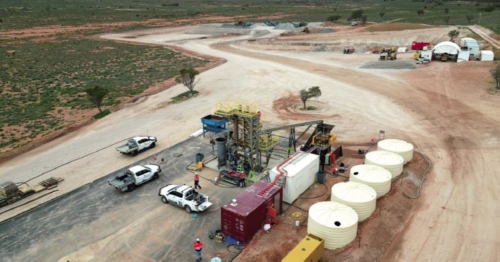
Pyrite hill site concentrator which sees a ~6.4x uplift in grade and 80% reduction in volume.
Canaccord also stated: “COB's technology is well-developed, with in-house expertise providing the potential to expand its operation organically or through partnership.
“We value the project at A$654 million and risk our price target by 50% on account of COB's early project stage.
“Our price target is set at A$1.10, net of corporate costs, cash and a nominal A$50 million technology value.”
This target represents upside for COB, with the share price trading up to A$0.69 today having hit a 12-month high of A$1.07 in early April.
Following are extracts from Canaccord Genuity’s ‘company update’ after the Broken Hill visit.
Strong progress with near-term potential catalysts
COB is less than a month from completion of the demonstration plant with all key items delivered and only minor fabrication tasks remaining.
Once delivered the plant will process up to 4,000 tonnes of ore with results supporting the DFS, providing product samples and proof of concept potential debt/equity partners.
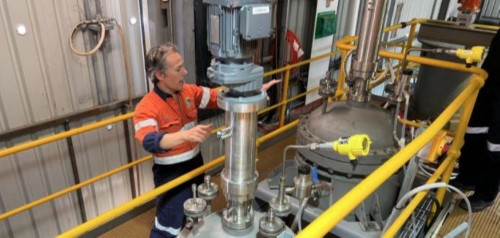
COB’s executive manager Dr Andrew Tong explains the autoclave in the leaching circuit (source Canaccord Genuity).
The company plans to lock in offtake and progress partnership discussions by the end of 2022, deliver the DFS and key approvals in 2023 and the FID thereafter, providing strong catalyst potential, in our view.
Management building out execution experience
The current team holds significant processing knowledge and project execution experience. The team has designed, procured and project managed the entire development of the demonstration plant, bolstered by its extensive experience.
We believe this will serve the company well when it progresses to full project development, with much of the leg work building the foundation of the owner's team.
Benefits of a mining town, Cobalt is part of the town
Broken Hill was founded by the mining industry and there is very strong support locally for the industry and diversification into new minerals.
COB has a strong hire local/develop local ethos which is supported by the local council (who want residential-based workforces) and has been working through plans so that issues such as suitable housing and regional support are addressed early.
Once operational, COB expects 400 full-time roles, with the demonstration plant currently employing 12 locals and an additional 18 people employed between the mining and geology teams.
People are already aware of the project and our view is the community has a positive take on it, after all the town actually has a Cobalt Street.
Long-life direct leverage to cobalt pricing
A 2020 study outlined the BHCP project as a +17-year mine producing ~3.5ktpa of cobalt (in either sulphate or mixed hydroxide product 'MHP' with >30% cobalt) and ~300ktpa of elemental sulphur.
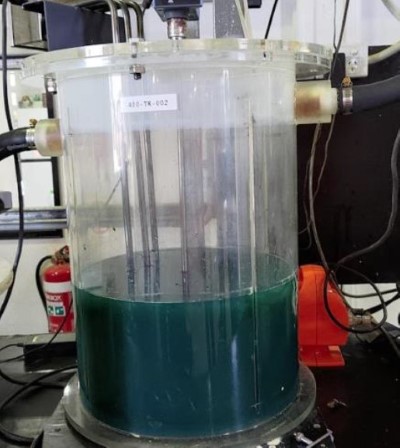
MHP precipitation (source Canaccord Genuity).
Management expects capital costs of A$560 million and noted cost inflation (we account for inflation in our model and use a A$780 million capex assumption) and AISC of US$13.6/lb vs spot of ~US$33/lb.
Given the long mine life and significant volume of cobalt, we believe the project will screen well with supply chain participants.
Critical element in EV supply chain
The BHCP was granted major project status by the Federal Government and various support is being offered to COB through all three levels of government.
Most recently COB received an A$15 million Critical Minerals Accelerator Grant in recognition of its potential position within the supply chain.
We think that once the demonstration plant is operational and the offtake agreements are signed there is strong potential that the government sources of funding will be offered to COB given its strategic nature, its ESG credentials (non-DRC cobalt) and its potential for long-life operations (supporting the community).
Processing
COB has developed its process flowsheet in-house for treating cobalt hosted in pyrite to produce either mixed hydroxide product (MHP) or cobalt sulphate.
While novel, the process builds on established technologies, reducing volumes of material processed through concentration before more power-intensive, resulting in a grade uplift.
Furthermore, the process addresses a number of constraints on capital costs, operational costs, waste products and revenue-generating products.
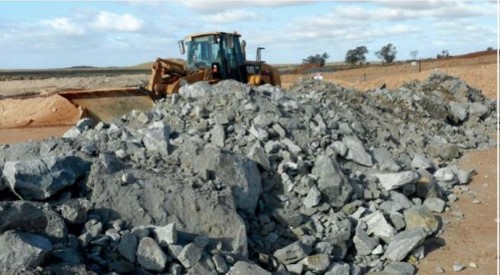
Freshly extracted ore sitting on the ROM (source Canaccord Genuity).
The cobalt is found within the pyrite and the grade of cobalt-bearing pyrite is consistent at 0.5% cobalt. The pyrite is calcined to produce pyrrhotite and elemental sulphur, with 45% of the sulphur recovered into a saleable product.
The pyrrhotite is then leached at a low temperature (120-140°C) and low pressure (2-15 bar) in an autoclave. Cobalt extraction into solution generally shows recovery >95% with oxygen consumption of 250kg/t.
The final step is MHP recovery from leach solution. Minor metals are recovered prior to MHP precipitation via precipitation, ion exchange and solvent extraction.
Unlike most MHPs on the market, cobalt is the dominant mineral with >30% cobalt and 7% nickel (most MHP is ~30% nickel 3% cobalt).
COB expects both metals to be payable, and we believe refiners will value the material given it allows flexibility in product blends. The leach residue is removed by filtration and further processed for sulphur recovery by remelting.
Timeline
Cobalt Blue expects completion of the demonstration plant in July followed by commissioning and ramp-up.
Demonstration results will be incorporated into the DFS, provide product sampling and proof of concept for customers allowing COB to work towards offtake agreement/strategic partnerships ahead of FID.
The company plans to lock in project partners/offtake by the end of 2022 with product samples sent to over 25 customers, including OEMs, traders, battery manufacturers in the EU, Asia, US, India and Korea.
Following this, the company expects to deliver the DFS with key approval in 2023.
We assume a two-and-a-half-year construction period and first production in FY26 and an 18-month ramp-up period to nameplate production.