
White Rock Minerals Ltd (ASX:WRM, OTCQX:WRMCF) has delivered bonanza grade hits including 0.2 metres at 140 g/t gold within 0.5 metres at 51.6 g/t during diamond drilling at Exhibition Reef of the Morning Star Underground Gold Mine in Victoria.
The company’s primary objective at Morning Star is a low capital cost restart of gold production from multiple reef locations and the new results provide further confidence in the strategy.
Notably, the Exhibition Reef high-grade gold target area is potentially more than 100 metres in strike length and up to 40 metres down-dip, delivering bonanza and high-grade hits including:
- 0.5 metres at 51.6 g/t gold, including 0.2 metres at 140 g/t;
- 0.4 metres at 35.9 g/t gold; and
- 0.4 metres at 21.2 g/t gold.
Looking ahead, multiple mineralised intersections through the Exhibition Reef provide encouragement that this area, close to the shaft and existing development between 3 Level and 4 Level, will provide an additional ore source once mining recommences.

Exhibition Reef potential
WRM plans to kick off low cap restart of production at Morning Star by identifying and drilling areas of the dyke with potential to host multiple high-grade gold quartz reefs proximal to existing underground development infrastructure.
The Exhibition Reef is one of five potential gold production areas at Morning Star Mine, with mining on track to restart in the September quarter of 2022.
It is a parallel mineralised quartz structure above the Dickenson Reef at the southern end of the mine where development is underway ahead of a mining restart.
White Rock will use current development on the Dickenson Reef to develop an exploration rise into the Exhibition Reef to confirm its potential for near-term mining.
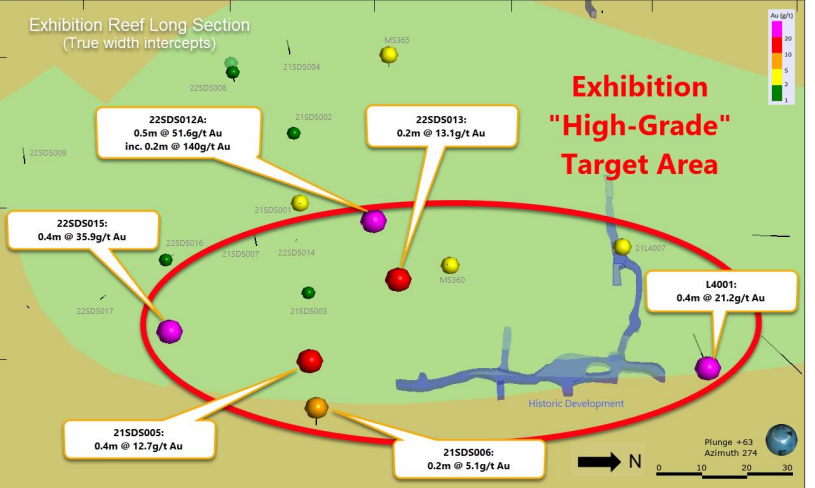
Exhibition high-grade target area.
Developments at Dickenson South
The Dickenson South target area is one such primary target with multiple high-grade, gold-bearing reefs.
The surface drill rig has completed a program of drill holes that assisted in the assessment of near-term development and production potential for further working areas close to the Main Shaft.
In late 2021, WRM commenced surface diamond drilling at the Dickenson South comprising 29 diamond drill holes for 4,055 metres, testing mineralised reefs including the Age of Progress, Stacpoole, Exhibition, Shamrock, Dickenson and Whitelaw Reefs, between surface and 6 level at the Morning Star Mine.
Drilling results have been encouraging, with multiple high-grade intersections across various reefs
These results support the interpretation that there may be an extension of the mineralisation from historic stoping with existing development access near the shaft, through to the southern dyke margin.
Gap Zone potential
Last month, WRM intersected 621 g/t gold — equivalent to 20 ounces a tonne — and abundant visible gold during drilling at the Morning Star Gold Mine’s Gap Zone.
The Gap Zone represents an area with 200 metres of vertical extent between areas of historic mining that occurred above 10-level (>500,000 ounces) and below 14-level (>300,000 ounces), with historic production of 883,000 ounces at 26.5 g/t.
Drilling to date has provided significant encouragement that a number of mineralised quartz reefs are distributed throughout the Gap Zone and exploration will continue to progress from underground, where the drill rig is completing a broad first-pass assessment of the Gap Zone’s potential to host significant mineralised quartz reefs.
Consequently, these results confirm WRM’s s priority of targeting high-grade gold for drill testing in the Gap Zone.
Shares are 8% higher at $0.135.