
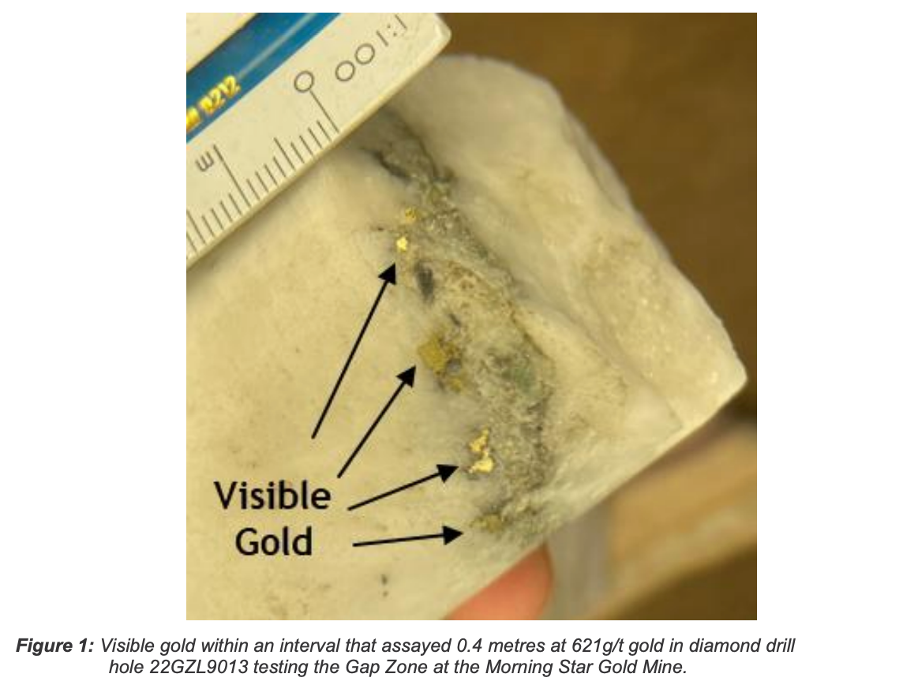
White Rock Minerals Ltd (ASX:WRM, OTCQX:WRMCF) has intersected 621 g/t gold — equivalent to 20 ounces a tonne — and abundant visible gold during drilling at the Morning Star Gold Mine’s Gap Zone in Victoria, Australia.
The 0.4-metre at 621 g/t gold hit confirms White Rock’s decision to test the previously underexplored Gap Zone as a priority diamond drill target.
Promisingly, this result is from the first significant hole drilled by White Rock into the host dyke body.
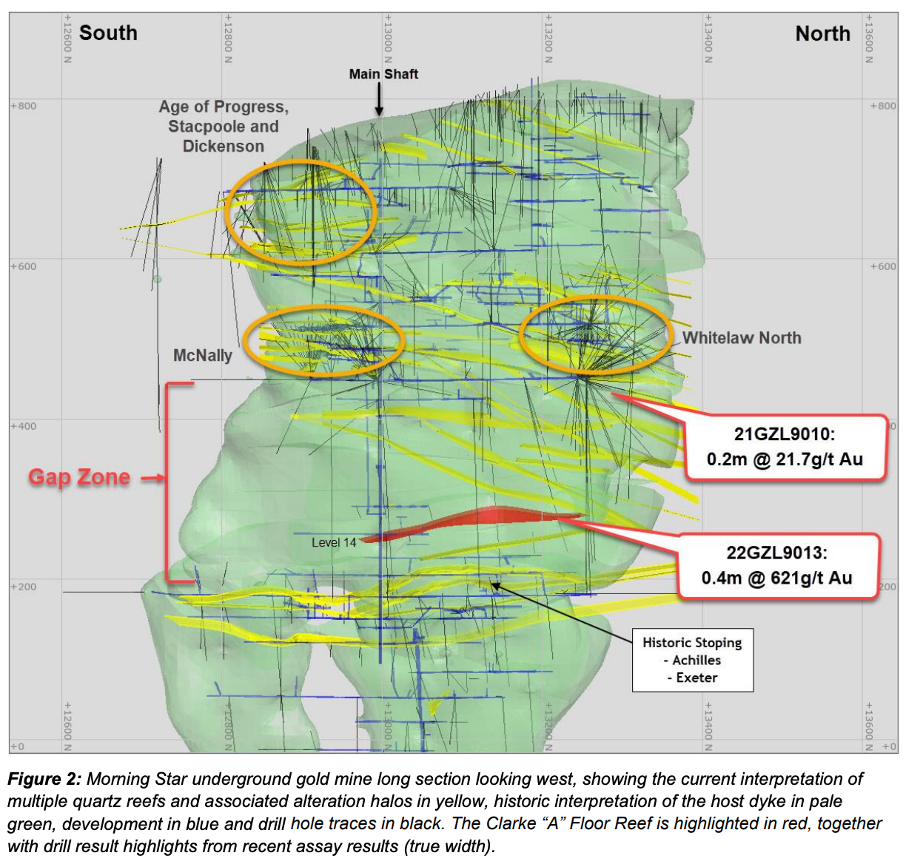
Earlier drilling, at the very northern margin of the host dyke, revealed at least 10 quartz reef structures.
Drilling the Gap Zone
White Rock recently recommenced diamond drilling at the Gap Zone after seeing out its last goal: to determine the near-term gold production potential of new mining areas at the Dickenson, Stacpoole and Whitelaw North targets.
The success of that drilling program provided the impetus for the company to begin pre-production development as it prepares to restart gold production in quarter three of 2022.

As a result, White Rock modified the Gap Zone drill program to provide a broad, first-pass assessment and better understand the target’s potential to host mineralised quartz reefs.
Drilling to date has tested the northernmost 150 metres of the known 600-metre strike extent of the Gap Zone’s prospective host dyke.
So far, White Rock has drilled 13 diamond drill holes for 2,156 metres and identified at least 10 quartz reef structures over 200 metres of vertical depth.
The company intends to test the full 600 metres of strike with a further 25 diamond holes, covering 5,600 metres.
In addition to uncovering at least 10 quartz reefs in the Gap Zone, White Rock is also buoyed by its 621 g/t gold hit.
Investors have responded positively, sending shares as much as 13.7% higher in the first half-hour of trading to $0.125.
What’s next?
White Rock says drilling the northern 150 metres of the Gap Zone has provided enough data to develop a working interpretation of the distribution and geometry of gold mineralised quartz reefs.
The company’s primary objective at the Morning Star Gold Mine within the Woods Point Project is to identify and drill areas of the dyke that have the potential to host multiple high-grade gold quartz reefs.
Using existing development infrastructure will support a low capital restart of production from multiple reef locations.
The Gap Zone is one such primary target in the mine due to its size, multiple high-grade gold bearing reef potential and proximity to existing infrastructure, including the Morning Star shaft.
As a result, White Rock’s first-pass drill program will provide sufficient data to assess and identify which of the Gap Zone’s quartz reefs holds the greatest potential for more detailed follow-up drilling.