
Amplia Therapeutics Ltd (ASX:ATX) has welcomed new preclinical data showing the efficacy of its investigational focal adhesion kinase (FAK) inhibitor, AMP945, in a mouse model of idiopathic pulmonary fibrosis (IPF).

Current pharmaceuticals for IPF
The existing pharmaceutical standards of care for idiopathic pulmonary fibrosis (IPF) include treatment with either OFEV® (nintedanib) or Esbriet® (pirfenidone).
Both of these drugs pose the threat of significant side effects which limit their utility and there is considerable effort underway to find more tolerable and effective treatments for this debilitating and deadly disease.
In 2020, net sales of OFEV® and Esbriet® were respectively EU$2.5 billion (AU$3.7 billion) and CHF$1.1 billion (AU$1.6 billion).
New results from preclinical studies show that in the industry-standard bleomycin challenge mouse model of IPF, AMP945 had comparable activity to OFEV®, the current market leader.
The studies were performed by an independent contract research organisation (CRO) specialising in fibrosis disease models.
Maximum effect reached for current treatments
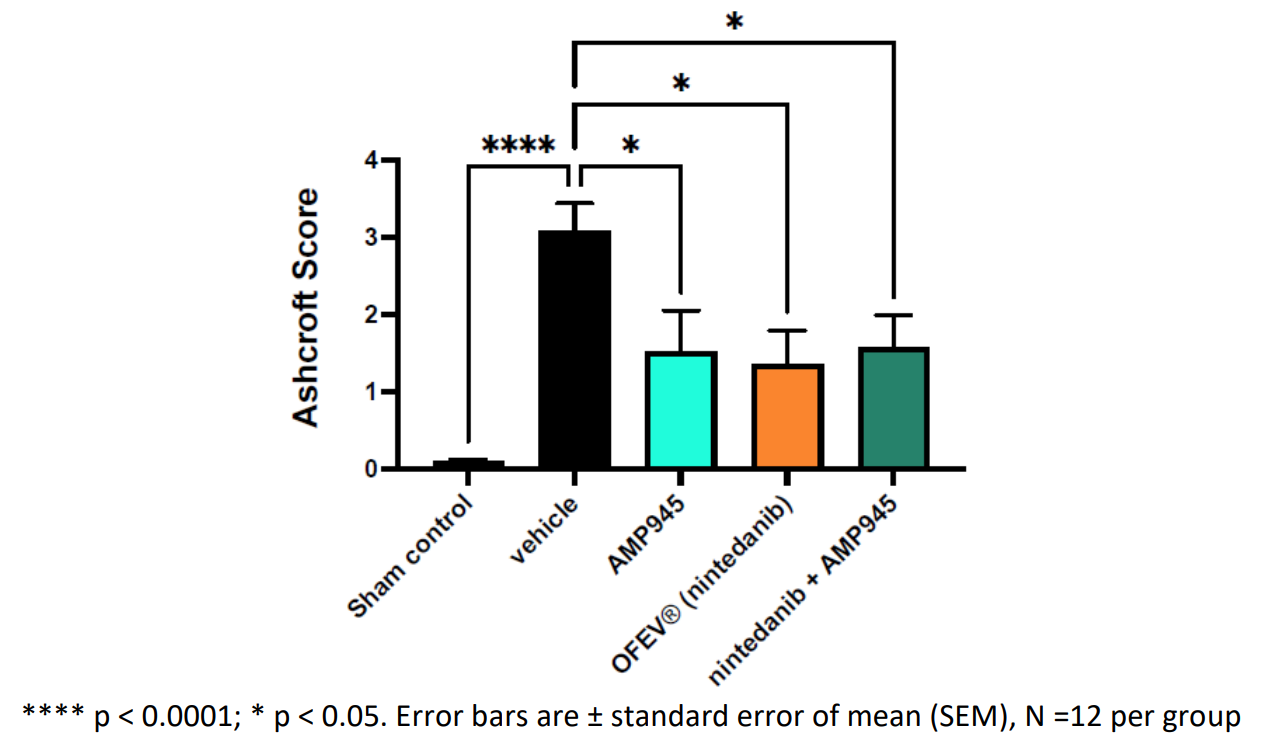
The company notes that, in particular a study arm combining treatment with AMP945 and OFEV®, there was no detectable increase in efficacy. This suggests that, in this model, the maximum effect had been reached for both AMP945 and OFEV®.
The study was designed as a more demanding and meaningful treatment model as opposed to often-used prevention models. Mice were challenged with saline only (sham) or bleomycin and lung fibrosis was allowed to develop for 7 days.
Mice which had been challenged with bleomycin were then randomised into four groups and treated orally with inactive drug delivery vehicle, AMP945, OFEV® or AMP945 + OFEV® for 14 days.
“Statistically significant” reduction
Following treatment, lung fibrosis was measured using the Ashcroft score – a standardised numerical scale used to quantify the extent of lung fibrosis in histological samples.
The figure below shows that AMP945 and OFEV® reduce lung fibrosis to a statistically significant extent, compared to treatment with vehicle.
Amplia CEO and managing director Dr John Lambert said: “We have established that AMP945 is a highly selective FAK inhibitor and our clinical studies to date have shown that AMP945 has an excellent safety and tolerability profile at doses that result in measurable inhibition of its intended target.
“These new results reconfirm the efficacy of AMP945 in the industry-standard preclinical IPF model and show that, in a head-to-head comparison, the activity of AMP945 is comparable to the current market leader, OFEV®.
“This information should provide significant encouragement to clinical investigators and patients in our planned clinical trials of AMP945 in this devastating disease. It will also strengthen our ongoing discussions with potential commercial and strategic partners.”