
FTSE 100 closes down 26 points
Investors worry over US monetary tightening
Sanctions against Russia ramping up
4:50pm: FTSE ends down but off its lows
The FTSE 100 pared its losses by the close but still ended lower on concerns about rising US interest rates and further sanctions against Russia in reponse to the atrocities that have been reported in Ukraine.
London's blue chip index closed 26 points, or 0.34% down at 7,588, above the session low of 7,536.
"After the slide in US markets yesterday on the back of the Brainard and Daly balance sheet and tightening comments, the tone for markets has soured significantly with European stocks sinking sharply as the mood music over more onerous sanctions on Russia ratchets up further in anticipation of that we could well see evidence of further Russian atrocities in the coming days," commented Michael Hewson, chief market analyst at CMC Markets UK.
"While the mood music around energy embargoes on Russian oil and gas still retains a degree of reluctance on the part of the European countries holding out, the direction of travel suggests that it’s only a matter of time before the pressure becomes too much and the hold outs like Germany have to bow to the inevitable lest be accused of condoning genocide."
On Wall Street by London's close, the Dow Jones Industrial Average was 257 points, or 0.74% lower at 34,384, while the broader S&P index shed 1.24% and the tech-laden Nasdaq Composite fell 2.4%.
4:15pm: Shell gains as IEA says it will release more emergy oil
The International Energy Agency said it will release another 60mln barrels of emergency oil to try and offset surging fuel and energy prices.
This addition will boost the 180mln-barrel release, which US President Joe Biden had already announced.
Shell PLC (LSE:SHEL, NYSE:SHEL) was amongst the FTSE 100 ‘top 10’ risers, having climbed 0.5% to 2,132p.
This comes as the US issued further sanctions on Russian individuals and banks, including Putin’s adult children, Sberbank and Alfabank.
Americans will also be stopped from investing in the state-owned nation.
3.28pm: US stocks plummet
As expected, American stocks declined heavily on open, mirroring European markets and extending Tuesday’s losses.
An hour into trade the Dow index sunk 283 points, or 0.8%, as it aimed to avoid consecutive 300+ point plunges.
The Nasdaq, which is heavily technology-influenced, nosedived 332 points or 2.3% to 13,872.
Meanwhile, the S&P 500 was sandwiched between the former US indexes, having given up 1.2% or 54 points.
2.52pm: Fuel cost hikes will be passed on to aircraft passengers
More problems for travelers and the airline industry, with providers expected to pass on rising fuel costs to passengers.
.@IATA says that Jet Fuel Price is up 77% in 2022 so far, versus 2021. Obviously this will reflect in ticket prices. pic.twitter.com/n2VvakOKKL
— Ajay Awtaney (@LiveFromALounge) April 6, 2022
Chief executive of the International Air Transport Association Willie Walsh added that the spike in energy costs will undoubtedly make for bleak reading for the industry.
2.15pm: Tobacco on top
Imperial Brands PLC (LSE:IMB) led the FTSE 100 risers after an improved performance in its next-generation products (NPG).
The tobacco and e-cigarette company, which saw its shares climb 3.7% to 1,675p, said it expected first-half profits to climb 2% on a constant currency basis because of reduced losses in its NPG business.
Tobacco demand has been on a steady decline according to research from the World Health Organisation.
What is “key for any tobacco company in today’s world is how they’re going to transition away from the increasingly unpopular classic tobacco products and build out an offering of NGPs,” Matt Britzman, Hargreaves Lansdown equity analyst, said.
The company behind brands such as Rizla and Winston is one year into its five-year strategy outlined last year, and the anticipated improved performance in vapes and e-cigarettes will be a sign it is on the right tracks.
1.40pm: Retailers retreat
Many retail companies in the FTSE 100 were amongst the biggest fallers, as they continued the downward trend from Tuesday after it was announced sales in the sector plunged 20% between February and April.
Next PLC (LSE:NXT), which was outpaced only by Smurfit Kappa Group plc (LSE:SKG) in its decline, eased 3.8% lower to 5,922p.
Meanwhile, Burberry Group PLC (LSE:BRBY) and JD Sports Fashion PLC (LSE:JD.) were also amongst the blue-chip index’s largest losers, having given up 3.3% and 3.0% respectively.
Scottish Mortgage Investment Trust and British Airways owner International Consolidated Airlines Group (LSE:IAG) SA were other notable stocks helping to bring the FTSE lower, having both slipped 3.5%.
12.59pm: Cobra buying interest rises on strong drilling results
Away from the big caps, Cobra Resources PLC (LSE:COBR) strong start to the day continued into lunchtime on the back of strong buying interest.
The gold explorer announced positive results from its Wudinna Gold Project in Southern Australia, with all holes, at a 350 parts per million (PPM) total rare earth oxide (TREO) cut-off, producing significant intersections.
Meanwhile, at a 500 PPM TREO cut-off, 81% or 13 of the holes returned multiple substantial intersections per hole.
The group said it will publish outcomes from a further 104 holes at two different projects later this month.
Its shares jumped 20% to 2.76p on the news on Wednesday.
12.10pm: US markets to open lower
US stocks are expected to extend Tuesday’s losses triggered by Federal Reserve Governor Lael Brainard’s hawkish comments, with the overall market likely remaining muted as investors sift for further clues on the policymaker’s approach in the minutes of its March meeting expected later today.
Bond yields rose to their year highs, pointing to the possibility that the world’s largest economy may be headed for a recession after Brainard said she expects a combination of interest rate increases and a rapid reduction of the Fed’s near US$9 trillion balance sheet to bring US monetary policy to a “more neutral position” later this year.
Futures for the Dow Jones Industrial Average fell 0.55% in Wednesday pre-market trading, while those for the S&P 500 were 0.67% lower, and contracts for the tech-heavy Nasdaq-100 slipped 1%.
The Fed’s release later today of the minutes of its March meeting is expected to keep traders sidelined as they digest fresh details on the central bank's plans to shrink its balance sheet to tame inflation. But activity in Fed funds futures is already indicating a more than 75% chance of a 50 basis-point increase at its May meeting.
“In this tense environment, investors will be closely watching the Fed minutes today. There would be no surprise if the Fed hinted a 50 basis-points hike in the next meeting. Yet, what will really make the difference is the speed at which the Fed will shrink the balance sheet. And there is a big potential for a hawkish pricing on this front,” said Ipek Ozkardeskaya, senior analyst at Swissquote Bank.
“The market risks remain tilted to the downside given the hawkish shift in Fed officials’ latest comments. Scary inflation figures, combined with abnormally strong jobs reports and higher wages support the idea that if there is a good time for the Fed to hit the brakes on its ultra-lose policy, it is now.”
Brent crude futures rose 1.2% to $107.96 a barrel in the commodities market.
“The black gold is trying its best to stay in positive territory … the chances of sanctioning Russian oil are minimal, and traders do not see any supply issues, keeping oil prices in check. Both crude and Brent oil prices continue to stay above the critical level of $100, which indicates that bulls are still very much in control of the price,” said Naeem Aslam, chief market analyst at Avatrade.
In premarket trading, Twitter fell 2.2% after rising this week on Tesla chief executive Elon Musk’s acquisition of a large stake in the social media company.
11.00am: Government proposes new energy security body
The UK government said it will make a new energy security body, The Future System Operator, which will oversee most non-renewable and green sources of power.
This “whole system” approach was aimed at reducing reliance on Russia and accelerating the move towards renewable energy.
Greg Hands, energy minister, said: “Russia’s appalling aggression in Ukraine amid escalating global gas prices has shown the vital importance of strategic change to the UK energy system.
“We need to boost our energy resilience, reduce our dependence on expensive imports and slash emissions.”
10.20am: UK construction rises in line with costs
March saw a continued rise in UK construction output, but inflationary pressures and war continued to hit sentiment for the sector, according to S&P Global.
The headline S&P Global / CIPS UK Construction Purchasing Managers’ Index (PMI) – which measures month-on-month changes in total industry activity – registered 59.1 in March, unchanged from February and well above the 50.0 mark that separates expansion from contraction. The latest reading signalled the joint-fastest rate of output growth since June 2021.
Commercial work was the best-performing segment in March at 60.8, with projects restarting after the lifting of pandemic restrictions. This part of the construction sector has seen output growth accelerate for three months in a row and the latest upturn was the strongest since June 2021.
In contrast, the recoveries in civil engineering at 56.3 and residential work at 54.9 lost momentum last month. The latter saw the slowest expansion of the three broad categories monitored by the survey.
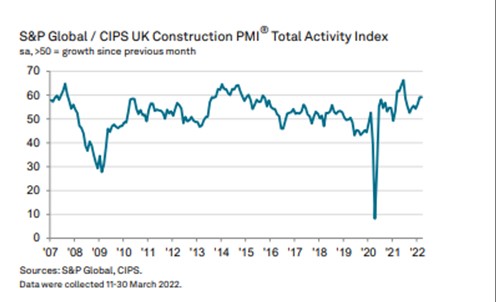
Concerns about the war in Ukraine, forecasts of severe cost inflation and a less favourable global economic outlook all weighed on constructors' confidence in March. Around 48% of the survey panel expect a rise in business activity during the year ahead, while only 15% predict a decline. However, the balance of positive sentiment was the weakest seen since October 2020.
“Escalating fuel, energy and commodity prices led to the fastest rise in costs for six months. Intense inflationary pressures appear to have unnerved some construction companies. Business optimism slipped to its lowest since October 2020 on concerns that clients will cut back spending in response to rising prices and heightened economic uncertainty,” said Tim Moore, economics director at S&P Global.
9.46am: Royal Mail the biggest faller
London’s blue-chip index has fallen 46 points so far, down to 7,567.
Royal Mail leads the way as the largest faller, down 4.21% to 318.5p, closely followed by Airtel Africa, losing 3.62% to 133.3p.
9.00am: Quick snapshot of the market
FTSE 100 opened lower, losing 31 points to 7,581. London’s blue-chip index had resisted the stock slide seen in America as investors mull the prospect of quantitative tightening from the US Federal Reserve.
Twitter confirmed that it was working on an edit button for tweets but denied that the idea came from Elon Musk. The billionaire acquired just over a 9% stake in the company this week which sent the shares soaring.
Imperial Brands leads the way as Footsie’s biggest climber so far today. The tobacco company informed investors in its trading statement that it is on track to deliver full-year results in line with its revised guidance.
The cost of filling a family car with petrol was a third higher in March than a year ago, while it was 40% more expensive for a diesel car. According to RAC Fuel Watch, the chancellor’s 5p fuel duty cut has had little to no effect.
Among the small caps, Gaming Realms gained exposure to Ontario, Canada, with seven mobile games launched. More content is expected to be certified “very soon”, with agreements to go live with many leading operators.
Afritin Mining laid out a plan to more than triple tin production in the coming five years, as well as significantly increasing its lithium and tantalum output. This should raise its revenues five-fold to US$100mln a year.
Eco (Atlantic) Oil & Gas raised nearly £20mln in an oversubscribed City fundraiser – cash that will bankroll its exploration efforts offshore South Africa. Investors subscribed for shares at 30p via a stock placing and a retail offer overseen by Primary bid.
8.19am: Quiet start
The FTSE 100 made a quiet start to proceedings, opening 4 points lower at 7,610.16.
It did, however, largely resist the stock slide that saw the Dow Jones end 280 points lower and knocked 338 points or 2.2% off the Nasdaq.
The potential for fiscal tightening in the US sent investors scurrying for cover.
“A likely escalation of sanctions and the possibility of a more aggressive Federal Reserve combined to pull the rug from markets,” said Richard Hunter, head of markets at Interactive Investor.
6.55 am: Footsie called lower
The FTSE 100 was indicated slightly lower as investors respond to the prospect of ‘quantitive tightening’ potentially to come from the US Federal Reserve, as the central bank seeks to fight inflation.
In London, CFD firm IG Markets saw the FTSE starting on the back foot making a price of 7,590 to 7,593 with just over an hour to go until the open.
“US markets had a difficult session, sliding back on comments from Fed governor Lael Brainard and Mary Daly of the San Francisco Fed, who both suggested that the Fed could start the process of reducing the size of the balance sheet at the same time as raising rates next month,” said Michael Hewson, analyst at CMC Markets.
“Yesterday’s comments put into sharp relief the concerns investors have, that in looking to rein back inflation, the Fed might overplay its hand and tighten too aggressively and tip the economy into recession. This concern looks set to manifest itself into a sharply lower open for markets in Europe this morning.”
Eyes will now be on the Federal Reserve’s meeting minutes later today for more insight.
Wall Street closed lower on Wednesday, particularly the growth stocks.
The Dow Jones was down 280 points or 0.8% at 34,641 whilst the S&P 500 was lower still, giving up 1.26% to close at 4,525.
At the same time, the Nasdaq was down 2.26% at 14,204 and the small-cap Russell 2000 index lost 2.36% to 2,046.
In Asia, Japan’s Nikkei slid 1.49% to 27,373 whilst Hong Kong’s Hang Seng was 1.3% lower at 22,210. The Shanghai Composite dipped only slightly, to 3,282.
Around the markets
The pound: US$1.3075, up 0.02%
Gold: US$1,923 per ounce, up 0.18%
Silver: US$24.36 per ounce, up 0.18%
Brent crude: US$106.87 per barrel, down 0.6%
WTI crude: US$101.84, down 1.39%
Bitcoin: US$45,377, down 2.99%
Ethereum: US$3,366, down 0.8%