The announcement from Oxford University spinout First Light Fusion that it had achieved fusion with a faster and cheaper method than rivals has raised hopes that the long hunt for a feasible form of this energy could finally be around the corner rather than the neverending five-to-ten years away.
Even before Russia’s invasion of Ukraine sent gas and oil prices soaring and restarted discussions about energy security and renewables, the fusion sub-sector has been making strides.
For decades, scientists and money-men have dreamed of the possibilities of developing fusion energy, the process that gives the sun its power.
In part this is because it should provide Earth with unlimited clean power as unlike existing nuclear power technologies, which are based on nuclear fission and the splitting of atoms, there is no long-lived waste, no meltdown risk, and raw materials can be found in abundance.
The problem with replicating the process outside of our nearest star has been that the process has required more energy to perform the fusion reaction than the energy produced, however, if this balance can be inverted and replicated at lower temperatures, known as ‘cold fusion’, the process could potentially produce limitless amounts of clean energy.
READ: Oxford University spinout achieves fusion using 'faster and cheaper' new approach
But the recent purple patch for fusion has included significant steps forward on both temperature and energy output, with First Light’s news today combining lower costs and potentially the speed of the path forward.
Earlier this year, other scientists in Oxfordshire’s Culham Centre for Fusion Energy in Oxfordshire doubled the previous record for energy generated by Fusion power, delivering 59 megajoules for five seconds from the Joint European Torus (JET) facility.
Last year, UK Atomic Energy Authority's MAST (Mega Amp Spherical Tokamak) Upgrade experiment, also at Culham, delivered a tenfold reduction in heat “from a blowtorch level down to more like you'd find in a car engine”.
Rival commercial companies in the space for First Light include General Fusion, a Canadian company backed by Microsoft and Jeff Bezos, which is building a new fusion demonstration plant at Culham to work on its Magnetized Target Fusion technology.
Once operational, which is expected by 2025, successful demonstrations should pave the way for a planned commercial pilot plant, which it is currently pencilling in for “the early 2030s”.
US-based Helion raised US$500mln, with fabled Silicon Valley investor Sam Altman describing the technology as “the most promising approach to fusion I’ve seen”.
The money is to enable Helion to build its Polaris fusion electricity demonstration generator, which it aims to demonstrate net electricity from fusion in 2024 and enable its long-term goal of producing electricity with no carbon emissions for 1 cent per kilowatt-hour.
Next steps for First Light are for a ‘gain’ experiment, where more energy is generated than it put in, which is says is “advancing at pace”.
The company plans to partner with existing power companies to develop a pilot plant using its fusion approach, with the current plan being to have a pilot plant producing around 150 MW of electricity and costing less than US$1bn in the 2030s.
First Light is working with investment bank UBS to “explore strategic options” for the next phase of its scientific and commercial development.
It said it is working with investment bank UBS to “explore strategic options” for the next phase of its scientific and commercial development.
How the fusion technologies differ
First Light
First Light says that, instead of using expensive and high-powered lasers or magnets to generate or maintain the conditions for fusion, its approach is to fire a projectile with a hyper-velocity gas gun that compresses the fusion fuel inside its “highly sophisticated” target.
The design of the “highly sophisticated” target is the key technology, as it “focuses the energy of the projectile, imploding the fuel to the temperatures and densities needed to make fusion happen”, with the resulting implosion accelerating the fuel at over 70 km per second (156,586mph).
First Light reckons its approach to fusion is “simpler, more energy efficient, and [with] lower physics risk” and by being simple this should be “the fastest path to commercially viable power generation from fusion. We aim for simplicity in the power plant engineering, but we also want to make the fusion process itself as simple as possible”. This claim is backed up by the achievement of fusion from less than £45mln spent.
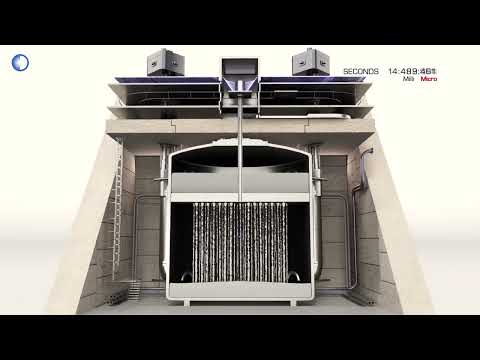
General Fusion
Its prototype machine “drives a forceful, but precisely shaped, symmetric collapse of a large liquid vortex cavity in tens of milliseconds. The forces involved in the full-scale FDP compression system will be immense, pushing the limits of material science, fluid dynamics, and mechanical design".
It is using a collapsing liquid metal cavity to heat and compress plasma fuel to fusion conditions at 100mln °C.
This will take the decades-old idea of using a collapsing liquid metal cavity, with General Fusion using high-speed digital control systems, additive manufacturing techniques and advanced composite materials to “make this concept viable and to de-risk its implementation”.

Helion
Inside a 40ft-long accelerator shaped like a giant dumbbell, where it heats deuterium and helium-3 fuel, Helion’s technique uses powerful magnets to confine the resulting plasma and ramp up the pressure to create a relatively stable donut-shaped ring of plasma called a Field Reversed Configuration (FRC).
Two of these FRCs are then accelerated to 1mln mph (which would be faster than First Light’s “fastest moving object on earth” claim) from opposite ends of its accelerator. When they collide in the bulging handle of the dumbbell shaped accelerator they are further compressed by more magnets until they reach fusion temperatures of 100mln °C.
At this temperature, Helion says, the deuterium and helium-3 ions are “moving fast enough to overcome the forces that would otherwise keep them apart and they fuse. This release more energy than is consumed by the fusion process.”
As a new fusion energy is created, the plasma expands and pushes back on the magnetic field and, by Faraday’s law, “the change in field induces current, which is directly captured as electricity”.

TAE
The oldest of the group, founded in 1998, TAE is now onto its fifth-generation fusion platform, named Norman after fusion pioneer and late co-creator Dr Norman Rostoker, with its next-generation machine called Copernicus coming later in 2022.
TAE uses hydrogen-boron or p-B11 as its base fuel, which is says “represents the cleanest, most abundant fusion fuel cycle on Earth, making it the ideal fuel source for TAE's commercial fusion solution”.
At 88ft, Norman is longer than Helion’s device and creates its FRC using a combination of its power management technology and megawatt-class particle accelerators that inject beams at the plasma’s edge “to drive current, heat and stabilise the plasma”.
It previous device showed the ability to confine and hold plasma indefinitely, with Copernicus a reactor-scale device designed to operate at about 100mln °C to simulate net energy production from its fuel cycle and so “will provide opportunities to license its technology for D-T fusion, while scaling to its ultimate goal”, with commercialisation of p-B11 fusion power plants “beginning by the late 2020s”.