
- FTSE 100 adds 57 points
- BP and Shell wanted despite oil price reversal
- Gold adds to last week's handsome gains
Britain's main equity index closed higher, led by oil and banking stocks, as investors continued to bet on rising interest rates globally, while stronger commodity prices lifted mining shares.
The FTSE 100 index closed nearly 0.8% higher at 7,573.47, with global miners Anglo American and Rio Tinto providing a strong boost to the blue-chip index.
HSBC, Barclays and the Lloyds Group closed higher, extending last week's winning run.
"A low tech exposure, high energy/resources, and large-cap weighting has insulated the UK equity market from the worst of the January global rout," Jefferies analysts wrote in a note to clients.
"Whilst cost pressures both at the consumer and corporate levels are hurting headline confidence and margins, the underlying data points are much more bullish."
3.54pm: FTSE 100 extends gains thanks to oil giants
Helped by a somewhat surprising rally by oil stocks, the UK’s index of leading shares is continuing its progress.
Entering the last hour of trading the index was up 62 points (0.8%) at 7,578, with BP PLC (LSE:BP.) and Shell PLC (LSE:SHEL, NYSE:SHEL, EURONEXT:SHELL) both modestly higher despite a faltering oil price.
READ BP tipped to reveal bumper cash profits thanks to high oil prices
“Oil prices are a little flat at the start of the week with the rally losing a little momentum after nuclear talks between the US and Iran appeared to make positive progress. It seems we're into the final stretch, one way or another, and Biden's decision to restore sanction waivers could signal that they're heading in the right direction,” suggested Craig Erlam at Oanda.
Brent crude is trading some 45 cents (0.5%) lower at US$92.82 a barrel while the US benchmark, West Texas Intermediate, is off 98 cents (1.1%) at US$91.34 a barrel.
“Biden has an additional incentive to reach a deal, given the sky-high crude prices and what a deal could do to ease the tightness in the market just before the midterms. He's tried a coordinated SPR release and let's be honest, it achieved very little. This could make a real difference at a time when crude appears destined for $100 and OPEC+ can't hit their output targets,” Erlam continued.
Elsewhere on the futures markets, gold is adding to recent gains, rising US$8.60 (0.5%) to US1,816.40 an ounce. The yellow metal enjoyed its best week since mid-November last week, with risk-averse investors turning to it as the inflation outlook starts to look scarier.
Talking of defensive investments, consumer goods giant Unilever PLC (LSE:ULVR) is getting some love after a tough start to 2022 that has seen its bid approach for GSK Consumer Healthcare rebuffed and its attempts to refashion itself come under criticism from some fund managers. Not, however, Aziz Alnaim, fund manager of the Mayar Responsible Global Equity Fund, who grumbled, “We note with disappointment the traction the idea of breaking up Unilever has gained in recent days. Far from solving the firm’s issues, we see this approach as the ‘next thing to try’ in the McKinsey-esque, hedge fund driven toolbox. This is symptomatic of thinking which prioritises short term stock market multiples over the longer-term fundamental change required to guide the company back to health.”
Unilever shares were up 1.4% at 3,867.5p.
2.50pm: US indices off to a surprisingly firm start
US indices started the week strongly, with the S&P 500 Index up 10 points (0.19%) and the Nasdaq Composite up 110.94 points (0.79%), clawing back some of last week's losses that came in the wake of Meta’s mega failure last week.
The Dow Jones index is barely changed (+0.07%), however; Neil Wilson from Markets.com said “the volatility remains,” and the small increase in points is “hardly a sign of calm returning.”
In the UK, the FTSE 100 continues to climb further and further, up by 45 points (0.61%) at 7,561.
Irish bookmaking company Flutter Entertainment led the way as today's biggest mover, up 4.25%, with Prudential PLC (LSE:PRU) in second, creeping 2.7% higher.
1.30pm: Lloyds and Rightmove going well despite cooling housing market
The balance of forces influencing house prices point to slower growth as 2022 progresses, according to the EY ITEM Club, commenting on this morning’s Halifax House Price Index release.
The news did not seem to stop property listings website Rightmove PLC (LSE:RMV) or mortgage lender Lloyds Banking Group PLC (LSE:LLOY) occupying two of the top three places on the Footsie leaderboard; both are up 2.1% while the blue-chip index is 35 points (0.5%) to the good at 7,551.
The EY ITEM club noted that housing demand will not receive the support offered by last year’s stamp duty holiday while the rising cost of living and higher interest rates will weigh on price growth.
“Recent months haven’t been short of new house price records. January brought another, with a 0.3% month-on-month (m/m) rise in the Halifax measure of house prices taking the average price to a new record high of £276,759; however, growth in prices in January was the slowest in six months, and presented a less strong picture than the Nationwide measure, which showed prices up 0.8% m/m,” said Martin Beck, the chief economic advisor to the EY ITEM Club.
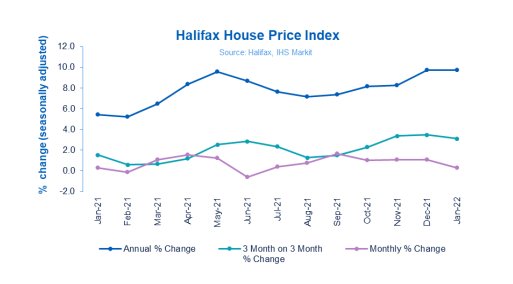
“January’s slowdown in the Halifax measure may be a sign of things to come. This year won’t see a boost to prices from the stamp duty holiday which ran through much of 2021. To the extent the tax holiday brought forward purchases, its after-effects may drag on housing market activity in the near term. Moreover, the EY ITEM Club thinks the Bank of England will add to recent rises in interest rates by raising rates twice more this year, pushing up mortgage rates and the rising cost of living faced by households from higher inflation and tax rises mean it’s likely that fewer people will be able to afford to borrow the necessary amount they need to buy at higher mortgage rates.
“But while house price growth will probably cool this year, the EY ITEM Club doesn’t expect prices to fall. The pile of unplanned savings built up by households during the pandemic will go some way to offsetting the income squeeze and with around 80% of the stock of UK mortgage debt at fixed rates, most mortgage holders are well insulated from increases in mortgage rates in the short term. Meanwhile, the more stringent affordability criteria and mortgage regulation introduced during the 2010s mean recent buyers should be better placed to cope with higher mortgage rates than in the past. And the clear message of housing policy in recent years, such as Help to Buy, the stamp duty holiday and the mortgage guarantee scheme, is that policymakers are willing to do what it takes to avoid a significant fall in house prices,” he added.
12.15pm: US stocks expected to open lower
US stocks were expected to ease back at the start of a new week as investors continue to digest Friday's stronger-than-expected January payrolls report and eye more earnings from major companies including Hasbro (NASDAQ:HAS).
Futures for the Dow Jones Industrial Average were down 0.2% on Monday, while those for the S&P 500 index shed 0.3%, and contracts for the tech-laden Nasdaq-100 futures lost 0.2%.
Friday’s jobs report turned traders’ attention back to Federal Reserve monetary policy, which is expected to tighten as early as next month as the US economy continues to recover.
Neil Wilson, chief market analyst for Markets.com noted: "Wages were up big, jobs growth much better than expected; a reading that gives the Fed carte blanche to hike in March by 50bps should it choose to. Also, there were some massive revisions to prior months.
"Indeed, the market is now pricing in a roughly one in three chance that the Fed raises its funds rate by 50bps next month, swaps show the market is pricing three 25bps hikes by end of June."
Stocks have made a volatile start to the year, amplified last week by extreme moves in tech stocks. Shares in Facebook owner Meta Platforms saw a record-breaking decline following an earnings disappointment, while Amazon.com shares posted their biggest rise since 2015 after its latest quarterly earnings.
The earnings season will roll on today, with meat processing giant Tyson Foods (NYSE:TSN) and toymaker Hasbro (NASDAQ:HAS) scheduled to report ahead of the opening bell. Earnings due later this week include Pfizer and KKR on Tuesday, Uber Technologies and Walt Disney on Wednesday, and Coca-Cola, PepsiCo and Twitter on Thursday.
Meanwhile, Peloton shares soared in premarket trading Monday after The Wall Street Journal reported that the stationary-bike company was drawing interest from Amazon and other potential suitors.
Cryptocurrencies gained Monday, with bitcoin rising 5% having risen above $40,000 on Friday after spending two weeks below that level but oil prices fell amid signs of progress in Iran nuclear talks. Late last week, the US government waived some sanctions aimed at reviving the 2015 nuclear deal. That could mean that restrictions on Iran’s oil industry are lifted, bringing new supply to the market, according to analysts.
Meanwhile, in London, the FTSE 100 was up 22 points (0.3%) at 7,538.
11.40am: House price growth slows in January
The Halifax House Price Index for January indicated the average house price rose by 0.3% from a month earlier, the lowest rise since June 2021.
The annual growth rate remained unchanged at 9.7%, with the average UK house sale now clocking in at £276,759.
House price growth to slow considerably.
According to Halifax:
“While the limited supply of new housing stock to the market will continue to provide some support to house prices, it remains likely that the rate of house price growth will slow considerably over the next year."
— UK Mortgage Advisors (@UKMortgageAdv) February 7, 2022
“House price growth slowed somewhat at the start of the year, rising by just 0.3% in January, the smallest monthly increase since June 2021. This followed four consecutive months of gains above 1%, and with annual growth remaining at 9.7%, the average UK house price was little changed, edging up slightly to a new record high of £276,759. Overall prices remain around £24,500 up on this time last year, and £37,500 higher than two years ago,” said Russell Galley, the managing director of the mortgage lender, which is part of the Lloyds Banking Group PLC (LSE:LLOY).
“Following the peak activity of 2021, transaction volumes are returning to more normal levels. Affordability remains at historically low levels as house price rises continue to outstrip earnings growth. Despite record levels of first-time buyers stepping onto the ladder last year, younger generations still face significant barriers to home ownership as deposit requirements remain challenging,” he added.
The FTSE 100 was up 17 points (0.2%) at 7,534, continuing its impression of the Grand Old Duke of York.
10.57am: Miners in demand; "ongoing inflationary environment should be positive for metal prices”
London's blue-chip benchmark, up 19 points at almost 7,536, is among the minority in the green this morning with European equities having a mixed time of it.
Italy is the big faller, with parts of Asia also not sharing the positive mood.
“There are plenty of reasons for investors to be cautious," says Russ Mould, investment director at AJ Bell.
"Strong US jobs data last week might suggest the Fed pushes up rates faster and harder than currently expected. Ongoing tensions between Ukraine and Moscow also hang over markets like clouds waiting to unleash a fury of rain.
“The reaction to corporate earnings in the US has been somewhat volatile with extreme movements either up or down. Labour cost pressures remain a worry, and inflationary pressures are certainly darkening the outlook for both consumer and business spending.
“On the UK market, miners were in demand as an ongoing inflationary environment should be positive for metal prices.”
Within the FTSE 350 company news, there were two new female CEO announced, at housebuilder Taylor Wimpey (read more here) and at retailer Pets at Home (more here).
As Mould says, there has long been an under-representation of females running top companies in London.
"It is positive to see two appointments that help address this problem," he says, noting that TW's promotion of Jennie Daly makes her the fourth CEO change for a FTSE 100 company already this year, following appointments at Johnson Matthey, Burberry and Anglo American, and the ninth FTSE 100 female CEO.
The 30% Club, which campaigns to increase gender diversity at board and executive-committee levels, notes that research shows diverse companies outperform less diverse peers.
9.55am: Waltzing higher and lower
The FTSE is having a bit of a rollercoaster morning, or maybe more of a waltzer, having sunk into the red after initially climbing higher, and now back up 8 points.
Fallers include Russian steel producer Evraz, now at a year's low amid ongoing tensions over Ukraine.
BP PLC (LSE:BP.), ahead of its results tomorrow, is not far behind, as are housebuilders, as Halifax data showed house price growth slowed to its weakest in five months.
There are also negative financial headlines for the UK about this morning, with Britain's economic recovery expected to slow as consumers start to feel the impact of higher inflation on their wallets, according to the EY Item Club.
The economic forecasting club now sees UK economic growth at 4.9% this year, cut from its former estimate of 5.6% as inflation is now expected to reach 7% in the spring, its highest level since 1992, meaning a fall in real wages.
EY believes the Bank of England (which predicts inflation will balloon to 7.25% by April) will respond to the rise in inflation by hiking its interest rate to 1% by the end of this year, from 0.5% at present following last Thursday's rise.
This comes as Tesco PLC (LSE:TSCO) chairman John Allan warned at the weekend that "the worst is yet to come" for rising food prices.
Explaining that grocers and suppliers were reacting to their own rising costs, he said supermarket prices could rise as much as 5% by the spring as energy and other costs feed through to the High Street, up from around 1% for Tesco in the last three months.
Industry data from Kantar revealed supermarket price inflation of 3.8% for January and 3.5% in December - a four-year high.
UK gilt yields are on the march this morning, with traders seeing a 50% chance the Bank of England will raise rates again next month.
8.29am: Opening in the green
The FTSE 100 opened in the green as London’s traders opted to ignore the global inflation threat and the local political difficulties being endured by Boris Johnson to focus on the positives.
Those ‘positives’ were the stellar reaction on Friday Amazon's earnings (which helped roll back some of the damage inflicted by Meta) and the unexpectedly robust US jobs numbers, which revealed the world’s largest economy was still in growth mode.
If equities greeted the non-farm payroll data with relief, the bond markets went the other way with yields spiking higher.
The underlying problem is still one of rising prices (fuelled now, presumably, by higher wages).
Thursday’s US CPI print will provide some insight on the issue, while possibly providing some guide to future Fed interest rate and monetary policy.
“With an inflation report due later in the week which could show an acceleration of core inflation by 5.9%, there are increasing suggestions that the first hike, widely expected in March, could be by as much as 0.5% with a year-end target of 1.5%,” said Richard Hunter, head of markets at Interactive Investor.
Scottish Mortgage Investment Trust PLC (LSE:SMT), one of Britain’s biggest Silicon Valley investors, was up 2.4% after it benefited from Friday’s tech sector rally.
6.50 am: FTSE set to open in the green
The FTSE 100 looks set to open the new trading week in the green following a mixed start in Asia.
Mainland China returned from the lunar new year with a bang, while the Nikkei was hit by the weak performance from the industrials sector.
Markedly better-than-expected US jobs numbers on Friday, along with upward revisions to the November and December prints, soothed economic growth worries but did little to salve inflation concerns.
“As we look ahead to the upcoming week, inflation expectations for the US economy are likely to encounter a new challenge with the release of US CPI [inflation] for January on Thursday, which is expected to rise,” said Michael Hewson, an analyst at CMC Markets.
“Friday’s payrolls report had the effect of pushing yields higher while keeping inflation expectations in check. This week’s US CPI report may well not have the same effect, which means last week’s volatility is unlikely to be a one-off.”
Here at home, the Downing Street soap opera looks set to rumble on with the PM pledging to hit the ‘reset button’ after a series of departures in the wake of the ‘Partygate’ saga.
Over the weekend it was announced that cabinet office minister Steve Barclay is set to become Boris Johnson’s chief of staff, while Dame Emily Lawson, the head of NHS England’s vaccination programme, is reported to be the new permanent secretary at No 10.
Moving from Westminster to the City, it looks set to be a big week for scheduled corporate news with updates from GlaxoSmithKline, AstraZeneca, Ocado and BP.
Around the markets
- Sterling US$1.3523 (-0.01%)
- Bitcoin US$42,775.80 (+0.85%)
- Gold US$1,810.40 (+0.14%)
- Brent crude US$93.49 (+0.24%)
6.50am: Early Markets - Asia / Australia
Asia Pacific markets were mostly lower on Monday after the US national security advisor Jake Sullivan warned on Sunday about the possibility of an imminent Russian invasion of Ukraine.
Japan’s Nikkei 225 fell 0.70% while South Korea’s Kospi slipped 0.19% to 2,745.06.
The Shanghai Composite in China jumped 1.82% after being closed last week for the Lunar New Year holidays, but Hong Kong’s Hang Seng index dipped 0.34%.
Australia’s S&P/ASX200 edged 0.13% lower even as the government’s decision to reopen the borders in two weeks helped lift the mood.