
Stellar Resource Ltd’s flagship Heemskirk Tin Project, which has the highest-grade of undeveloped tin resource in Australia and the second-highest worldwide, is well-positioned to take advantage of the booming tin market.
Tin prices have soared since the start of 2021, exceeding 10-year highs.
The London Metal Exchange (LME) spot tin price averaged around US$34,800 per tonne over the September quarter and since climbed further, trading in the $38,000 to $39,000 per tonne range since mid-October due to strong physical global tin demand growth.
This strong tin demand growth, combined with falling global tin supply over the past three years has resulted in an extremely tight market for tin with LME tin stocks at record lows.
It is thus an excellent time to capitalise on market forces.

Drilling aimed at extending mineralisation at Heemskirk well underway
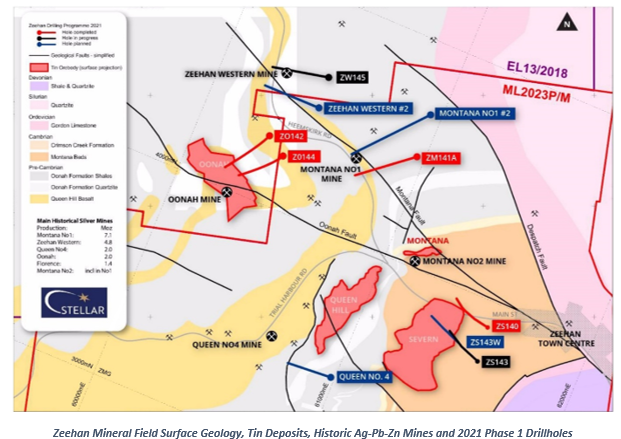
A 9-hole Phase 1 diamond drilling program (for ~4,900 metres) using two rigs commenced in June 2021, targeting new areas of high-grade tin mineralisation commenced in June 2021 with two rigs on site including:
- Severn program - Two holes targeting depth extensions below the Severn tin resource. Severn is the largest of the four deposits comprising the Heemskirk Tin Project and remains open at depth; and
- Depth extensions of key historic silver-lead-zinc mines - Seven holes targeting depth extensions below key historic silver-lead mines with typical ore grades of 20 to 100 oz/t silver. Hole target depths test where interpreted transition of silver-lead-zinc mineralisation into cassiterite mineralisation may occur.
Four holes have been completed and two holes are in progress with a total of 3,021 metres drilled to October 28, 2021.
Hits multiple wide tin zones in first drill hole at Heemskirk
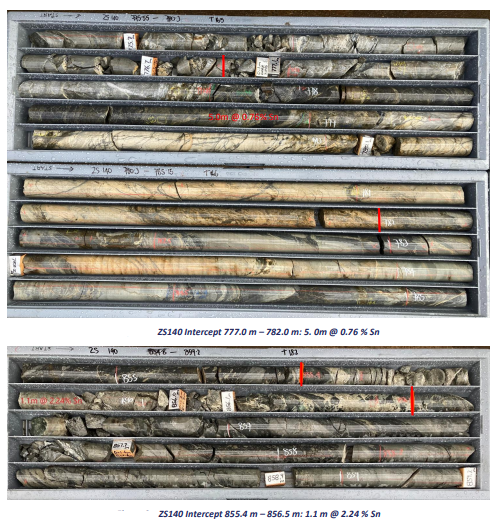
Stellar recently reported multiple wide tin zones from the maiden hole in its phase one drilling program at the Heemskirk Tin Project in Tasmania.
The technology metal explorer unearthed a series of high-grade tin hits from hole ZS140, roughly 240 metres down-dip from an existing mineral resource at Heemskirk’s Severn deposit.
READ: Stellar Resources hits multiple wide tin zones in first drill hole at Heemskirk
Severn is the largest of four deposits that make up the flagship Heemskirk Project, and it remains open at depth, meaning Stellar is keen to better understand its scope.
A deeper look at the Heemskirk Tin Project
The Heemskirk Project includes four nearby tin deposits: Severn, Queen Hill, Montana and Oonah.
Stellar holds secure mining leases over the project, including the tailings pipeline route and tailings storage site.
It also owns a portfolio of nearby exploration licences (ELs), including the Montana Flats and Mount Razorback Els, which contain several historic silver-lead-zinc mines with associated tin mineralisation, and the St Dizier and Mount Razorback satellite tin deposits.
Enviable location
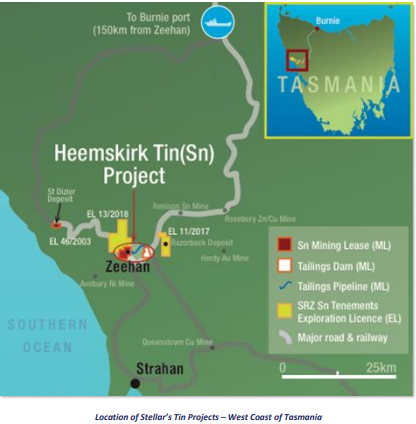
The company’s tin projects have an enviable location within the well-established mining district on the West Coast of Tasmania, with access to established infrastructure including water and renewable power, the port of Burnie 150 kilometres to the north via sealed highway for export of concentrate, and a competitive local market for services, mining and processing inputs and labour.
It is also just 18 kilometres to the southwest of the Renison tin mine, the largest and most productive tin mine in Australia.
Including Renison, there are five major underground metal mines, three of which are operating, within 30 kilometres of the Heemskirk Project.
Australia’s highest grade undeveloped tin resource
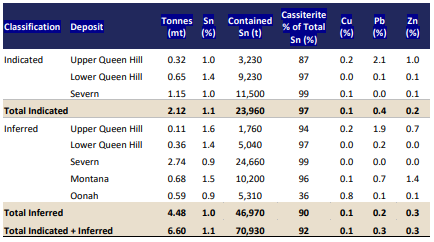
The Heemskirk Project has a total mineral resource of 6.6 million tonnes at 1.1% tin at a 0.6% cut-off grade, of which 2.12 million tonnes is in the indicated mineral resource category and 4.48 million tonnes is in the inferred mineral resource category.
All deposits have higher grade zones and are amenable to mining at higher cut-off grades, as well as open at depth.
The St Dizier tin deposit has a total mineral resource of 2.26 million tonnes at 0.61% tin, of which 1.20 million tonnes are in the indicated mineral resource category and 1.06 million tonnes is in the inferred mineral resource category.
Heemskirk is the highest grade undeveloped tin resource in Australia and the second highest grade tin resource globally.
2019 scoping study confirms attractive economics
In October 2019, Stellar announced the results of its Heemskirk Tin Project Scoping Study based on the development of an underground mine, processing plant, tailings storage facility and surface infrastructure to mine ~ 350ktpa ore at a LOM head grade of ~ 0.95% tin from the Queen Hill and Severn tin deposits over a 10-year initial mine-life.
The project also includes open-pit mining of the St Dizier satellite tin deposit and trucking of ore to the Heemskirk processing plant during year 11 of the mine plan. The processing plant is expected to produce ~4,500tpa of concentrate containing ~2,200tpa of tin.
Concentrate produced will be trucked 150 kilometres to the north via sealed road to the Port of Burnie for export to smelters in Asia. The 2019 scoping study confirmed the Heemskirk Tin Project has attractive economics.
Phase 2 drilling program
Stellar is continuing its review of a larger Phase 2 Heemskirk tin drilling program, which includes a deep hole targeting the potential main conduit of mineralising fluids at Heemskirk and an indicated resource infill drilling program over key Heemskirk deposits.
PFS/BFS completion
Other project workstreams and studies required to advance the Heemskirk Project to pre-feasibility study (PFS) and bankable feasibility study (BFS) completion are also now under review by Stellar.
Many of the project workstreams and studies have already been completed to a PFS level.
Work towards completion of the Development Proposal and Environmental Management Plan (DPEMP) is well progressed with environmental assessment program agreed and stage 1 surveys completed.
Tin demand
Physical tin demand is growing due to increasing global usage of electronics, driven in part by COVID-19, and the increase in remote working boosting demand for computers and other home electronics devices.
As tin solder is the ‘glue’ connecting everything electronic, this has effectively meant an increased demand for tin.
There has also been a continued demand for tin in traditional uses such as tinplate, chemicals, lead-acid batteries, alloys, among others.
On the other hand, the global tin supply has fallen in the past three years. Production has fallen this year from the world’s top four producers - China, Indonesia, Myanmar and South America.
The #1 new technology metal
Tin has been ranked as the top metal best placed to benefit from new technology, according to a survey by Boston’s Massachusetts Institute of Technology (MIT) for Rio Tinto in 2018.
Around 50% of all tin is used as solder in electronics.
Further, the world’s clean, new technology future is being driven by robotics, advanced computing, electric vehicles, energy storage and renewables.
Growing research is also showing that tin may be a more effective anode material in lithium-ion batteries.
Tin isn’t the only metal in Stellar’s arsenal: NE Tasmania Gold Exploration Project
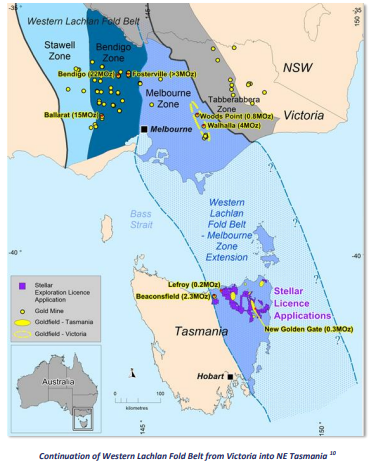
Gold deposits in North East Tasmania lie within a continuation of the Western Lachlan Fold Belt in Victoria – one of the world’s largest orogenic gold provinces and hosts the more than 3 million ounces Fosterville Mine, Bendigo and other Tier 1 goldfields.
NE Tasmania hosts the Beaconsfield Mine (2.3 million ounces), New Golden Gate Mine (0.3 million ounces) and Lefroy Goldfield (0.2 million ounces), along with hundreds of smaller historic gold mines and occurrences.
While Victoria is currently experiencing intense gold exploration activity, NE Tasmania has had very little modern gold exploration undertaken.
Stellar’s holds eight exploration licences (ELs) covering 1,899 square kilometres in NE Tasmania which were granted in August 2021.
Stellar also has two EL applications over the Beaconsfield South and Scamander areas, covering a combined area of 384 square kilometres, which are expected to be granted in November or December 2021.
Two further EL applications were lodged by Stellar in March 2021 covering a combined area of 240 square kilometres in the South Scamander, Pyengana and Quakers Ranges areas. These two ELs are expected to be granted by around the end of January 2022.
Stellar’s eight granted ELs and remaining four EL applications in NE Tasmania are highly prospective for Victorian-style orogenic gold and for intrusive-related gold systems (IRGS).
NE Tasmania Gold exploration program
Dr Josh Phillips, who was engaged in September 2021 to lead Stellar’s NE Tasmania exploration program, has completed a review of Stellar’s NE Tasmania EL’s/EL applications.
This included analysis of further historic soil and rockchip geochemical data recently captured by Stellar, and a review of all desktop orogenic and IRGS gold exploration targets identified by Stellar’s technical team.
Additional desktop targets have been identified and all targets are now being prioritised for field exploration.
Initial field reconnaissance to the Back Creek area on EL12/2020 and to the Blessington area on EL14/2020 was undertaken in September and October, with follow-up exploration over these targets now being planned.
Further reconnaissance visits and follow-up field exploration are now being planned. Field support personnel and drilling contractors have been identified for the exploration program.