
Cobalt Blue Holdings Ltd (ASX:COB, OTC:CBBHF)’s strong progress at its Broken Hill Cobalt Project (BHCP) in Far West New South Wales is supported by encouraging current and future trends in the cobalt market and burgeoning electric vehicle (EV) sales.
As the only ASX-listed pure-play cobalt company, COB is developing an integrated cobalt supply program centred on the BHCP and incorporating the production of samples from a Pilot Plant for potential global partners and customers.
This Global Sample Program will be expanded by a Demonstration Plant that will supersede the pilot operations early in 2022 to produce larger samples.
Encouraged by market trends
Cobalt has a role to play in the EV revolution that is sweeping the world as part of the global transformation to a cleaner, greener and more sustainable future.
As a future ethical supplier of cobalt, COB is encouraged by trends in EV use in China, Europe and the US along with developments in India where the Government is implementing reforms to accelerate new low carbon sectors such as renewable energy, energy storage and electric mobility.
Electric vehicles take off
There has been a strong uptake in sales of Battery Electric Vehicles (BEVs) and Plug-in Hybrid Electric Vehicles (PHEVs) in recent times.
In June and July of 2021, China recorded its strongest monthly sales for these vehicles while EV sales in Europe in the first six months of 2021 were up almost 160% on the same period of what was a record-breaking 2020.
This trend has even been replicated in the US, the third-largest market after Europe and China, which has typically lagged behind both in EV sales. The US achieved its best three-month period to date for EV sales.
Historically, much of the growth in sales has been driven by government incentives in the shape of tax exemptions and purchasing grants but China and the EU have both shown that EV demand is now able to withstand reductions in incentives.
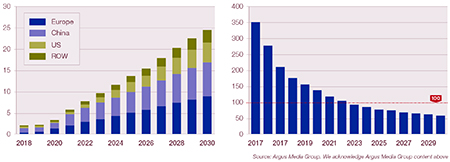
LEFT: Global EV car sales (million units). RIGHT: Lithium-ion battery prices ($/kwh).
Falling battery prices
A key driver in vehicle sales is economic and for EVs this is driven by falling battery prices. Batteries are a key component of retail pricing and had made EVs more expensive than conventional Internal Combustion Engine (ICE) vehicles.
Today, many EVs are already less expensive on a lifetime basis due to the comparatively low cost of electricity, but consumers are sensitive to sticker prices which is why purchase grants had been so effective.
Production economies of scale, technological advances and changes in the choice of battery chemistry have combined to push down EV battery prices, which will reach a nominal US$100/kWh — a benchmark price level at which EVs will assume price parity with ICE vehicles — by 2022-23.
EV consumer survey
Reflecting the growing interest in EVs is the 5th annual EV consumer survey in six of the largest global car markets conducted by the UBS Investment Bank.
These trends as shown in the figure below show a strong purchasing trend in play in the US, particularly after the 2020 Federal election.
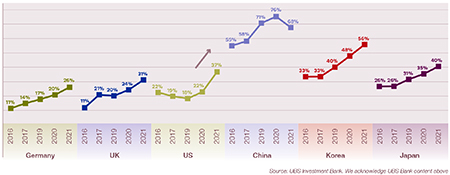
UBS Investment Bank survey – Are you likely to consider buying a BEV? (%, by region) – Answer “Likely”.
The survey underpins that consumers are not only more likely to buy an EV than in previous surveys but also that their key concerns and pushbacks about EVs, including high price, limited range and access to charging, are easing.
For the first time, purchase intentions for (full battery) EVs are also higher than for Plug in Hybrid Vehicles.
Spotlight on India
COB is also keeping a close eye on the ‘cobalt potential’ of the Indian market.
Government reforms include production linked incentives for multiple sectors such as advanced chemistry cell battery storage for electric vehicles. Its current target is to have 30% of vehicles powered by electricity by 2030.
The International Energy Agency (IEA) forecasts India to develop 50 Gigawatt hours (GWh) of cell manufacturing capacity by 2025, however by 2030, total demand for lithium-ion batteries will reach about 492 GWh, representing greater than 50% annual growth later this decade.
Demand will be driven by grid-scale storage and EVs, which together are expected to account for approximately 98% of overall battery storage and as a result, India plans to establish significant downstream capacity for EVs and lithium-ion batteries.
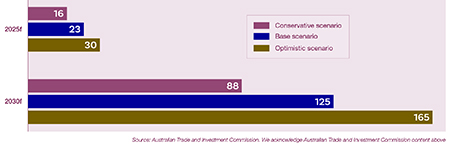
Cumulative Indian cobalt market demand potential (ktpa).
The figures above highlight the cobalt demand growth over the 2025–2030 period under three scenarios as defined by the Australian Trade and Investment Commission.