
White Rock Minerals Ltd (ASX:WRM, OTCQX:WRMCF) has started a surface diamond drilling program to test multiple mineralised quartz reefs within Dickenson South target area at the underground Morning Star mine, part of the newly acquired Woods Point Gold Project in Victoria, Australia.
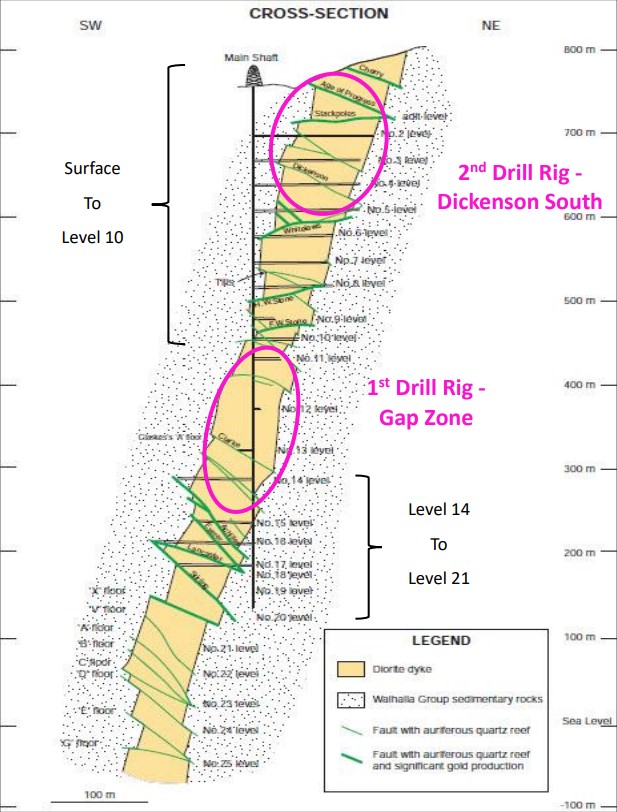
A 3,000-metre diamond drill program from surface has commenced at Morning Star to test the 100-metre strike extent of quartz reefs within the host dyke immediately south of historic stoping on the Dickenson and Shamrock reefs.
The diamond drill operating at Dickenson South is the second diamond drill rig to commence testing the high-grade gold potential at Morning Star.
It was just last week, that WRM began its major underground diamond drilling program.
The first drill rig is testing an under-explored 200-metre zone between 10-level and 14-level, referred to as the Gap Zone – a high priority, high-grade exploration target at Morning Star.
Target contains high-grade gold
The Dickenson South target contains the Dickenson, Shamrock, Exhibition and Stacpoole reefs, all of which contain high-grade gold mineralisation along strike to the north.
Diamond drill contractor Deepcore Australia Pty Ltd has mobilised a track-mounted surface drill rig and is currently drilling the first hole of Ring 1 at the Dickenson South target.
This target is only sparsely drill tested with historic drill hole intersections at the southern end of the host dyke including:
- 2.6 metres at 16.9 g/t gold including 0.3 metres at 132.7 g/t (MS364); and
- 0.8 metres at 13.2 g/t including 0.3 metres at 33.4 g/t (20MS01).
Quartz reef face sampling along the 4-level drive in the vicinity of historic stoping of the Dickenson Reef is close to the main shaft. Previously returned results include:
- 0.6 metres at 3,140 g/t gold;
- 0.5 metres at 127 g/t
- 0.5 metres at 3.8 g/t; and
- 0.6 metres at 2.3 g/t.
WRM is conducting a first-pass drill program totalling 3,000 metres in 16 drill holes.
The program is planned to provide systematic coverage across the Dickenson South gold target, with three drill hole rings on sections spaced 20 to 40 metres apart.
Each ring has five to six drill holes planned to test from surface through multiple known high-grade gold quartz reefs including Cherry, Age of Progress, Stacpoole, Exhibition, Shamrock and Dickenson, prior to terminating around 5-Level where the Whitelaw Reef was extensively mined during the 1920s (65,421 tonnes at 31.2 g/t gold for 65,600 ounces).
Drill hole toe spacing (the distance between the bottom of each hole in each ring) is nominally 20 metres.
The first-pass drill hole spacing is sufficient to identify quartz reef structure geometry, that in conjunction with gold grade, is key to defining the most attractive individual quartz reef positions within the dyke for more detailed drilling before any development decisions are reached.
Primary objective
WRM is looking to identify and drill areas of the dyke that have the potential to host multiple high-grade gold quartz reefs.
It will use existing development infrastructure for a low capital restart of production from multiple reef locations.
The Dickenson South target area is one such primary target in the mine due to its size, multiple high-grade gold-bearing reef potential, proximity to surface and existing infrastructure.
WRM is also working to further targets along strike to the north and plans to continue drilling from surface before remobilising the drill rig onto regional exploration targets during the coming summer months.