
White Rock Minerals Ltd (ASX:WRM, OTCQX:WRMCF) has started a major underground diamond drilling program at the Gap Zone, a high priority, high-grade exploration target at the Morning Star mine, part of the newly acquired Woods Point Gold Project in Victoria, Australia.
Diamond drill contractor Deepcore Australia Pty Ltd has begun work with an underground electric hydraulic rig drilling the first hole of Ring 3 at the northern end of the Morning Star mine.
Woods Point was acquired by White Rock when it merged with ASX-listed AuStar Gold and the keys were handed over less than two months ago. This project also came with a highly prospective and under-explored Victorian goldfields tenement package covering 670 square kilometres.
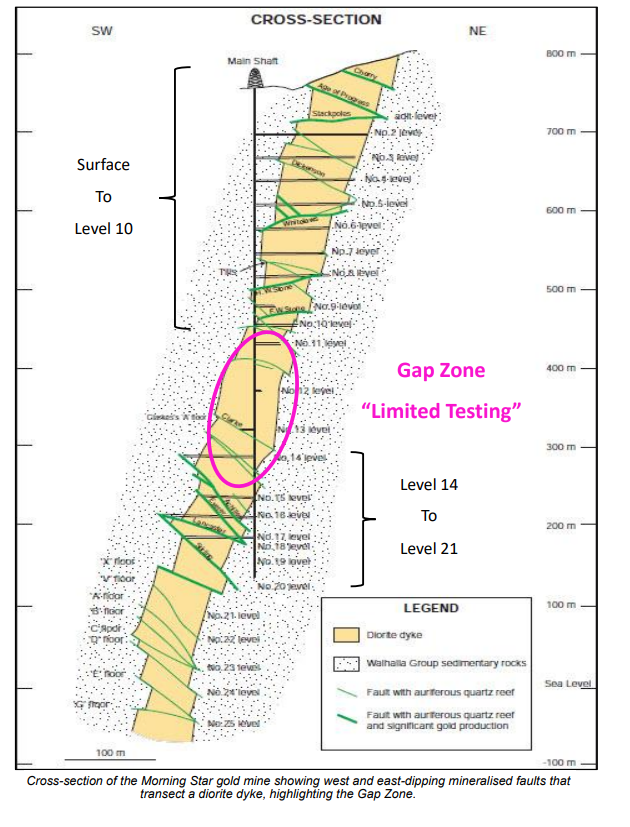
Gap Zone explained
Historic exploration is limited throughout the Gap Zone with historic mining having pursued high-grade gold mineralisation above the Gap Zone prior to World War II and then below the zone prior to its closure in 1963.
White Rock's managing director and CEO Matt Gill told Proactive, "This drill program focuses on an area at the underground mine that has had no recorded gold production, yet above this zone, more than 500,000 ounces of high-grade gold was mined, and below more than 300,000 ounces of high-grade gold had been mined. Hence - there is a 'gap' in the middle.
"You may ask 'Why is there this gap?' Great question. We do not see any geological reason for such a gap; we believe it was the result of certain activities and focus back in the period on either side of World War II. Our drilling will hopefully answer this question."
Historic production of 883,000 ounces of gold at 26.5 g/t has been reported from quartz reefs distributed over a total vertical extent of 500 metres, excluding the under-developed Gap Zone, a 200-metre vertical extent.
Exploratory potential
At the time of historical closure, the middle section of the dyke from 10-level to 14-level, known as the Gap Zone, had not yet been developed. The zone offers high exploratory potential along the 600-metre strike length of the host dyke, extended across its full 40-80 metres width.
White Rock’s drilling campaign is designed to identify and explore areas of the Morning Star dyke that have the potential to host high-grade gold quartz reefs. Existing development structure will support a low capital restart of production from multiple reef locations.
The Gap Zone is one such target, a priority due its size, multiple high-grade bearing reef potential and proximity to existing infrastructure including the Morning Star shaft.
Gap Zone drill program
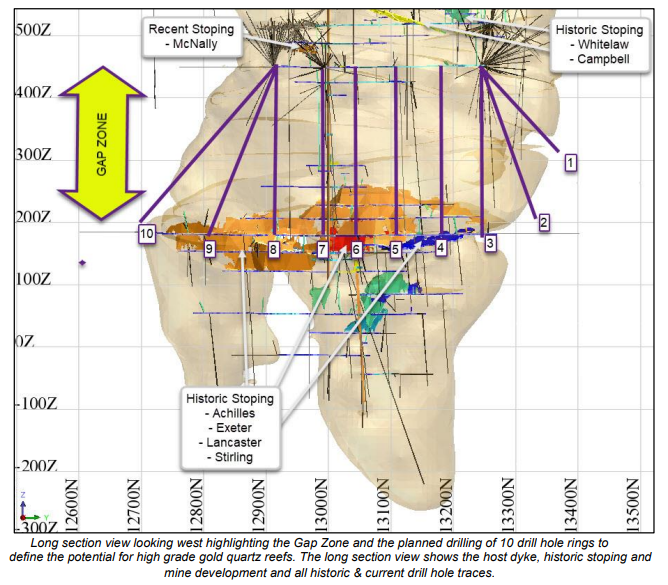
The first-pass drill program will total 11,500 metres over 50 drill holes, planned to provide systematic coverage across the full length and depth of the Gap Zone with 10 drill hole rings spaced 60 to 80 metres apart.
Each ring has 4 to 6 drill holes, planned to test the zone from 9-level through to the Achilles Reef below 14-level which produced gold historically for Gold Mines of Australia before closure in 1963.
Drill holes are intended to provide broad spacing to identify quartz reef structure geometry. In conjunction with gold grade, the geometry of the reef is key to defining the most attractive positions within the dyke to undertake more detailed drilling before development decisions are reached.
About the company
White Rock Minerals is an explorer and near-stage gold producer with three key assets.
The Red Mountain Project is in central Alaska, a polymetallic VMS mineralisation rich in zinc, silver, lead, gold and copper. There are already two high-grade deposits with an inferred mineral resource of 9.1 million tonnes at 13% zinc equivalent or 609 g/t silver equivalent.
Mt Carrington is in northern New South Wales, with gold and silver mineral resources and an ore reserve of 4 million tonnes at 1.3 g/t gold, for 174,000 ounces of gold defined by White Rock. Recent exploration focused on the potential for the project to host intrusion-related (porphyry) copper mineralisation.
Woods Point is White Rock’s newest acquisition in Victoria, hosting the Morning Star gold mine and a large 670-square-kilometre exploration land package.