
Last month, something rocked the NFT world.
An employee at online marketplace Opensea used insider information to cherrypick non-fungible tokens — or NFTs — that were likely to sell high and flipped them for a profit.
We’re conducting a thorough review of yesterday’s incident and are committed to doing the right thing for OpenSea users.
We have posted an official statement here: https://t.co/NWExSdThOf
— Devin Finzer (dfinzer.eth) (@dfinzer) September 15, 2021
It came out after a community-led investigation on the employee’s Ethereum transactions, which led to his resignation from the NFT bazaar.
Ethereum’s a kind of cryptocurrency that’s based on blockchain, meaning all exchanges are written on a public ledger — and the online sleuths could track down the culprit.
“Because there’s a blockchain … at least we know a hell of a lot more and can talk about it,” said NFT trader ‘fungiblΞs’ at the time.
There’re a lot of concepts at play here. But how do they link to the blockchain?"
I’m here to give you the building blocks. And if you want to get to know the world of NFTs and crypto, understanding blockchain is a good place to start.
What is blockchain?
Let’s face it: blockchain is a head-scratcher. But it doesn’t have to be.
Think of it like a big online database. Bigger than big. So big that it runs across millions and millions of computers around the world.
We’re used to databases being a big amalgamation of info — just like a library, they’re filled with trillions of different bits.
But adding, removing or changing a single book won’t fundamentally transform the whole library.
And that’s not the case with blockchain — in fact, that’s where the ‘chain’ comes in.
See, every time a new block of info joins the blockchain, the entire chain is updated.
That’s because each new block comes with a unique, cryptographic fingerprint that distinguishes it from every other piece that’s come before it.
It also carries the fingerprint of the previous block, linking them together in an immutable chain that’s reflected all the way back to the very first line on the ledger.
It’s what makes this database so secure, because if you want to alter a single block, you’ve got to alter all the blocks that follow.
There’s no one librarian in charge of the blockchain either. It’s decentralised, meaning there’s a whole network of peers actively reviewing new additions to the blockchain — and keeping the tampered blocks off the chain.
That’s the gist of it. What’s even more interesting is why this tech exists.
Bitcoin could overhaul the way we transact. Source Pascal Bernardon/Unsplash.
Why do we want this technology?
To put it simply: we can’t trust each other.
It sounds dramatic, but this concept lies at the core of blockchain’s existence.
In essence, our lives revolve around give and take — we exchange information, cash, goods and services every day.
But how do we verify that what we’re receiving — and who we’re getting it from — is legitimate?
Blockchain entrepreneur and researcher Bettina Warburg put it best in her 2016 TED Talk: “While blockchain technology is relatively new, it's also a continuation of a very human story.
“The story is this: as humans, we find ways to lower uncertainty about one another so that we can exchange value.”
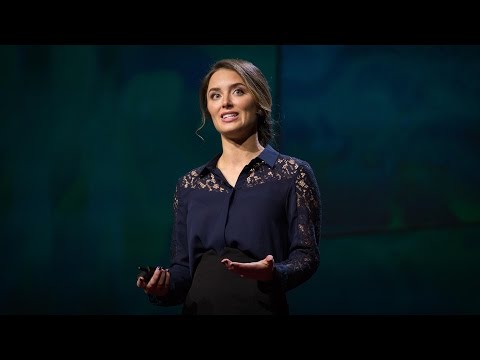
That idea is the heart of the blockchain network: a decentralised database with an immutable, unforgeable ledger that’s open to anyone.
If that record is nigh impossible to corrupt, you can be sure that you own what it says you own.
“It's basically a public registry of who owns what and who transacts what,” Bettina explained.
But creating legitimacy in our transactions isn’t a new concept. So, what sets blockchain apart?
It’s all about trust
Before the age of blockchain, we relied on a different kind of system to legitimise our trade.
Welcome to the world of the third party — an authoritative, independent source that can manage transactions and ensure they’re legit.
In an economic context, we often call these third parties banks. And they take a small cut for facilitating trade.
But whenever you start a transaction — be it at an Eftpos machine or your own computer — that bank needs to run a series of checks to settle the trade.
They’ve got to make sure you’re good for the money, check-in with the card association and issuing bank and help make the transfer, which is why pending transactions can take some time to clear.
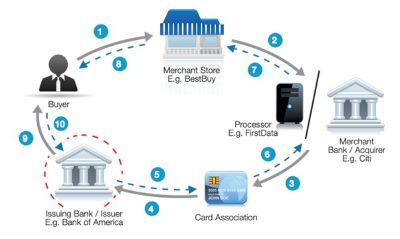
The transaction cycle. Source: Capgemini.
But when you apply the logic of blockchain to the transaction cycle, that timeframe changes.
That’s because you have lots of nodes — also known as miners — on what’s called the peer-to-peer network, verifying new transactions and adding new blocks to a chain every time a transaction occurs.
When you’ve got all these nodes working to verify the trade and add it to the blockchain, you don’t need to worry about running it through multiple channels for verification.
In the case of the first popular blockchain application, it’s a concept that’s taken off.
It’s Bitcoin, baby
Established in 2009, Bitcoin took the world by storm with its blockchain base.
It saw users trade cash for the cryptocurrency, with each transaction added to an online ledger that could be tracked and verified publicly.
That cryptocurrency has gone on to spawn many others — even meme currencies like the adorable Dogecoin.
Dogecoin is another cryptocurrency that uses blockchain technology. Source: Executium/Unsplash.
With others cryptos like Ethereum and Litecoin on the rise, the blockchain tech is gaining ground.
But this kind of currency is still finding its sea legs: while Bitcoin has rallied 30% this month and is racing towards what’s possibly an all-time high, it’s experienced some considerable lows in the past few years and haemorrhaged value at the drop of a tweet from Elon Musk.
But as more cryptocurrencies join the market and blockchain technology establishes a foothold, we could see more of this database in the years to come.
Read: Cryptocurrency, what it is and how it works
Where else could we see blockchain?
Blockchain technology has myriad implications beyond the world of cryptocurrency and finance.
Down the line, it could be applied to any scenario that requires information to be protected and held securely.
Medical records, notary documents, land contracts, tracking information — the list of data that could be held in a blockchain goes on.
Some have even lauded this as a tool that could end poverty and solve the counterfeit drug problem!
And while this technology is still in its infancy, it stands that it could revolutionise the way we interact and transact in the not-so-distant future.
Let’s wait and see.