
In recent years, cryptocurrency has established its prominence within the financial landscape, transitioning from a fad investment into the portfolio of seasoned investors and financial institutions.
Investors are speculating the future prospects for this new form of decentralised tender, powered by revolutionary blockchain technology and secured by state of the art cryptographic algorithms.
Interestingly, it has been a breakthrough year for crypto, with soaring prices and mounting hype, gaining widespread acceptance into mainstream culture and our investment choices.
What is cryptocurrency?
Cryptocurrency takes its name from the combination of 'cryptography' and 'currency', and is a medium of exchange, that is digital, encrypted and decentralised.
This currency is created and stored digitally in a ledger called a ‘blockchain’, using encryption techniques to control the creation of monetary units and to verify the transfer of funds.
Unlike the dollar or the pound, there is no centralised authority that manages and maintains the value of a cryptocurrency, instead, these tasks are distributed across the users of currency on the internet.
This decentralised and distributed system ensures that there is no single point of control nor a single point of failure across the whole system, making it a secure yet transparent infrastructure.
Origins
Cryptocurrency traces its origins to Bitcoin, the first and still the most popular cryptocurrency in the world.
Presently, there are more than 6,000 cryptocurrencies in circulation, with other popular versions including Etherium, Monero, Litecoin, Dogecoin, to name a few.
The framework of Bitcoin was first described by an author or authors calling themselves Satoshi Nakamoto in a paper: Bitcoin: A Peer-to-Peer Electronic Cash System.
As outlined by Nakamoto, this project was “an electronic payment system based on cryptographic proof instead of trust”.
This cryptographic proof originates in the form of transactions that are verified and recorded in an electronic ledger; the backbone of every cryptocurrency called the blockchain
What is Blockchain?
Blockchain, sometimes referred to as Distributed Ledger Technology (DLT), can be considered as an electronic ledger, which makes the history of any digital asset unalterable and transparent through the use of decentralisation and cryptographic hashing.
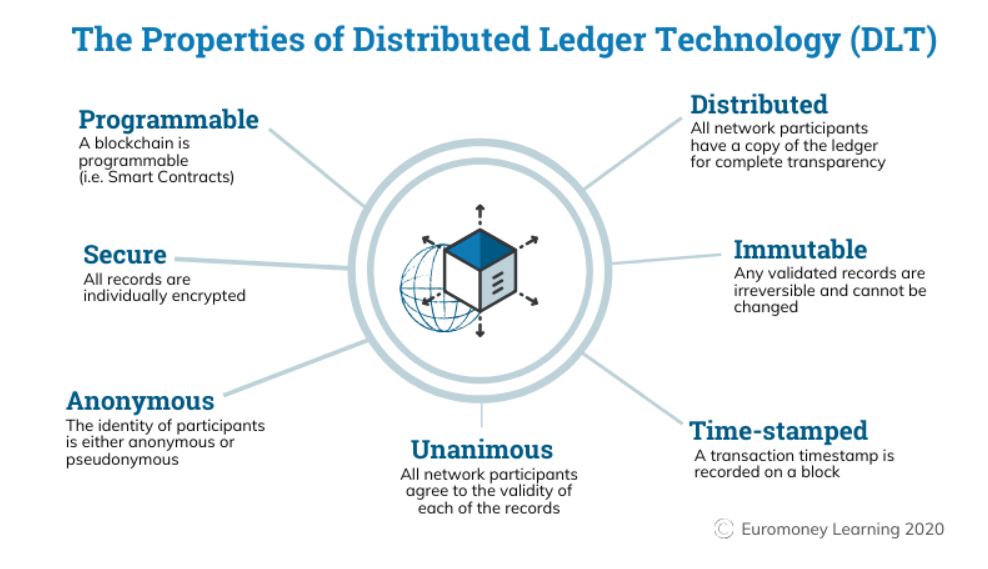
Properties of distributed ledger technology.
A simple analogy to understand blockchain technology could be explained in the workings of Google Docs.
When we create a Google docs document and share it with a group of peers, the document is distributed instead of copied or transferred, creating a decentralised distribution chain that gives everyone access to the document at the same time.
Applying this analogy into the blockchain, each person who uses a cryptocurrency has their copy of the ‘document’ (blockchain) to create a unified transaction record, the software logs each new transaction as it happens, and every copy of the blockchain is updated simultaneously with the new information, keeping all records identical, accurate and immutable.
How is Cryptocurrency generated?
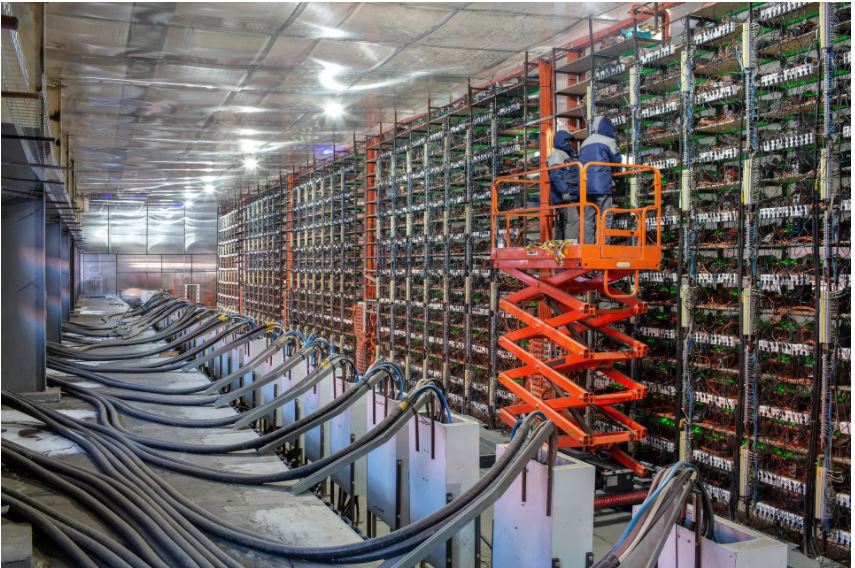
A large scale crypto mining operation.
Crypto Mining is the process by which new units of cryptocurrency are released into the crypto eco-system, generally in exchange for validating transactions on the blockchain.
While it’s theoretically possible for the average person to mine cryptocurrency, it is proving to be increasingly difficult in proof of work systems, like Bitcoin.
“Proof of work is a method of verifying transactions on a blockchain in which an algorithm provides a mathematical problem that computers race to solve”, says Xcoins social media manager Simon Oxenham.
The race to solve these complex cryptographic puzzles requires an immense amount of computational power and electricity that makes mining unsustainable to the common man.
While it is not feasible for the average person to earn crypto by mining in a proof of work system, the proof of stake model requires less in the way of computational power and resources, instead, validators are chosen at random based on the amount they stake. It does, however, require that you already own a cryptocurrency to participate.
What can you do with Crypto?

A POS supporting cryptocurrencies.
Although cryptocurrency adheres to the characteristics of both currency and investment, there’s still debate among experts about whether cryptocurrency is one or the other.
As its name suggests, one could use cryptocurrency to make purchases, however, there are very limited points of sale that accept crypto as an acceptable form of tender.
“That lack of widespread adoption, plus crypto’s volatility, limits its use as a currency, says Roger Aliaga-Díaz, principal and senior economist with Vanguard Investment Strategy Group.
Many people consider crypto as a means of alternative investment, similar to purchasing stocks or bonds, you can buy cryptocurrency with the hope that it will increase in value over time, allowing you to cash out for a profit at a later date.
Classifying crypto as an investment is a problem too, It doesn’t quite fit the bill of a conventional stock or bond, and while cryptocurrencies do share characteristics of commodities, they have no inherent physical value or use.
How do you buy cryptocurrency?
Cryptocurrencies can be purchased through peer-peer networks and exchanges on the internet.
At the outset, in order to store the crypto, a digital wallet needs to be downloaded eg electrum or exodus, that facilitates safe and secure storage for your crypto
Interestingly, cryptocurrencies can also be stored offline (cold storage), where a crypto can be withdrawn from an exchange and stored on an offline wallet.
Cryptocurrencies can also be purchased from online exchanges, similar to traditional stock exchanges, where one could purchase any crypto of their choice for a brokerage.
In Australia, Coinbase and EToro are some of the popular exchanges to name a couple.
Looking ahead
Cryptocurrency and its underlying blockchain technology may represent the start of a new wave of technology-driven markets that have the potential to disrupt conventional market infrastructure, traditional business practices and established regulatory outlooks, all to the benefit of consumers and broader macroeconomic efficiency.
However, Nobel prize-winning economist Paul Krugman argues that cryptocurrencies play almost no role in normal economic activity, “Almost the only time we hear about them being used as a means of payment, as opposed to speculative trading, is in association with illegal activity.”
Government attitudes around the world are inconsistent when it comes to the classification, treatment and legality of cryptocurrency where regulations are also evolving at different paces in different regions.
Looking ahead, cryptocurrencies carry the ground-breaking potential to allow consumers access to a global payment system anywhere and anytime, in which participation is restricted only by access to technology.
Apart from the declared value of cryptocurrency, those invested in it appear to be relying on its perceived “inherent value”. This includes the technology and network itself, the integrity of the cryptographic code and the decentralised network.
Promisingly, the discussion is no longer one of whether a cryptocurrency will survive, but rather how it will evolve and when it will reach maturity.