
Strategic Elements Ltd (ASX:SOR) has achieved another milestone with its self-charging battery technology fabricated onto a flexible textile cloth and mechanically bent more than 2,000 times.
In early-stage work, the battery ink technology has shown strong potential to be a highly flexible power source for electronics, capable of a very small 6mm bending radius, which is smaller than the average adult human finger.
After 2,000 bending cycles, no visible cracks were present on the battery ink layer on the textile device and the device showed stable open-circuit voltage performance.
Mechanical flexibility testing
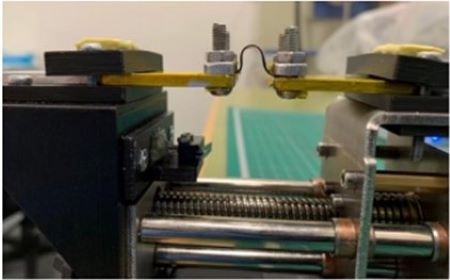
Mechanical flexibility testing of the textile cloth.
To assess the mechanical flexibility of the battery ink textile prototype, a programmable linear motion stage was used to systematically input bending strain on the device to simulate the device being bent.
UNSW conducted 2,000 bending cycles for the textile prototype device using the programmable linear motion stage, programmed to simulate a bending radius of 5.85mm on the textile device for 2,000 bending cycles at a bending rate of 10mm per second.
On an alternate testing method, the open-circuit voltage output of another textile device was measured for two hours before flexibility testing was conducted.
The textile device was then subjected to 1,000 bending cycles using the programmable linear motion stage and tested again for open-circuit voltage for two hours.
It was subjected to a further 1,000 bending cycles and measured again for two hours after the additional 1,000 bending cycles.
Flexibility testing results
Before the textile device was subjected to bending cycles, open-circuit voltage output was measured for two hours and it was generating a constant voltage of about 0.7 Volts.
After continuous 2,000 bending cycles, the open-circuit voltage output was measured for two hours and voltage output remained constant before and after mechanical bending cycles.
On an alternate testing method, open-circuit voltage output pre-flexibility testing was measured for two hours and showing a stable open-circuit voltage output of 0.7 Volts.
After the first 1,000 bending cycles, the open-circuit voltage of the device was measured for two hours and voltage output remained stable.
As the device showed no degradation for the first 1,000 bending cycles, the device was subjected to a further 1,000 bending cycles.
The open-circuit voltage output was measured for two hours and a similar voltage output was achieved.
Flexible self-charging battery technology
The self-charging battery ink technology generates electricity from humidity in the air or skin surface.
It is being developed under a collaboration partially funded by a Federal Government grant with CSIRO and the University of New South Wales (UNSW).
The technology is being designed to be a hybrid electric generator - battery cell fabricated with a printable ink.
Development to date has been focused on voltage and the ability to harvest energy from humidity in the air.
The mechanical flexibility testing results demonstrate another potential competitive advantage of the technology over current battery technologies that are bulky and rigid.
The ability for the high humidity levels of the human skin to be harvested by battery ink cells and the need for a less bulky and flexible power source make the electronic skin patch sector a natural fit for the battery ink technology.
Flexible skin patches are wearable products that have integrated electronic components such as sensors are attached to the surface of the skin.
Battery market
The sector produced US$10 billion in revenue in 2019 and notwithstanding the bulk and rigidness limitations of current batteries, it is forecast to grow to nearly US$40 billion by 2030 technology.
Likewise, environmental and infrastructure sensors are designed to be built on plastic, glass or wrapped around other curved surfaces and require a power source that can conform to curved or flexible surfaces and are also attractive initial user applications.
Initial market focus
Thus, the initial market focus is on wearables and Internet of Things (IoT) related devices such as cosmetic, pressure, environmental and health such as diabetes or cardiovascular monitoring, as they have lower energy output requirements.
Higher performance applications will include the development of a capacitor for energy storage/regulation and focused on at a later date.
Next steps
Early results from UNSW on textile material demonstrates the battery ink has a very small bending radius and is a potential power source for current and future flexible electronics.
The next steps in mechanical flexibility will involve increasing power output beyond the comparative time period used to date and further optimisation of the fabrication and adhesion properties of the battery ink on other flexible substrates such as plastic.
The company is currently attempting to develop battery ink cells up to four times smaller than existing battery ink cells to demonstrate the potential of the technology to be scaled down in size and open up the potential for scaling down even further.
Smaller batteries serially connected can create more power output from the space available within an electronic device and also provide ever smaller and lighter devices with an alternate power source.
Future milestones
Further information regarding future milestones and timeframes relating to overall forward-looking battery ink technology development will be released when the outcome of the battery size reduction development program has been received and assessed by the company.