Critical Resources Ltd (ASX:CRR) has joined forces with Australia’s national science agency CSIRO to optimise and scale its Dry Supersonic Deposition (DSD) battery manufacturing technology, adding an Australian research workstream to its existing development program in the United States.
The collaborative research project will be co-funded through CSIRO’s Kick-Start program and will focus on refining CRR’s solvent- and binder-free DSD process, which forms part of the company’s licensable battery manufacturing intellectual property.
CSIRO researchers at the Lab22 advanced manufacturing facility in Clayton, Victoria, will apply digital twin modelling to CRR’s deposition process, aiming to identify operating parameters, understand potential defect mechanisms and provide recommendations for optimisation and future scale-up.
The $100,000 project is expected to begin in September 2026 and run for up to 12 months, with CSIRO contributing up to $50,000 and Critical Resources funding the balance.
Digital twin targets scale-up challenges
Critical Resources’ DSD process is being developed with the South Dakota School of Mines & Technology (SDM) within the US National Science Foundation-supported Centre for Solid-State Electric Power Storage.
Unlike conventional battery manufacturing, which uses solvents, polymer binders and high-temperature drying ovens, DSD accelerates cathode and electrolyte materials to supersonic velocity and deposits them dry in a single step.
CSIRO will construct a three-dimensional digital model of the spray nozzle and deposition environment, analysing gas flows, particle trajectories, velocities and temperatures.
The modelling will also assess particle-size-dependent behaviour, deposition efficiency and potential causes of cracking or poor bonding before delivering recommendations for experimental validation and scale-up.
That modelling will run alongside experimental deposition trials and electrochemical testing already underway with SDM.
Building a licensing pathway
The company is pursuing a capital-light commercialisation strategy focused on licensing its battery materials and manufacturing intellectual property rather than building its own cell manufacturing capacity.
Critical Resources believes independent validation of the process can strengthen its patent position and provide the engineering understanding required by potential cell or component manufacturing partners.
Previous peer-reviewed work reported about 154 milliamp-hours per gram from an initial unoptimised DSD cathode trial, with around 85% capacity retention after 500 cycles at a 1C rate and coulombic efficiency above 99.5%.
Managing director Tim Wither highlighted manufacturability as a key challenge for next-generation batteries, noting that the collaboration would help CRR build the process knowledge needed to understand how DSD behaves at scale.
The company cautioned that the collaboration remains an early-stage research and modelling program and does not currently involve a commercial licence, partnership or revenue agreement.

Project workflow. CRR's deposition parameters are modelled using CSIRO's Digital Twin capability at Lab22, producing technical recommendations for process optimisation and scale-up. Illustrative process flow only — not actual project results.
Next steps
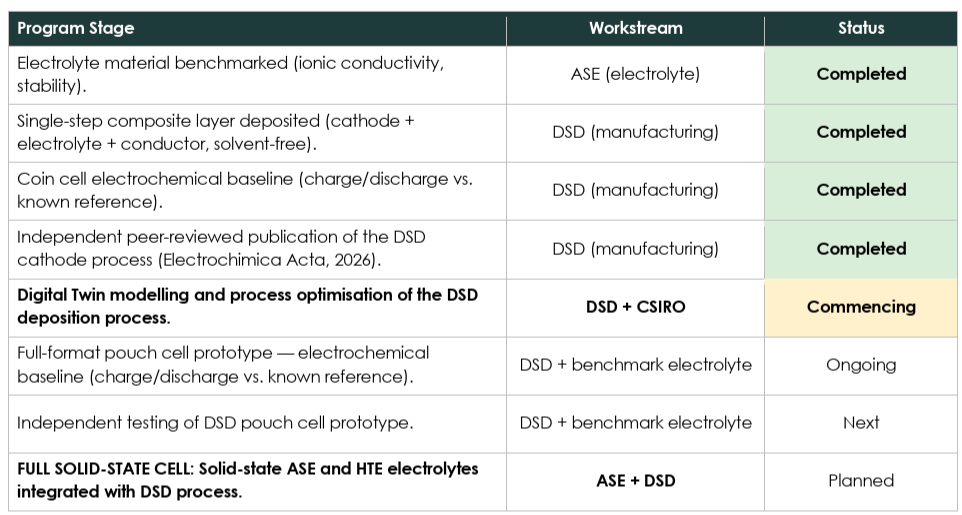
Critical Resources will now begin construction and simulation of the DSD digital twin while continuing pouch-cell testing, third-party electrochemical validation and work to integrate its sulphur-free Amorphous Solid-State Electrolyte with the DSD manufacturing process.
The resulting process data is intended to support future licensing and partnership discussions with battery cell and component manufacturers.